
Pulp Fiction, 1878 · page 12 of 20
Beadle's Half Dime Library, No. 25 — page 12: what you’re looking at
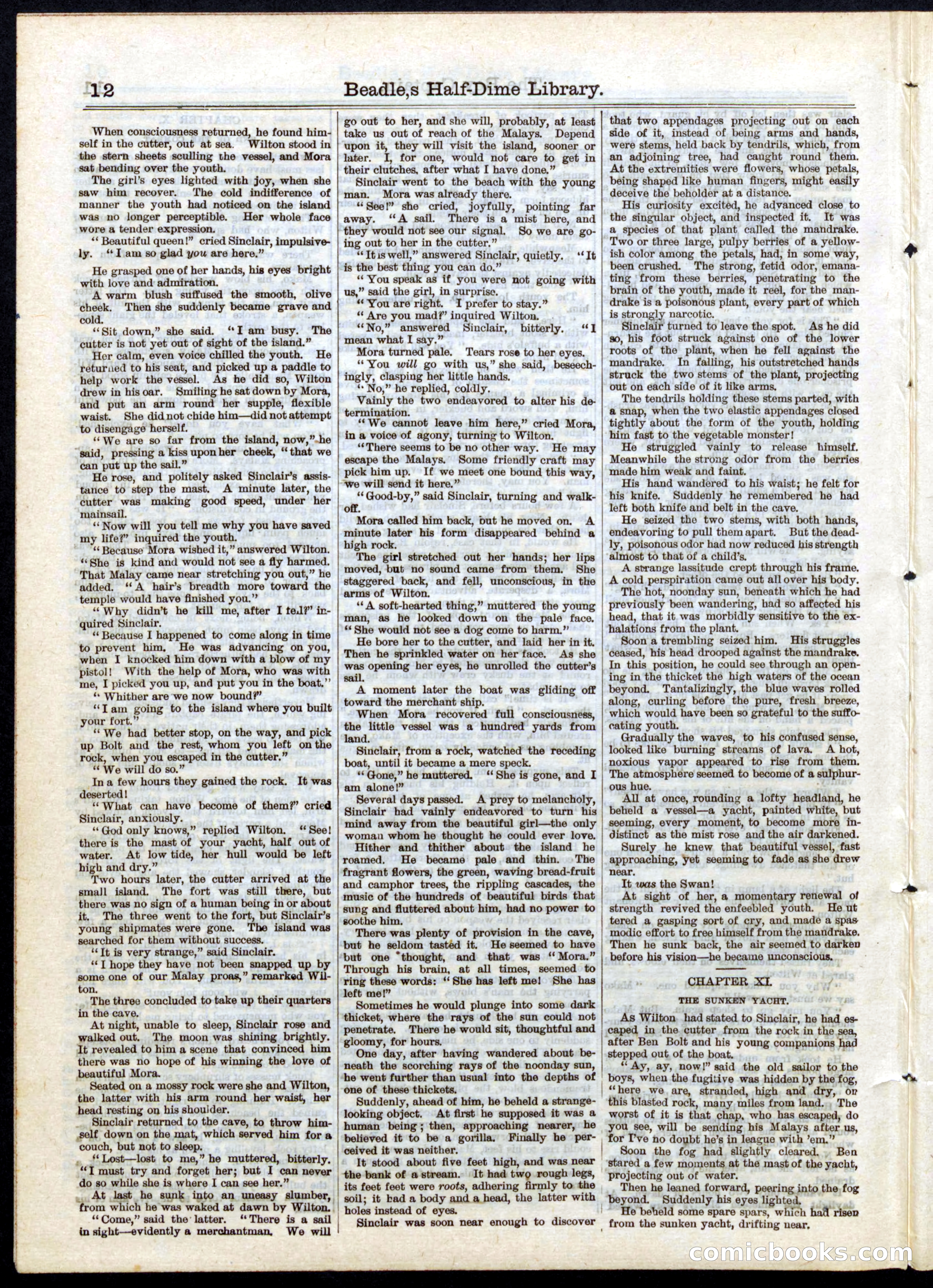
A restored page from Pulp Fiction, 1878. Page through the whole issue in the reader above.
📄 Transcribed text from this page (OCR, searchable)
Machine-transcribed from the original scan — historical spelling and the odd misread are preserved.
ee ge ee ee ee re re eee SS SO 12 ES A — _ — = - Beadle,s Half-Dime Library. — When consciousness returned, he found him- self in the cutter, out at sea. Wilton stood in the stern sheets sculling the vessel, and Mora sat bending over the youth. The girl’s eyes lighted with joy, when she saw him recover. The cold indifference of manner the youth had noticed on the island was no longer perceptible. Her whole face wore a tender expression. ‘* Beautiful queen!” cried Sinclair, impulsive- ly. .‘*I.am so glad you are here,” He grasped one of her hands, his eyes bright with love and admiration. . A warm blush suffused the smooth, olive cheek. Then she suddenly became grave and cold. ‘‘Sit down,” she said. cutter is not yet out of sight of the island.” Her calm, even voice chilled the youth. He returied to his seat, and picked up a paddle to help work the vessel. As he did so, Wilton drew in hisoar. Smiling he sat down by Mora, and put an arm round her supple, flexible waist. She didnot chide him—did not attempt to disengage herself. ‘‘We are so far from the island, now,”.he “gaid, pressing a kiss uponher cheek, “that we can put up the sail.” He rose, and politely asked Sinclair’s assis- tance to step the mast. A minute later, the cutter was making good speed, under her mainsail. ‘‘ Now will you tell me why you have saved my life?” inquired the youth. ‘¢ Because Mora wished it,” answered Wilton. ‘She is kind and would not see a fly harmed. That Malay came near stretching you out,” he added. ‘A hair’s breadth more toward the temple would have finished you.” ‘““Why didn’t he kill me, after I fe.l?’ in- quired Sinclair. ‘‘ Because I happened to come along in time to prevent him, He was advancing on you, when I knocked him down with a blow of my pistol! With the help of Mora, who was with me, I picked you up, and put you in the boat,”’ ‘‘ Whither are we now bound?’ ‘Tam going to the island where you built | your fort.” ‘‘We had better stop, on the way, and pick up Bolt and the rest, whom you left on the rock, when you escaped in the cutter,” “We will do so.” Ina few hours they gained the rock. It was deserted! ‘“What can have become of them?” cried Sinclair, anxiously. ‘*God only knows,” replied Wilton. “See! there is the mast of your yacht, half out of water. At low tide, her hull would be left high and dry.” Two hours later, the cutter arrived at the small island. The fort was still there, but there was no sign of a human being in or about it. The three went to the fort, but Sinclair’s young shipmates were gone. The island was searched for them without success. ‘Tt is very strange,” said Sinclair. ‘“T hope they have not been snapped up by some one of our Malay proas,” remarked Wil- ton. The three concluded to take up their quarters in the cave, At night, unable to sleep, Sinclair rose and walked out. The moon was shining brightly. It revealed to him a scene that convinced him there was no hope of his winning the love of beautiful Mora. Seated on a mossy rock were she and Wilton, the latter with his arm round her waist, her head resting on bis shoulder. Sinclair returned to the cave, to throw him- down on the mat, which served him fora couch, but not to sleep. . ‘*Lost—lost to me,” he muttered, bitterly. “T must try and forget her; but I can never do so while she is where I can see her.” ‘At dae he s om which he was waked at dawn by Wilton. ‘‘Come,” said the: latter. in sight—evidently a merchantman, We will “JT am busy. The | unk into an uneasy slumber, go out to her, and she will, probably, at least take us out of reach of the Malays. Depend upon it, they will visit the island, sooner or later. I, for one, would not care to get in their clutches, after what I have done,” Sinclair went to the beach with the young man. Mora was already there. “See!” she cried, joyfully, pointing far away. ‘“‘A sail. There is a mist here, and they would not see our signal, So we are go- ing out to her in the cutter,” *“* Tt is well,” answered Sinclair, quietly. is the best thing you can do.” “You speak as if you were not going with us,” said the girl, in surprise. “You are right. I prefer to stay.” ‘* Are you mad?” inquired Wilton. ‘‘No,” answered Sinclair, bitterly. mean what I say.” Mora turned pale. Tears rose to her eyes. “You will go with us,” she said, beseech- ingly, clasping her little hands. ‘** No,” he replied, coldly. Vainly the two endeavored to alter his de- termination. “We cannot leave him here,” cried Mora, in a voice of agony, turning to Wilton. ‘“*There seems to be no other way. He may escape the Malays. Some friendly craft may pick him up. If we meet one bound this way, ‘we will send it here.” **Good-by,” said Sinclair, turning and walk- off. Mora called him back, but he moved on. A minute later his form disappeared behind a high rock. The girl stretched out her hands; her lips moved, but no sound came from them. She staggered back, and fell, unconscious, in the arms of Wilton. ‘* A soft-hearted thing,” muttered the young man, as he looked down on the pale face. **She would not see a dog come to harm.”’ He bore her to the cutter, and laid her in it. Then he sprinkled water on her face. As she was opening her eyes, he unrolled the cutter’s sail. A moment later the boat was gliding off toward the merchant ship. When Mora recovered full consciousness, the little vessel was a hundred yards from land. Sinclair, from a rock, watched the receding boat, until it became a mere speck. **Gone,” he muttered, ‘She is gone, and I am alone!” Several days passed. A prey to melancholy, Sinclair had vainly endeavored to turn his mind away from the beautiful girl—the only woman whom he thought he could ever love. Hither and thither about the island he roamed. He became pale and thin. The fragrant flowers, the green, waving bread-fruit and camphor trees, the rippling cascades, the music of the hundreds of beautiful birds that sung and fluttered about him, had no power to soothe him. There was plenty of provision in the cave, but he seldom tastéd it. He seemed to have but one “thought, and that was “ Mora.” Through his brain, at all times, seemed to ring these words: ‘‘ She has left me! She has left me!” Sometimes he would plunge into some dark thicket, where the rays of the sun could not penetrate. There he would sit, thoughtful and gloomy, for hours. One day, after having wandered about be- neath the scorching rays of the noonday sun, he went further than usual into the depths of one of these thickets. Suddenly, ahead of him, he beheld a strange- looking object. At first he supposed it was a sé It “ey mmm eee eee eee LL TD that two appendages projecting out on each side of it, instead of being arms and hands, were stems, held back by tendrils, which, from an adjoining tree, had caught round them. At the extremities were flowers, whose petals, being shaped like human fingers, might easily deceive the beholder at a distance. His curiosity excited, he advanced close to the singular object, and inspected it. It was a species of that plant called the mandrake. Two or three large, pulpy berries of a yellow- ish color among the petals, had, in some way, been crushed. The strong, fetid odor, emana- ting from these berries, penetrating to the brain of the youth, made it reel, for the man- drake is a poisonous plant, every part of which is strongly narcotic. Sinclair turned to leave the spot. As he did so, his foot struck against one of the lower roots of the plant, when he fell against the mandrake. In falling, his outstretched hands struck the two stems of the plant, projecting out on each side of it like arms, The tendrils holding these stems parted, with a snap, when the two elastic appendages closed tightly about the form of the youth, holding him fast to the vegetable monster! He struggled vainly to release himself. Meanwhile the strong odor from the berries made him weak and faint. His hand wandered to his waist; he felt for his knife. Suddenly he remembered he had left both knife and belt in the cave. He seized the two stems, with both hands, endeavoring to pull themapart. But the dead- ly, poisonous odor had now reduced his strength almost to that of a child’s. A strange lassitude crept through his frame. A cold perspiration came out all over his body. The hot, noonday sun, beneath which he had previously been wandering, had so affected his head, that it was morbidly sensitive to the ex- halations from the plant. Soon a trembling seized him. His struggles ceased, his head drooped against the mandrake. In this position, he could see through an open- ing in the thicket the high waters of the ocean beyond. Tantalizingly, the blue waves rolled along, curling before the pure, fresh breeze, which would have been so grateful to the suffo- eating youth. Gradually the waves, to his confused sense, looked like burning streams of lava. A hot, noxious vapor appeared to rise from them. The atmosphere seemed to become of a sulphur- ous hue. All at once, rounding a lofty headland, he beheld a vessel—a yacht, painted white, but seeming, every moment, to become more in- distinct as the mist rose and the air darkened. Surely he knew that beautiful vessel, fast approaching, yet seeming to fade as she drew near. It was the Swan! At sight of her, a momentary renewal of strength revived the enfeebled youth. He ut tered a gasping sort of cry, and made a spas modic effort to free himself from the mandrake. Then he sunk back, the air seemed to darken before his vision—he became unconscious, CHAPTER XI 7, THE SUNKEN YACHT. As Wilton. had stated to Sinclair, he had es- in the cutter from the rock in the sea, after Ben Bolt and his young companions had stepped out of the boat, *‘ Ay, ay, now!” said the old sailor to the boys, when the fugitive was hidden by the fog, “‘here we are, stranded, high and dry, or this blasted rock, many miles from land. , The worst of it is that chap, who has , do human being; then, approaching nearer, he you see, will be sending his Malays after us, believed it to be a gorilla, Finally be per- for I’ve no doubt he’s in league with ’em.” ceived it was neither. Soon the fog had slightly cleared.. Ben It stood about five feet high, and was near stared a few moments at the mast of the yacht, the bank of a stream. It had = rough legs, projecting out of water. its feet feet were roots, adhering y to the soil; it bad a body and a head, the latter with peyond. '| holes instead of “There is a sail | —~ Econ Then he leaned forward, peering into the, fog Suddenly his eyes lighte He beheld some spare spars, which hail risen Sinclair was soon near enough to discover _ from the sunken yacht, drifting near, IO'O (EO “S (E (E()