
Pulp Fiction, 1877 · page 6 of 16
Beadle's Half Dime Library, No. 22 — page 6: what you’re looking at
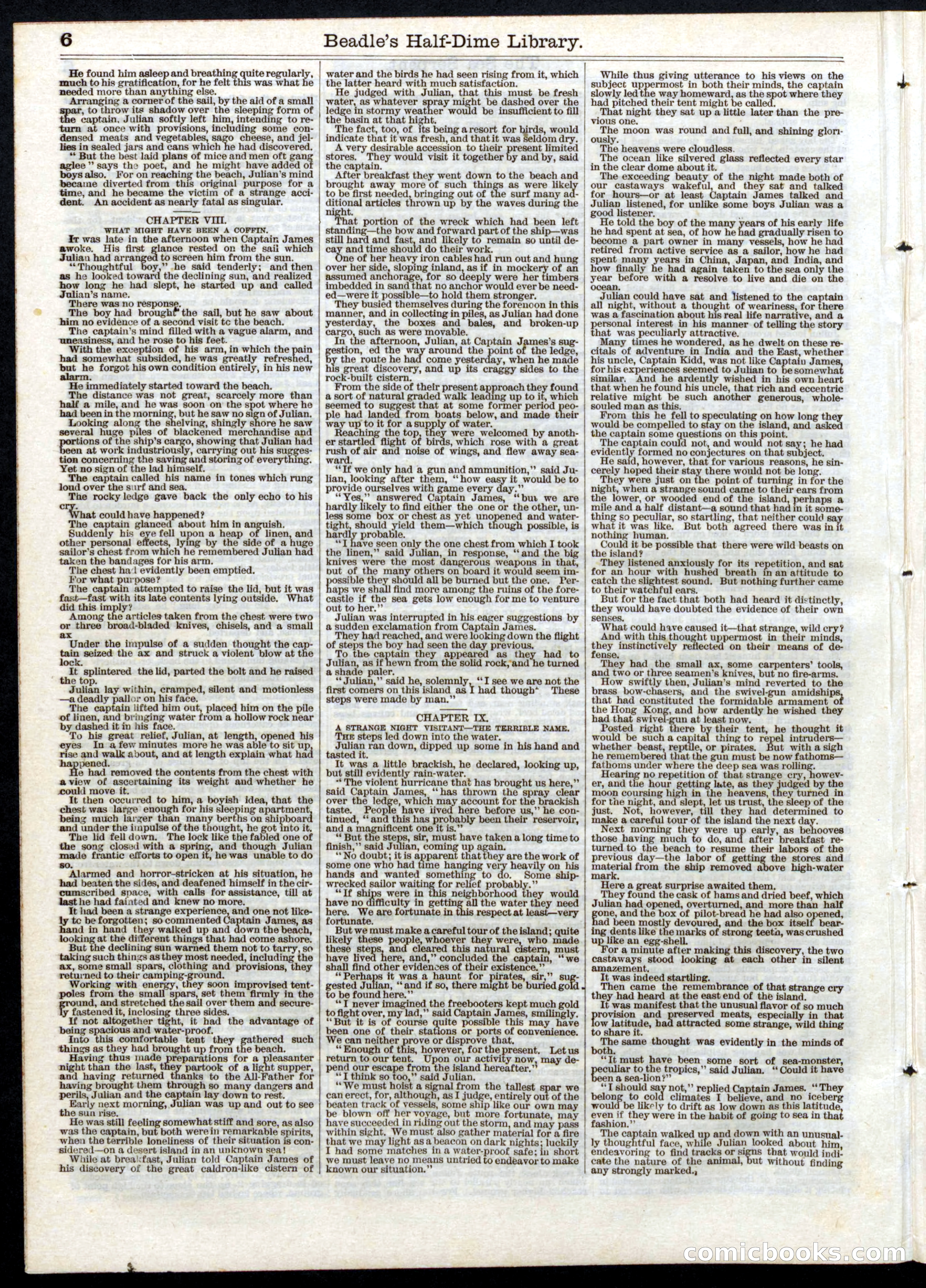
A restored page from Pulp Fiction, 1877. Page through the whole issue in the reader above.
📄 Transcribed text from this page (OCR, searchable)
Machine-transcribed from the original scan — historical spelling and the odd misread are preserved.
————— He found him asleep and breathing ae regularly, much to his gratification, for he felt this was what he ed more than anything else. Arranging a corner of the sail, by the aid of a small , to throw its shadow over the sleeping form of the captain, Julian softly left him, intending to re- turn at once with provisions, including some con- densed meats and vegetables, o cheese, and jel- lies in sealed jars and cans which he had discovered, ** But the best laid plans of mice and men oft gan aglee’ says the poet, and he might have added o boysalso. For on reaching the beach, Julian’s mind became diverted from this original purpose for a time, and he became the victim of a strange acci- An accident as nearly fatal as singular. CHAPTER VIII. WHAT MIGHT HAVE BEEN A COFFIN. Ir was late in the afternoon when Captain James awoke. His first glance rested on the saii which Julian had arra to screen him from the sun. “Thoughtful y,”’ he said tenderly; and then as he looked toward the parmgeere Few and realized how long he had slept, he s up and called Julian’s name. There was no See me | The boy had brough(’ the sail, but he saw about him no evidence of a second visit tc the beach. The captain’s mind filled with a vague alarm, and uneasiness, and he rose to his feet. With the exception of his arm, in which the pain had somewhat subsided, he was greatly refreshed, but he forgot his own condition entirely, in his new He immediately started toward the beach. The distance was not great, scarcely more than half a mile, and he was soon on the spot where he had been in the morning, but he saw no sign of Julian. Looking along the shelving, shingly shore he saw several huge piles of blackened merchandise and —- of the ship’s cargo, showing that Julian had n at work industriously, carrying out his sugges- tion concerning the saving and storing of everything. Yet no sign of the lad himself. The captain called his name in tones which rung loud over the surf and sea. The rocky ledge gave back the only echo to his What could have happened? The captain glanced about him in sh. Suddenly his eye fell upon a heap of linen, and other personal effects, ly by the side of a huge sailor’s chest from which he remembered Julian had taken the bandages for his arm. The chest ha‘! evidently been emptied. For what purpose? The captain attempted to raise the lid, but it was fast—fast with its late contents lying outside. What did this imply? Among the articles taken from the chest were two or three broad-bladed knives, chisels, and a small the impulse of a sudden thought the cap- the ax and struck a violent blow at the ax Under tain lock. a agape the lid, parted the bolt and he raised e top. Julian lay within, cramped, silent and motionless —a deadly pallor on his face. The cap lifted him out, placed him on the pile of linen, and bringing water from a hollow rock near by dashed it in his face. To his great relief, Julian, at length, opened his es. In afew minutes more he was able to sit up and walk about, and at length explain what had e had removed the contents from the chest with aview of ascertaining its weight and whether he could move it. It then occurred to him, a boyish idea, that the chest was large enough for his eeping apartment being much larger than many berths on shipboa and under the iinpulse of the thought, he got into it. The lid felldown. The lock like the fabled one of the song closed with a spring, and though Julian made frantic efforts to open it, he was unable to do sO. Alarmed and horror-stricken at his situation, he had beaten the sides, and deafened himself in the cir- cumscribed space, with calls for assistance, till at oe a and a en aah t n a strange experience, and one not like- ly tc be forgotten; so commented Ob tain James, as hand in hand they walked up and down the beach, me rs the different things that had come ashore. But the declining sun warned them not to tarry, so taking such things as they most needed, including the ax, some small spars, clothing and provisions, they returned to their ripe om yh rite Working with energy, they soon improvised tent- poles from the small on set them firmly in the und, and stretched the sail over them and secure- fastened it, inclosing three sides. If not altogether tight, it had the advantage of being spacious and water-proof. Into comfortable tent they gathered such things as they had brought up from the beach. might than tue laty Way pastook cf a Rent capper, of a light supper, and having returned t to the All-Father for having brought them through so many dangers and — Julian and the ca lay down to rest. Early next morning, Julian was up and out to see the sun rise. He was still feeling somewhat stiff and sore, as also was the captain, but both werein remarkable ae, when the terrible loneliness of their situation is con- sidered—on a desert island in an unknown sea! While at brealfast, Julian told Captain James of his discovery of the great caldron-like cistern of e Beadle’s Half-Dime Library. water and the birds he had seen rising from it, which the latter heard with much satisfaction. He judged with Julian, tha water, as whatever spray might be dashed over the ledge in stormy weather would be insufficient to fill the basin at that hight. The fact, too, of its being aresort for birds, would indicate that it was fresh, and that it was Seldom dry. A very desirable accession to their stores. They would visit it together by and by, said the captain. After breakfast they went down to the beach and brought away more of such things as were ape i to be first needed, bringing out of the surf many ad- og articles thrown up by the waves during the t portion of the wreck which had been left standing—the bow and forward part of the ship—was still hard and fast, and likely to remain so until de- es and time should do their work. ne of her heavy iron cables had run out and hung over her side, sloping inland, as if in mockery of an assumed anchorage, for so deeply were her timbers imbedded in sand that no anchor would ever be need- ed—were it possible—to hold them stronger. They busied themselves during the forenoon in this manner, and in collecting in piles, as Julian had done yesterday, the boxes and bales, and broken-up cargo, such as were movable. In the afternoon, Julian, at Captain James's sug- estion, ed the Me f around the point of the ledge, Py the route he come yeste , when he made s great discovery, and up its craggy sides to the rock-built cistern. From the side of their Trenens spptonch ma found a sort of natural graded walk | g up to it, which seemed to suggest that at some former period peo- ple had landed from boats below, and made their way up to it for asupply of water. hing the top ra gd welcomed by anoth- er startled flight of b , Which rose with a great ch Pg air and noise of wings, and flew away sea- ward. “Tf we only had a gun and ammunition,” said Ju- lian, looking after them, “how it would be to provide ourselves with game every yy . ” answered Captain James, “but we are hardly likely to find either the one or the other, un- less some box or chest as yet unopened and water- tight, should yield them—which though possible, is hardly probable. “I have seen only the one chest from which I took the linen,” said Julian, in response, “and the big knives were the most dangerous weapons in that, put of the many others on board it would seem im- grea a they should all be burned but the one. Per- aps we shall find more among the ruins of the fore- castle if the sea gets low enough for me to venture out to her.”’ Julian was interrupted in his eager suggestions by a sudden exclamation from Captain James. They had reached, and were looking down the flight of steps the boy had seen the day previous, To the captain they appeared as they had to Julian, as if hewn from the solid rock, and he turned a shade paler. ** Julian,’’ said he, solemnly first comers on this island as steps were made by man.” CHAPTER IX, A STRANGE NIGHT VISITANT—THE TERRIBLE NAME. Tre steps led down into the water. ME eae ran down, dipped up some in his hand and It was a little brackish, he declared, looking up, but still evidently rain-water. “The violent hurricane that has brought us here,” said Captain James, ‘‘ has thrown the spray clear over the ledge, which may account for the brackish taste. People have iived here before us,’’ he con- tinued, ‘‘ and this has probably been their reservoir, and a magnificent one it is.”’ “* But the steps, sir, must have ae a long time to finish,’’ said Julian, pee up ag that they are the work of ‘**No doubt; it is apparen some one who had time ha rare heavily on his 0. Some ship- hands and wanted something to wrecked sailor waiting for relief probably.” neighborhood they would “T see we are not the Thad though* These WP Fo Rad all th ter they need ave no cu n ge e water the eo ae are Satponiie te thin respect at phat — wary ortunate. But we must make a careful tour of the island; quite likely these people, whoever they were, who made these steps, and cleared this na 1 cistern, must have liv ere, and,’’ concluded the captain, “‘we shall find other evidences of their existence.”’ **Perhaps it was a haunt for pira sir,” % , “and if so, there malght be buried goki ested J be found here.”’ “T never ed the freebooters kept much gold to fight over, my lad,”’ said Captain James, smilingly. ‘But it is of course quite possible this may have been one of their stations or ports of convenience. We can neither ve or disprove that, “Enough of this, however, for the present, Letus return to our tent. Upon our activity now, may de- pend our escape from the island hereafter.’ ‘I think so too,” said Julian. ‘We must hoist a signal from the tallest can erect, for, although, as I judge, entirely out of the beaten track of vessels, some ship like our own may be blown off her voyage, but more fortunate, may have succeeded in riding out the storm, and may pass within sight, We must also gather material for a fire that we may light as a beacon on dark nights; luckily I had some matches in a water-proof safe: in short we must leave no means untried to endeavor to make known our situation.” we t this must be fresh slowly ledt resent limited | ee ee Eee eee ee While thus giving utterance to his views on the subject Po ape in both their minds, the captain e way homeward, as the - im where they had pitched their tent might be called. That night they sat up a little later than the pre- vious one. | on moon was round and full, and shining glon- ously. The heavens were cloudless. The ocean like silvered glass reflected every star in the clear dome about it. The exceeding beauty of the night made both of our castaways wakeful, and they sat and talked for hours—or at least Captain James talked and Julian listened, for unlike some boys Julian was a good listener. He told the boy of the many years of his early life he had spent at sea, of how he had gradually risen to become a part owner in many vessels, how he had retired from active service as a sailor, how he had spent many years in China, Japan, and India, and how finally he had again taken to the sea only the year before with a resolve to live and die on the ocean Julian could have sat and listened to the captain all night, without a thought of weariness, for there was a fascination about his real life narrative, and a personal interest in manner of telling the story that was peculiarly attractive. Many times he wondered, as he dwelt on these re- citals of adventure in India and the East, whether his uncle, Captain Kidd, was not like Captain Jame for his experiences seemed to Julian to Eoanawiat similar. And he ardently wished in his own heart that when he found his uncle, that rich and eccentric relative might be such another generous, whole- souled man as this. From this he fell to speculating on how long they would be compelled to stay on the island, and asked the captain some questions on this point. The captain could not, and would not say; he had evidently formed no conjectures on that subject. He said, however, that for various reasons, he sin- cerely hoped their wey ge would not be long. ‘They were just on the point of turning in for the night, when a strange sound came to their ears from the lower, or wooded end of the island perhaps a mile and a half distant—a sound that had in it some- thing so peculiar, so startling, that neither could sa what it was like. But both agreed there was in it nothing human. Could it be possible that there were wild beasts on the island? | They listened anxiously for its be ates and sat for an hour with hushed breath in an attitude to catch the slightest sound. But nothing further came to their watchful ears. But for the fact that both had heard it distinctly, they would have doubted the evidence of their own senses. What could have caused it—that apamee, wild cry? And with this thought uppermost in their et oz instinctively ected on their means of de- ense. They had the small ax, some carpenters’ tools, and two or three seamen’s knives, but no fire-arms. How swiftly then, Julian’s mind reverted to the brass bow-c rs, and the swivel-gun eo that had constituted the formidable armament o the Hong Kong, and how ardently he wished they had that swivel-gun at least now. Posted right there by their tent, he thought it would be such a capi thing to —_ intruders— whether beast, reptile, or pirates. But with a sigh he remembered that the gun must be now fathoms— aoe under ner the bee sea was rolling. ore no repetition o at strange cry, howev- er, and the hour getting late, as they judged by the moon coursing high in the heavens, they turned in for the in ge and slept, let us trust, the sleep of the just. Not, however, till they had determined to e a careful tour of the island the next day. Next morning they were up early, as behooves those having much do, and after breakfast re- turned to the beach to resume their labors of the previous day—the labor of getting the stores and mo from the ship removed above high-water mal . Here a great surprise awaited them. They found the cask of hams and dried beef, which Julian had opened, overturned, and more than half one, and the box of pilot-bread he had also opened, been mostly devoured, and the box itself bear- ing dents like the marks of strong teeta, was crushed up like an egg-shell. or a minute after making this discovery, the two castaways stood looking at each other in silent amazement, It was indeed startling. Then came the remembrance of that strange cry they had heard at the east end of the island. It was manifest that the unusual flavor of so much rovision and ed meats, especially in that sons * | had attracted some strange, wild thing bane same thought was evidently in the minds of “It must have been some sort of sea-monster, peawies to the tropics,” said Julian. ‘Could it have na sea-lion?” *T should = f not,’’ replied Captain James. ‘‘ They or to cold climates I believe, and_no_ iceberg would be likely to drift as low down as this latitude a if they were in the habit of going to sea in tha ion.”’ The captain walked up and down with an unusual- ly thoughtful face, while Julian looked about him, endeavoring to find tracks or er that would indi- cate the nature of the animal, but without finding any strongly marked., GO (EG) O)(0)(0)