
Pulp Fiction, 1877 · page 5 of 16
Beadle's Half Dime Library, No. 22 — page 5: what you’re looking at
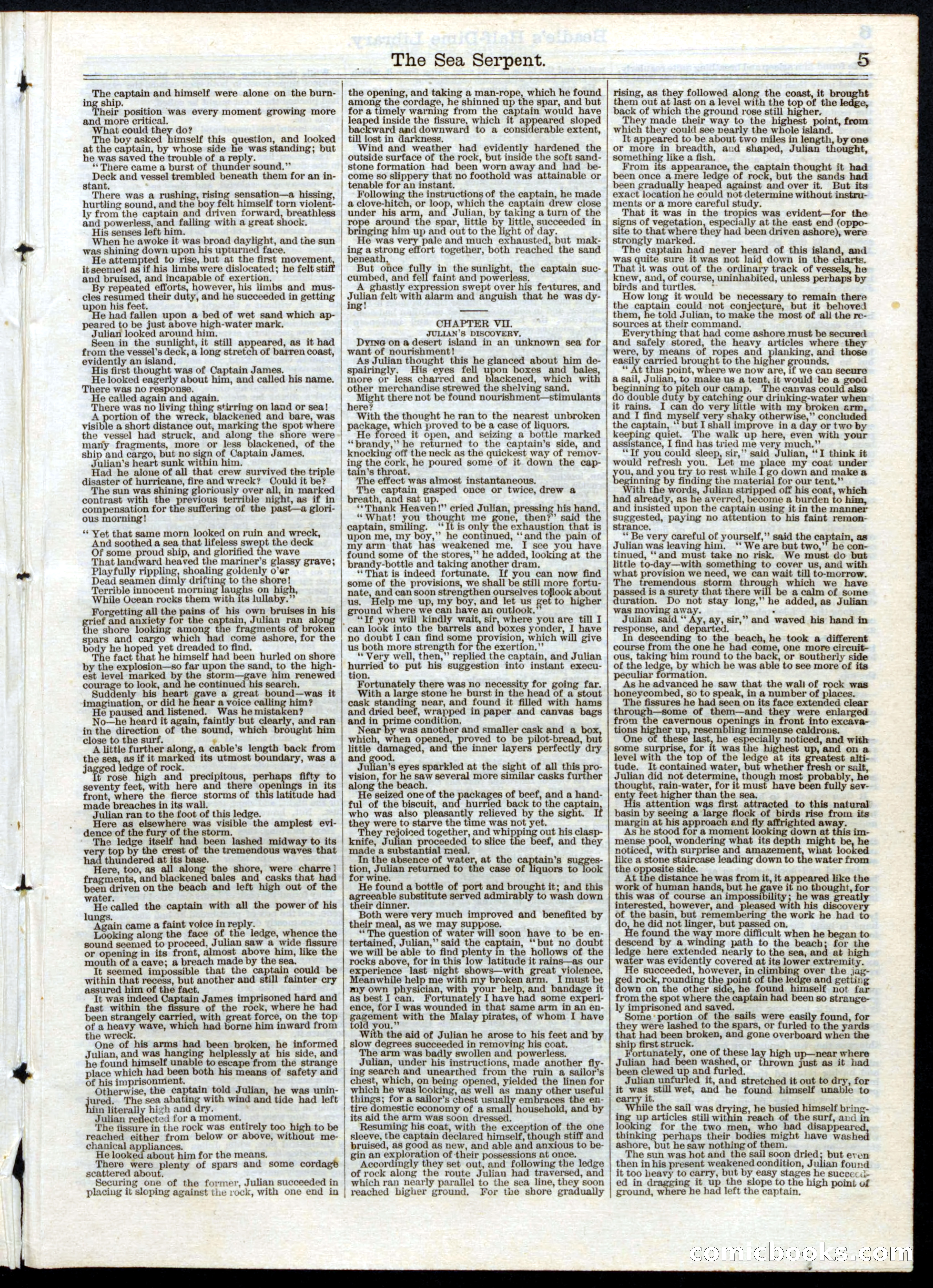
A restored page from Pulp Fiction, 1877. Page through the whole issue in the reader above.
📄 Transcribed text from this page (OCR, searchable)
Machine-transcribed from the original scan — historical spelling and the odd misread are preserved.
ae ——t—ss—i‘_S—S ——_ on ay captain and himself were alone on the burn- ship. hele. position was every moment growing more and more critical. What could they do? The boy asked himself this question, and looked | till lost in darkn at the captain, by whose side he was standing; but he was saved the trouble of a reply. ‘* There came a burst of thunder sound.” Deck and vessel trembled beneath them for an in- stant. There was a rushing, rising sensation—a hissing, hurtling sound, and the boy felt himself torn violent- ly from the captain and driven forward, breathless and powerless, and falling with a great shock. His senses left him. ; When he awoke it was broad daylight, and the sun was shining down upon his upturned face. He attempted to rise, but at the first movement it seemed as if his limbs were dislocated; he felt stiff and bruised, and incapable of exertion. By repeated efforts, however, his limbs and mus- cles resumed their duty, and he succeeded in getting ones his feet. , e had fallen upon a bed of wet sand which ap- peared to be just above high-water mark. Julian looked around him. Seen in the sunlight, it still ap , as it had from the vessel's deck, a long stretch of barren coast, evidently an island, His first thought was of Captain James. He looked eagerly about him, and called his name. There was no response. He called again and — There was no living thing stirring on land or sea! A portion of the wreck, blackened and bare, was visible a short distance out, marking the spot where the vessel had struck, and along the shore were many fragments, more or less blackened, of the ship and cargo, but no sign of Captain James. Julian's heart sunk within him. Had he alone of all that crew survived the triple disaster of hurricane, fire and wreck? Could it be? The sun was shining gloriously over all, in marked contrast with the previous terrible night, as if in compensation for the suffering of the past—a glori- ous morning! ‘* Yet that same morn looked on ruin and wreck, And soothed a sea that lifeless swept the deck Of some proud ship, and glorified the wave That landward heaved the mariner’s glassy grave; Playfully rippling, shoaling goldenly o'er Dead seamen dimly drifting to the shore! Terrible innocent morning laughs on high, While Ocean rocks them with its lullaby.” Forgetting all the pains of his own bruises in his ef and anxiety for the oe Julian ran along he shore looking a. e fragments of broken spars and cargo which had come ashore, for the body he ho et dreaded to find. The fact that he himself had been hurled on shore by the explosion—so far upon the sand, to the high- est level marked by the storm—gave him renewed co to look, and he continued his search. Suddenly his heart ahs a great bound—was it imagination, or did he hear a voice calling him? He paused and listened. Was he mistaken? No—he heard it again, faintly but clearly, and ran in the direction of the sound, which brought him close to the surf. . A little further along, a cable’s length back from the as if it marked its utmost boundary, was a ; ote on oy recipito haps fifty to t rose and precipitous, per seventy feet, with here and there o ning? in its front, where the fierce storms of this latitude had made breaches in its wall. Julian ran to the foot of this ledge. Here as elsewhere was visible the amplest evi- dence of the fury of the storm. The ledge itself had been lashed midway to its very top by the crest of the tremendous waves that had thundered at its base. Here, too, as all along the shore, were charre | fragments, and blackened bales and casks that had been driven on the beach and left high out of the water. He called the captain with all the power of his lu ngs. ain came a faint voice in reply. Teoxing along the face of the ledge, sound seemed to proceed, saw a wide or opening in its front, almost above him, like the mouth of a cave; a breach made by the sea. It seemed im ble that the captain could be within that recess, but another and still fainter cry assured him of the fact. It was indeed Captain James imprisoned hard and fast within the fissure of the rock, where he had oe the been strangely carried, with great force, on the top of a woe wave, which had borne him inward from the wreck. One of his arms had been broken, he informed Julian, and was hanging helplessly at his side, and he found himself unable to escape from the strange lace which been both his means of safety and of his imprisonment. Otherwise, the captain told Julian, he was unin- ured. The sea aba with wind and tide had left in literally high and dry. Julian reflected for a moment. The fissure in the rock was entirely too high to be reached either from below or above, without me- chanical appliances. He looked. about him for the means. There were plenty of spars and some cordagt scattered about. ' for a timely warning from the captain would have renee inside the fissure, which it eae sloped backward and downward to a considerable extent, ess. Wind and weather had evidently hardened the outside surface of the rock, but inside the soft sand- | stone formation had been worn away and had be- | LL Securing one of the former, Julian succeeded in | placing it sloping against the rock, with one end in | reached bigher ground. For the shore gradually . 2, come so slippery that no foothold was attainable or tenable for an instant. Following the instructions of the captain, he made a clove-hitch, or loop, which the captain drew close under his arm, and Julian, by taking a turn of the — around the spar, little by little, succeeded in bringing him up and out to the light of day. He was very pale and much exhausted, but mak- ing a rene effort together, both reached the sand neat But ofce fully in the sunlight, the captain suc- cumbed, and fell faint and powerless. A ghastly expression swept over his fevtures, and he felt with alarm and anguish that he was dy- CHAPTER VU. JULIAN’S DISCOVERY. Dymo on a desert island in an unknown sea for want of nourishment! As Julian thought this he glanced about him de- spairingly. His eyes fell upon boxes and bales, more or less charred and blackened, which with other merchandise strewed the shelving sand. . Might there not be found nourishment—stimulants ere? With the thought he ran to the nearest unbroken package, which proved to be a case of liquors. He forced it open, and seizing a bottle marked “brandy,” he returned to the captain’s side, and knocking off the neck as the quickest way of remov- ing the cork, he poured some of it down the cap- n's throat. The effect was almost instantaneous. The captain gasped once or twice, drew a breath, and sat up. ‘*Thank Heaven!” cried Julian, pressing his hand. “What! you re me gone, then?” said the captain, smiling. ‘It is only the exhaustion that is upon me, my boy,”’ he continued, ‘‘and the pain of my arm that has weakened me. I see you have found some of the stores,”’ he added, looking at the brandy-bottle and taking another dram. ‘That is indeed fortunate. If you can now find some of the provisions, we shall be still more fortu- nate, and can soon strengthen ourselves orn about us. Help me up, my boy, and let us ge to higher ground where we can have an outlook, “Tf you will kindly wait, sir, where you are till I can look into the and boxes yonder, I have no doubt I can find some provision, which will give us both more strength for the exert ion.” “Very well, then,” replied the captain, and Julian — to put his suggestion into instant execu- tion. Fortunately there was no necessity for going far. With a large stone he burst in the head of a stout cask standing near, and found it filled with hams and dried beef, wrapped in paper and canvas bags and in prime condition, Near by was another and smaller cask and a bo which, when opened, proved to be pilot-bread, bu rte 9 damaged, and the inner layers perfectly dry an Julian’s eyes sparkled at the sight of all this pro- vision, for he saw several more similar casks further along the beach. He seized one of the packages of beef, and a hand- ful of the biscuit, and hurried back to the captain oe were 21 eine t pattern! a yet. anes ey rejo ether, and w out his p- knife, J proceeded to slice fhe beef, and they In the absence of water, at the tion, Julian returned to the case of liquors He found a bottle of port and brought it; and this ble substitute served admirably to wash down Both were very much improved and benefited by their meal, as we may sup who was also pleasantly relieved by the sight. if made a substantial meal. ‘ti s « to look for wine. eir dinner. uestion of water will soon have to be en- 7 The tertained, Julian,” said the captain, *“‘ but no doubt we will be able to find plent the hollows of the rocks above, for in this low latitude it rains—as our experience last night shows—with great violence. Meanwhile help me with my broken arm. I must be my own physician, with your help, and bandage it as best I can. Fortunately I have some experi- ence, for I was wounded in that same arm in an en- ement with the Malay pirates, of whom I have Id you.” With the aid of Julian he arose to his feet and by succeeded in removing his coat. The arm was badly swollen and powerless. Julian, under his instructions, made another fly- ing search and unearthed from the ruin a sailor's chest, which, on being opened, yielded the linen for which he was looking, as well as many other useful th ; for a sailor’s chest us embraces the en- tire domestic economy of as household, and by its aid the arm was soon dressed. his coat, with the exception of the one sleeve, the captain declared himself, though stiff and bruised, as good as new, and able and anxious to be- gin an exploration of their ons at once. Accordingly they set out, and following the ledge of rock along the route Julian had traversed, and which ran nearly parallel to the sea line, they soon The Sea Serpent. 5 the opening, and taking a man-rope, which he found | rising, as they followed along the coast, it b among the cordage, he shinned up the spar, and but | them out at last on a level with the top of the 2, back of which the ground rose still higher, They made their way to the highest point, from which they could see nearly the whole island. It appeared to be about two miles in length, by one or more in breadth, and shaped, Julian thought, something like a fish. From its appearance, the captain thought it had been once a mere | of rock, but the sands had been gradually hea against and over it. But its exact location he could not determine without instru- ments or a more careful study. ’ . it arto in the mentee ys 4 rye a the si of vegetation, especially at the east end (oppo- into that where they had been driven ashore), were strongly marked. The captain had never heard of this island, and was quite sure it was not laid down in the charts. That it was out of the ordinary track of vessels, he knew, and, of course, uninhabited, unless perhaps by birds and turtles. ~ How long it would be necessary to remain there the captain could not conjecture, but it behoved them, he told Julian, to make the most of all the re- sources at their command. Everything that had come ashore must be secured and safely stored, the heavy articles where they were, by means of ropes and planking, and those easily carried brought to the higher grounds. “ At this point, where we now are, if we can secure a sail, Julian, to make us a tent, it would be a good beginning to ge our camp. The canvas could also do double duty by catching our dri -water when it rains. I can do very little with my broken arm and I find myself very shaky otherwise,” concluded the captain, ** but I shall improve in a day or two by keeping quiet. The walk up here, even with your assistance, I find has tried me very much.”"’ “If you could sleep, sir,’ said Julian, “I think it would refresh you. Let me panes my coat under ou, and you try to rest while I go down and make a beginnin by finding the material for our tent.” ith the words, Julian stripped off his coat, which had already, as he averred, become a burden to him, and insisted upon the captain using it in the manner suggested, paying no attention to his faint remon- strance. ‘“* Be very careful of yourself,” said the captain, as Julian was leaving him. ‘* We are but two,”’ he con- tinued, ‘‘and must take no risk. We must do but little to-day—with something to cover us, and with what provision we need, we can wait till to-morrow. The tremendous storm through which we have pared it haere that there will be a calm of some uration. Do not stay long,” he added, as Julian was moving away. : Julian said “‘ Ay, ay, sir,”’ and waved his hand in response, and departed. In descending to the beach, he took a different course from the one he had come, one more cireuit- ous, taking him round to the back, or southerly side of the ledge, by which he was able to see more of its peculiar formation. As he advanced he saw that the wali of rock was honeycombed, so to speak, in a number of places. The fissures he had seen on its face extended clear pa dg | iy of them—and they were enlarged from the cavernous mec od in front into excava- tions higher up, resembling immense caldrons. One of these last, he especially noticed, and with some rise, for it was the highest up, and on a level with the top of the ledge at its test alti- tude. It contained water, but whether or salt, Julian did not determine, though most probably, he thought, rain-water, for it m have been fully sev- enty feet higher than the sea. attention was first attracted to this natural basin by seeing a large flock of birds rise from its margin at his approach and fly affrighted wey: 8 As he stood for a moment looking down at im- mense 1, wondering what its depth might he noticed, with surprise and amazement, what looked like a stone staircase leading down to the water from the oupodite side. At the distance he was from it, it 4 work of human hands, but he gave it no thought, for this was of course an im ility; he was greatly interested, however, and pleased with his discovery of the basin, but remembering the work he had to do, he did not linger, but passed on. He found the wa ‘more difficult when he began to descend by a path to the beach; for the ledge here extended nearly to the sea, and at high water was evidently covered at its lower extremity. He succeeded, however, in climbing over the jag- ged rock, rounding the point of the and getting own on the other side, he found himself not far from the spot where the ca been so strange- ly imprisoned and saved. Some portion of the sails were easily found, for they were lashed to the spars, or furled to the yards that had been broken, and gone overboard when the ship first struck. ortunately, one of these lay high up—near where Julian had washed, or thrown just as it had been clewed = and furled. Julian unfurled it, and stretched it out to dry, for it was still wet, and he found himself unable to it. “While the sail was d , he busied himself bring- ing up articles still wit reach of the surf, and in looking for the two men, who had oe tee thinking perhaps their es might have wash ashore, but he saw nothing of them. The sun was hot and the sail soon dried; but even then in his present weakened condition, Julian found it too heavy to carry, but by easy stages he succeci- ed in ¢ ing it up the slope to the high point of ground, where he had left the captain. peared like the JOO eom (G (©)