
Pulp Fiction, 1877 · page 7 of 16
Beadle's Half Dime Library, No. 22 — page 7: what you’re looking at
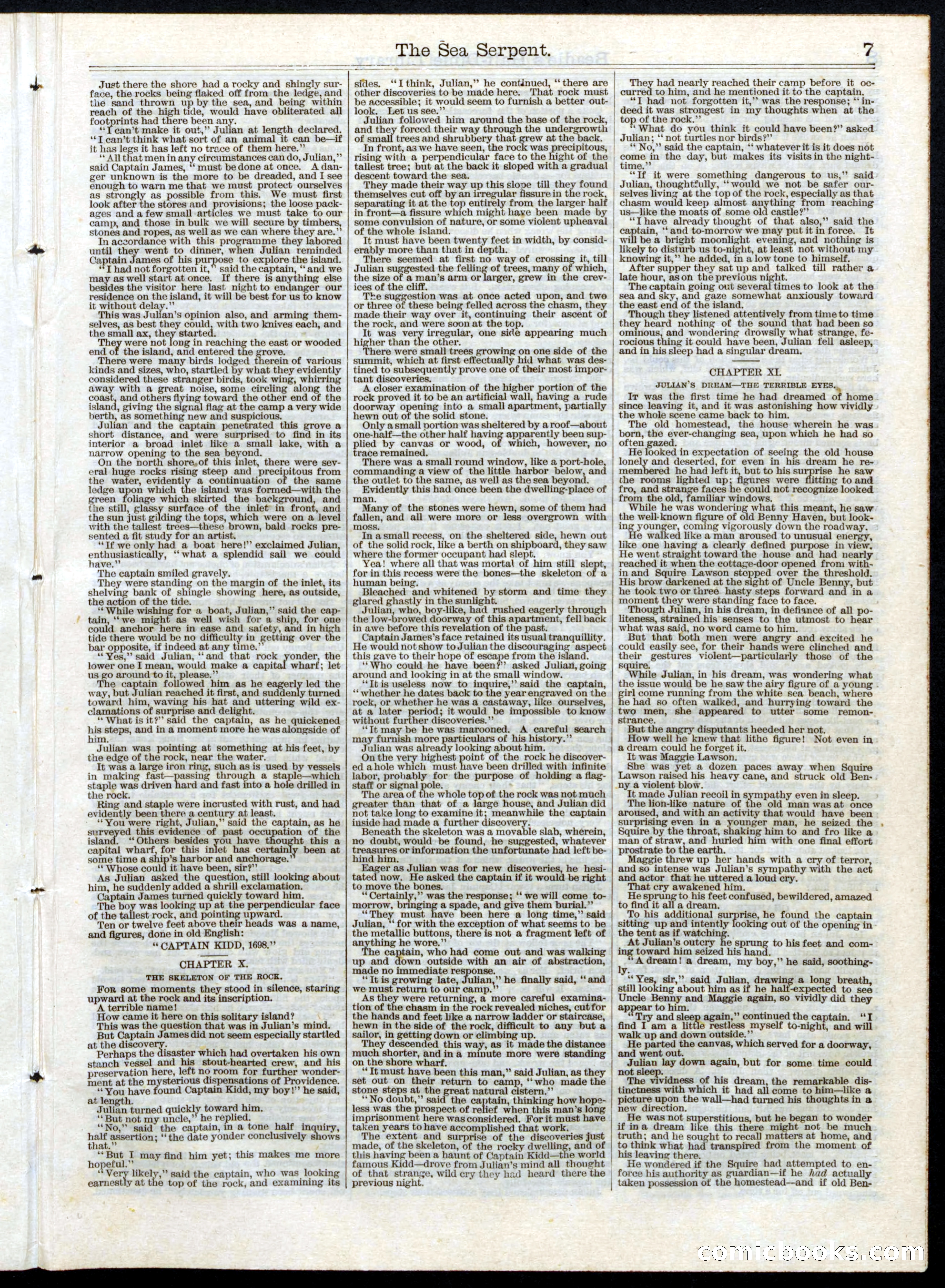
A restored page from Pulp Fiction, 1877. Page through the whole issue in the reader above.
📄 Transcribed text from this page (OCR, searchable)
Machine-transcribed from the original scan — historical spelling and the odd misread are preserved.
—— — Just there the shore had a rocky and shingly sur- face, the rocks being flaked off from the ledge, and the sand thrown up by the sea, and being within reach of the high tide, would have obliterated all footprints had there been any. “T can’t make it out,” Julian at length declared. ‘‘T can’t think what sort of an animal it can be—if it has legs it has left no trace of them here.” ‘** All that menin any circumstances can do, Julian,” said Captain James, *‘ must bedone at once. A dan- ger unknown is the more to be dreaded, and I see enough to warn me that we must protect ourselves as strongly as possible from this. We must first look after lee stores and provisions; the loose pack- ages and a few small articles we must take to our camp, and those in bulk we will secure b timbers, stones and ropes, as well as we can where they are.’ In aczordance with this programme they labored until they went to dinner, when Julian reminded Captain ames of his purpose to explore the island. ‘**T had not forgotten it,”’ said the captain, ‘“* and we may as well start at once. If there is anything else des the visitor here last night to en r our residence on the island, it will be best for us to know it without delay.” This was Julian’s opinion also, and arming them- selves, as best they could, with two knives each, and the small ax, they started. They were not long in reaching the east or wooded end of the island, and entered the ve. There were many birds lodged therein of various kinds and sizes, who, startled by what they evidently considered these stranger birds, took wing, whirring away with a great noise, some circling along the coast, and others flying toward the other end of the island, giving the signal flag at the camp a very wide berth, as something new and suspicious. Julian and the captain penetrated this grove a short distance, and were surprised to find in its interior a broad inlet like a small lake, with a narrow opening to the sea beyond. On the north shore,of this inlet, there were sev- eral huge rocks ri steep and precipitous from the water, evidently a continuation of the same ledge upon which the island was formed—with the green foliage which skirted the background, and the still, glassy surface of the inlet in front, and the sun just gilding the tops, which were on a level with the tallest trees—these brown, bald rocks pre- sented a fit study for an artist. “Tf we only had a boat here!’ exclaimed Julian enthusiastically, ‘‘what a splendid sail we could have.” The captain smiled gravely. They were standing on the margin of the inlet, its shelving bank of shingle showing here, as outside, me While wishing f ra. boat, Julian,” said th ‘ e or a . an,” e cap- tain, ‘‘we might as well wish for a ship, for one could anchor here in ease and safety, and in high tide there would be no difficulty in getting over the bar opposite, if indeed at any time.”’ “Yes,” said Julian, ‘‘and that rock yonder, the lower one I mean, would make a capi wharf ; let us go around to it, please.”’ e captain followed him as he eagerly led the way, but Julian reached it first, and suddenly turned toward him, waving his hat and uttering wild ex- clamations of surp and delight. “What is it?’ said the captain, as he quickened his steps, and in a moment more he was alongside of him. Julian was pointing at something at his feet, by the edge of the rock, near the water. It was a large iron ring, such as is used by vessels in making re Soe wee = a staple—which staple was driven hard and fast into a hole drilled in the rock. Ring and staple were incrusted with rust, and had evidently been there a century at least. ‘* You were right, Julian,’ said the captain, as he surveyed this evidence of past occu on of the island. “Others besides you have ht this a capital wharf, for this inlet has ce y been at some time a ship's harbor and anchorage.’ ‘* Whose could it have been, sir?”’ As Julian asked the question, still looking about him, he suddenly added a shrill exclamation. Captain James turned quickly toward him. The boy was looking up at the perpendicular face of the tallest rock, and poin upward. Ten or twelve feet above their heads was a name, and figures, done in old English: “CAPTAIN KIDD, 1698.”’ CHAPTER X. THE SKELETON OF THE ROCK. For some moments they stood in silence, staring upward at the rock and its inscription. A terrible name! How came it here on this solitary island? This was the question that was in Julian’s mind. But Captain James did not seem especially startled at the sen fone - Perhaps the r which had overtaken his own stanch v and his stout-hearted crew, and his preservation here, left no room for further wonder- ment at the mysterious dispensations of Providence. ‘“ You have found Captain Kidd, my boy!’’ he said, at length. : J io. turned quickly toward him. ‘‘But not my uncle,” he replied. “No,” said the captain, in a tone half inquiry, — assertion; “‘the date yonder conclusively shows that.” ‘*But I may find him yet; this makes me more hopeful.” “Very likely,” said the captain, who was looking earnestly at the top of the rock, and examining its = — es oe The Sea Serpent. 7 -_- _ ~ _ — sides. “‘I think, Julian,” he continued, “ there are other discoveries to be made here. That rock must be accessible; it would seem to furnish a better out- look. Let us see.” Julian followed him around the base of the rock, and they forced their way through the undergrowth of small trees and shrubbery that w at the back. In front, as we have seen, the rock was precipitous, rising with a perpendicular face to the hight of the descent toward the sea. ' had nearly reached their camp before it oc- “T had not forgotten it,’’ was the response; “ in- deed it was strongest in my thoughts when at the The oma to him, and he mentioned it to the captain. of the rock.”’ ‘What do you think it could have been?” asked Julian; ‘‘ not turtles nor birds?’’ ‘** No,”’ said the captain, ‘‘ whateverit is it does not come in the day, but makes its visits in the night- tallest tree; but at the back it sloped with a gradual | They made their way up this slope till they found | themselves cut off by an r fissure in the rock, separating it at the top entirely from the larger half in front—a fissure which might haye been made by of the whole island. It must have been twenty feet in width, by consid- erably more than that in depth. There seemed at first no way of crossing it, till Julian suggested the felling of trees, many of which, the size of a man’s arm or larger, grew in the crev- ices of the cliff. The meee was at once acted upon, and two or three of these being felled across the chasm, they made their way over it, continuing their ascent of the rock, and were soon at the top. It was very irregular, one side appearing much higher than the other. There were small] trees growing on one side of the summit, which at first effectually hid what was des- tined to subsequently prove one of their most impor- tant discoveries. A closer examination of the higher portion of the rock proved it to be an artificial wall, having a rude doorway opening into a small apartment, partially hewn out of the solid stone. Only asmall portion was sheltered by a roof—about one-half—the other half ie apparently been sup- plied by canvas or wood, of which, however, no trace remained. There was a small round window, like a port-hole commanding a view of the little harbor below, an the outlet to the same, as well as the sea beyond. Evidently this had once been the dwelling-place of man. Many of the stones were hewn, some of them had fallen, and all were more or less overgrown with moss. In asmall recess, on the sheltered side, hewn out of the solid rock, like a berth on shipboard, they saw where the former occupant had slept. Yea! where all that was mortal of him still slept, for in this recess were the bones—the skeleton of a human being. Bleached and whitened by storm and time they glared ghastly in the sunlight. Julian, who, boy-like, had rushed eagerly through the low-browed doorway of this apartment, fell back in awe before this revelation of the past. Captain James’s face retained its usual tranquillity. He would not show toJulian the discouraging aspect this gave to their hope of escape from the island. ‘*Who could he have been?’’ asked Julian, going around and looking in at the small window. “Tt is useless now to ae le pe said the captain, ‘whether he dates back to the year engraved on the rock, or whether he was a castaway, like ourselves, at a later period; it would be impossible to know without further discoveries.”’ ‘Tt may be he was marooned. A careful search may furnish more particulars of his history.” Julian was already looking about him. On the very highest point of the rock he discover- ed ahole which must have been drilled with infinite labor, probably for the purpose of holding a flag- staff or signal pole. . The area of the whole top of the rock was not much greater than that of a large house, and Julian did not take long to examine it; meanwhile the captain inside had made a further discovery. Beneath the skeleton was a movable slab, wherein, no doubt, would be found, he suggested, whatever treasures or information the unfortunate had left be- hind him. — as Julian was for new discoveries, he hesi- tate be right now. He asked the captain if it wo to move the bones. ‘“*Ce ,”’ was the response; ‘‘ we will come to- morrow, b a spade, and give them burial.”’ “They must have been here a long time,” said Julian, *‘ for with the exception of what seems to be the metallic buttons, there is not a fragment left of ——e he wore.”’ e ca , who had come out and was walking wn outside with an air of abstraction, made no immediate nse. “It is growing late, ulian,”” he finally said, ‘and we must return to our camp.” As they were returning, a more careful examina- tion of the chasm in the rock revealed niches, cut for the hands and feet like a narrow ladder or staircase, hewn in the side of the rock, difficult to any but a sailor, in getting down or climbing up. They descended this way, as it made the distance much shorter, and in a ute more were standing on eo — — “Tt must have n this man,” said Julian, as they set out on their return to camp, ‘‘who made the stone steps at the t natural cistern.”’ ‘No doubt,” said the captat, thinking how hope- less was the prospect of relief when this man’s long imprisonment here was considered. For it must have taken years to have accomplished that work. The extent and surprise of the discoveries just made, of the skeleton, of the rocky dwelling, and of this having been a haunt of Captain Kidd—the world famous Kidd—drove from Julian’s mind all thought | TT TL LL ~~ time.” “Tf it were something dangerous to us,” said ae ees ‘“‘would we not be safer our- selves living at the top of the rock, especially as that chasm would keep almost anything from reaching _ us—like the moats of some old castle?” some convulsion of nature, or some violent upheaval “Thave already thought of that also,”’ said the captain, ‘and to-morrow we may put itin force. It will be a bright moonlight evening, and nothing is likely to disturb us to-night, at least not without my knowing it,’’ he added, in a low tone to himself. After supper they sat up and talked till rather a late hour, ason the previous night. The captain going out several times to look at the sea and sky, and gaze somewhat anxiously toward the east end of the island. Though they listened attentively from time to time they heard nothing of the sound that had been so ominous, and wondering drowsily what strange, fe- rocious thing it could have been, Julian fell asleep, and in his sleep had a singular dream. CHAPTER XI. JULIAN’S DREAM—THE TERRIBLE EYES Ir was the first time he had dreamed of home since leaving it, and it was astonishing how vividly the whole scene came back to him. The old homestead, the house wherein he was born, the ever-changing sea, upon which he had so often gazed. He looked in expectation of seeing the old house lonely and deserted, for even in his dream he re- mem he had Jeft it, but to his surprise he saw the rooms lighted up; figures were flitting to and fro, ands faces he could not recognize looked from the old, familiar windows. ‘ While he was wondering what this meant, he saw the well-known “oan of old Benny Haven, but look- ing younger, coming vigorously down the roadway. e walked like a man aroused to unusual energy, like one ame. a clearly defined purpose in view, He went straight toward the house and had nearly reached it when the cottage-door opened from with- in and Squire Lawson stepped over the threshold. His brow darkened at the sight of Uncle Benny, but he took two or three hasty steps forward and in a moment they were standing face to face. h Julian, in his dream, in defiance of all po- liteness, strained his senses to the utmost to hear what was said, no word came to him. But that both men were and excited he could easily see, for their hands were clinched and their gestures violent—particularly those of the squire. “While Julian, in his dream, was wondering what the issue would be he saw the airy figure of a young . girl come running from the white sea beach, where e had so often walked, and hurrying toward the ha men, she appeared to utter some remon- rance, But the angry disputants heeded her not. How well he knew that lithe figure! Not even in a dream could he forget it. It was Maggie Lawson. She was yet a dozen paces away when — Lawson raised his heavy cane, and struck old Ben- ny a violent blow. It made Julian recoil in Senn gl even in sleep. The lion-like nature of the old man was at once aroused, and with an activity that would have been surprising even in a younger man, he seized the . Squire by the throat, s g him to and fro like a man of straw, and hurled him with one final effort prostrate to the earth. Maggie threw up her hands with a cry of terror and so intense was Julian’s sympathy with the ac and actor that he uttered a loud cry. That cry awakened him. ' He sprung to his feet confused, bewildered, amazed to find it all a dream. _To his adaanal s rise, he eee the captain sitting up an n ooking out of the opening in. wee as if — i 4 ex ulian’s outcry he sprung to feet and com- ing toward him seized hie bank: ; A dreamin! a dream, my boy,” he said, soothing- y- “Yes, sir,’’ said Julian, dra a long brea still looking about him as if he nalberpected to me Uncle Benny and Maggie again, so vividly did they appear to him. “Try and sleep again,” continued the captain. “TI find I am a little restless myself to-night, and will walk up and down outside.”’ He parted the canvas, which served for a doorway, and went out. Julian lay down again, but for some time could es The vividness of his dream, the remarkable dis- tinctness with which it had all come to him—like a picture upon the wall—had turned his thoughts in a “i ot. he began to wond e was not superstitious, but he wonder if ina dream like this thease ht not be much truth; and he sought to recall] mat at home, and to think what transpired from the moment of his leaving there. He wondered if the Squire had attempted to en- of that strange, wild cry they had heard there the | force his authority as guardian—if he had actually previous night. | taken possession of the homestead—and if old Ben- O)ONO) (E@) (E@)