
Pulp Fiction, 1877 · page 4 of 16
Beadle's Half Dime Library, No. 22 — page 4: what you’re looking at
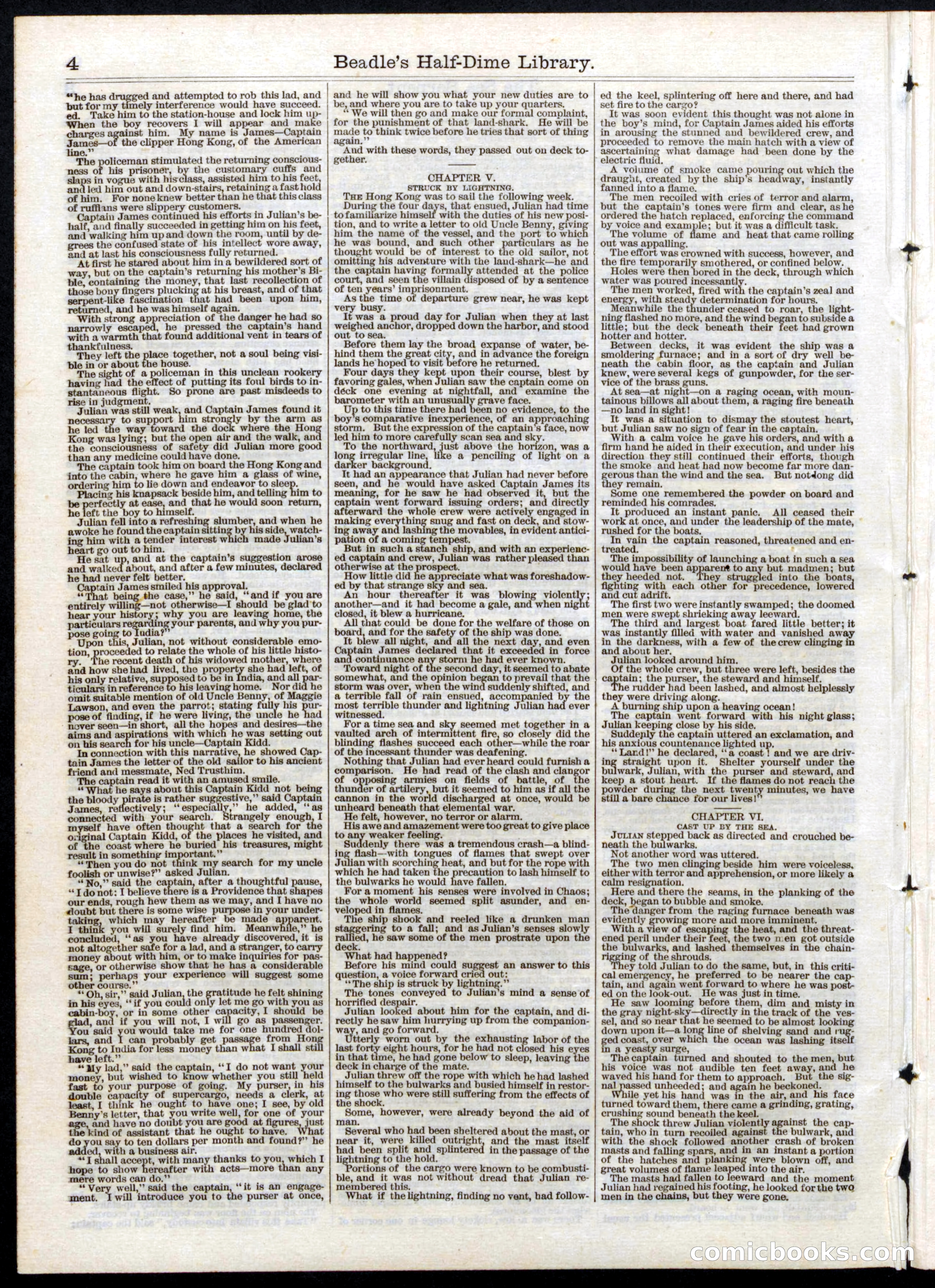
A restored page from Pulp Fiction, 1877. Page through the whole issue in the reader above.
📄 Transcribed text from this page (OCR, searchable)
Machine-transcribed from the original scan — historical spelling and the odd misread are preserved.
eee —— -_ = Beadle’s Half-Dime Library. “he has aregsee and attempted to rob this lad, and | and he will show you what your new duties are to but for my When the boy recovers I will appear and make charges ere him. My name is James—Captain James—of the clipper Hong Kong, of the American line.” The ness of his prisoner, b liceman stimulated the returning conscious- the customary cuffs and slaps in vogue with hisclass, assisted him to his feet and led him out and down-stairs, retaining a fast hold of him. For —_— knew —— than he that this class of ruffians were slippery customers. | x Captain James continued his efforts in Julian’s be- half, and finally succeeded in getting him on his feet, and walking him up and down the room, until by de- the confused state of his intellect wore away, and at last his consciousness fully returned. At first he stared about him in a bewildered sort of way, but on the captain’s returning his mother’s Bi- ble, containing the money, that last recollection of those bony fingers plucking at his breast, and of that serpent-like fascination that had been upon him, returned, and he was himself again. With strong appreciation of the danger he had so narrowly esca he pressed the captain’s hand with a warmth that found additional vent in tears of hankfulness. ‘ They left the place together, not a soul being visi- ble in or about the house. The sight of a policeman in this unclean rookery having had the effect of putting its foul birds to in- stantaneous flight. So prone are past misdeeds to rise in judgment. J ian was still weak, and Captain James found it necessary to support him strongly by the arm as he led the way toward the d where the om] Kong was lying; but the open air and the walk, an the consciousness of safety did Julian more good than any medicine could have done. The captain took him on board the Hong Kong and into the cabin, where he gave him a glass of wine, ordering him to lie down and endeavor to one. his knapsack beside him, and telling him to be perfectly at — and that he would soon return, he left the boy to himself. Julian fell into a ee slumber, and when he awoke he found the captain a side, watch- ing him with a tender interest which made Julian's heart go out to him. He sat up, and at the captain’s suggestion arose and walked about, and after a few minutes, dec he had never felt better. tain James smiled his approval. + t bei e case,” he said, “andif you are y willing—not otherwise—I should be glad to hear your history; why you are leaving home, the particulars ~~ g your parents, and why you pur- ndia?”’ pose going to Woes this Julian, not without considerable emo- tion, proceeded to relate the whole of his little histo- ry. The recent death of his widowed mother, where and how she had lived, the property she had left, of his only relative, supposed to be in India, and all a ticulars in reference to his leaving home. Nor did he omit suitable mention of old Uncle Benny, of Maggie Lawson, and even the parrot; stating fully his pose of finding, if he were living, the uncle he had nover seen—in short, all the ex and d the aims and aspirations with which he was setting out on his search for his uncle—Captain Kidd. In connection with this narrative, he showed Cap- tain James the letter of the old sailor to his ancient friend and messmate, Ned thim. The captain read it with an amused smile. a t he says about this Captain Kidd not being the bloody pirate is rather suggestive,” said Captain James, reflectively; ‘“ especi x he added, ‘‘as connected with your search. Strangely enough, I m f have orteridd. , 4 that a “oe Hoar - original Captain oO e places he an of the coast Re ome —— his treasures, might result in something rtant.”’ “Then you do not think my search for my uncle foolish or unwise?” asked Julian. “No,” said the —_ after a thoughtful pause, “I do not: I believe there is a Providence that shapes our ends, rough hew them as we may, and I have no doubt but there is some wise purpose in your under- taking, which may hereafter be made apparent. I think you will surely find him. Meanwhile,” he , ‘as you have already discovered, it is not al ther sate for a lad, and a stranger, to carry money about with him, or to make inquiries for pas- sage, or otherwise show that he has a considerable sum; perhaps your experience will suggest some urse.”” “Oh, sir,” said Julian, the gratitude he felt shining in his eyes, “‘if you could only let me go with you as cabin-boy, or in some other re ay I should be and if you will not, I will go as Lome ou said you would take me for one hundred dol- and lars, can probably get nme from Ho Kong to India for leas ay than what I shall s have | ‘ eft. “My lad,” said the captain, “I do not want your money, but wished to know whether you still held fast es your purpose of g. My purser, in his double capacity of su Rone. needs a clerk, at least, I think he ought to have one; I see, by old Benny’s letter, that you write well, for one of your and have no doubt you are good at figures, just the kind of assistant that he ought to have. t do you say to ten dollars per month and found?” he ed, with a business air. “T shall acce t, with ————_ to you, which I hope to show hereafter with acts—more than any mere words can do,”’ =e well,” said the omg it is an engage- ment. I will introduce you to the purser at once, ely interference would have succeed. | ed. Take him to the station-house and lock him up- | be, and where you are to take up your quarters. “We will then go and make our formal complaint, for the punishment of that land-shark. He will be made to think twice before he tries that sort of thing again.”’ And with these words, they passed out on deck to- gether. CHAPTER V. STRUCK BY LIGHTNING. THe Hong Kong was to sail the following week. During the four days, that ensued, Julian had time tofamiliarize himself with the duties of his new posi- tion, and to write a letter to old Uncle Benny, givin him the name of the vessel, and the port to whic he was bound, and such other capri: as he thought would be of interest to the old sailor, not omitting his adventure with the land-shark—he and the captain having formally attended at the police court, and seen the villain disposed of by a sentence of ten years’ imprisonment. As the time of departure grew near, he was kept very busy. It was a proud day for Julian when they at last weighed anchor, dropped down the harbor, and stood out to sea. Before them lay the broad expanse of water, be- hind them the great city, and in advance the foreign lands he hoped to visit before he returned. Four days they kept upon their course, blest by favoring gales, when Julian saw the captain come on déck one evening at nightfall, and examine the barometer with an wy Aad hs face. Up to this time there had n no evidence, to the boy’s comparative a emg of an approaching storm. But the expression of the captain's face, now led him to more carefully scan sea and sky. To the northward, just above the horizon, was a long irregular line darker background, It had an appearance that Julian had never before seen, and he would have asked Captain James its meaning, for he saw he had observed it, but the Se een went forward issuing orders; and directly afterward the whole crew were actively engaged in e a penciling of light on a making et snug and fast on deck, and stow- ing away an the movables, in evident antici- pation of a coming tempest. But in sucha stanch ship, and with an experienc- ed captain and crew, Julian was rather pleased than otherwise at the prospect. How little did he appreciate what was foreshadow- ed by that strange sky and sea. An hour the r it was blowing Mesiggeee another—and it had become a gale, and when night closed, it blew a hurricane. All that could be done for the welfare of those on board, and for the safety of the ship was done. It blew all night, and all the next day, and even Captain James declared that it exceeded in force and continuance any storm he had ever known. Toward night of the second day, it seemed to abate somewhat, and the opinion b to prevail that the storm was over, when the wind suddenly shifted, and a terrible fall of rain ensued, accompanied by the most terrible thunder and lightning Julian ever witnessed. For a time sea and 4 seemed met together in a vaulted arch of intermittent fire, so closely did the blinding flashes succeed each other—while the roar of the incessant thunder was deafening. Nothing that Julian had ever heard could furnish a comparison. He had read of the clash and anger of opposing armies on fields of battle, of the thunder of artilery, but it seemed to him as if all the cannon in the world discharged at once, would be unheard beneath that elemental war. He felt, however, no terror or alarm. His awe and amazement were too great to give place to a weaker feeling. Suddenly there was a tremendous crash—a blind- Rao Agnne tongues of flames that swept over Julian with scorching heat, and but for the rope with which he had taken the precaution to lash himself to the bulwarks he would have fallen. For a moment his senses were involved in Chaos; the whole world seemed split asunder, and en- veloped in flames. The ship shook and reeled like a drunken man staggering to a fall; and as Julian’s senses slowly : ~~ he saw some of the men prostrate upon the eck. What had happened? Before his mind could su an answer to this question, a voice forward cried out: “The ship is struck by lightning.” The tones conveyed to Julian’s mind a sense of horrified despair. Julian looked about him for the captain, and di- rectly he saw him hurrying up from the companion- way, and go forward. tterly worn out by the exhausting labor of the last forty eight hours, for he had not closed his eyes in that time, he had gone below to sleep, leaving the deck in charge of the mate. Julian threw off the rope with which he had lashed himself to the bulwarks and busied himself in restor- ing those who were still suffering from the effects of the shock. Some, however, were already beyond the aid of man. Several who had been sheltered about the mast, or a n split and sp n the of the lightning to the hold, ortions of the cargo were known to be combusti- ble, and it was not without dread that Julian re- membered this. What if the lightning, finding no vent, had follow- ed the keel, splintering off here and there, and had set fire to the cargo? It was soon evident this thought was not alone in the boy’s mind, for Captain James aided his efforts in arousing the stunned and bewildered crew, and proceeded to remove the main hatch with a view of ascertaining what damage had been done by the electric fluid. A volume of smoke came pourin draught, created by the ship fanned into a flame. The men recoiled with cries of terror and alarm, but the captain’s tones were firm and clear, as he ordered the hatch replaced, enforcing the command by voice and example; but it was a difficult task. The volume of ae and heat that came rolling out was appalling. The effort was crowned with success, however, and the fire temporarily smothered, or confined below. Holes were then bored in the deck, through which water was poured incessantly. The men worked, fired with the captain's zea] and energy, with steady determination for hours. Meanwhile the thunder ceased to roar, the light- ning flashed no more, and the wind began to subside a little; but the deck beneath their feet had grown hotter and hotter. Between decks, it was evident the ship was a smoldering furnace; and in a sort of dry well be- neath the cabin floor, as the captain and Julian knew, were several kegs of gunpowder, for the ser- vice of the brass guns. At sea—at night—on a raging ocean, with moun- tainous billows all about them, a raging fire beneath —no land in sight! It was a situation to dismay the stoutest heart, but Julian saw no sign of fear in the captain. With a calm voice he gave his orders, and with a firm hand he aided in their execution, and under his direction they still continued their efforts, though the smoke and heat had now become far more dan- Npipe than the wind and the sea. But notdong did ey remain. Some one remembered the powder on board and reminded his comrades. It produced an instant panic. All ceased their work at once, and under the leadership of the mate, rushed for the boats. In vain the captain reasoned, threatened and en- treated. : The impossibility of launching a boat in such a sea would have been ap m to any but madmen; but they heeded not. ey struggled into the boats ge with each other for precedence, lowered and cut adrift. The first two were instantly swamped; the doomed men were swept greeny Ty leeward. The third and largest boat fared little better; it was instantly filled with water and vanished away in the darkness, with a few of thecrew clinging in and about her. Julian looked around him. Of the whole crew, but three were left, besides the captain; the purser, the steward and himself. e rudder had been lashed, and almost helplessly they were driving along. A burning ship upon a heaving ocean! The captain went forward with his night glass; Julian keeping close by his side. Suddenly the captain uttered an exclamation, and his anxious countenance lighted Bp **Land!”’ he declared, ‘“‘a coast ! and we are driv- ing straight upon it. Shelter yourself under the bulwark, Julian, with the purser and steward, and keep a stout heart. If the flames do not reach the powder during the next twenty minutes, we have still a bare chance for our lives! CHAPTER VI. CAST UP BY THE SEA. JULIAN stepped back as directed and crouched be- neath the bulwarks. Not another word was uttered. The two men ao ie beside him were voiceless, either with terror and apprehension, or more likely a calm resignation. Here and there the seams, in the planking of the deck, began to bubble and smoke. The danger from the furnace beneath was evidently Lge 3 more and more imminent. With a view of escaping the heat, and the threat- ened peril under their feet, the two men got outside the bulwarks, and lashed themselves in the chain- g of the shrouds. ey told Julian to do the same, but, in this criti- cal perigee f he preferred to be nearer the cap- tain, und again went forward to where he was post- ed on the look-out. He was just in time. He saw looming before them, dim and misty in the gray night-sky—directly in the track of the ves- sel, and so near that he seemed to be almost looking down upon it—a long line of shelving sand and He ged coast, over which the ocean was lashing i a yeasty surge, The captain turned and shouted to the men, but his voice was not audible ten feet away, and he waved his hand for them to approach. But the sig- nal unheeded; and afo he beckoned. ile yet his hand was in the air, and his face turned toward them, there came a grinding, grating, crushing sound beneath the keel. The shock threw Julian violent nst the cap- tain, who in turn recoiled the bulwark, and with the shock followed another crash of broken masts and falling spars, and in an instant a portion of the hatches and pl were blown off, and great volumes of flame lea into the air. Julian had regained his footing, he looked for the ow@ ulian regain 00 , He 100 or the °o men in the chains, but they were gone, out which the s headway, instantly <€om GDOGKS 1 <4