
Pulp Fiction, 1871 · page 15 of 100
Beadle's Dime Novels No. 226: The Mustang-Hunters — page 15: what you’re looking at
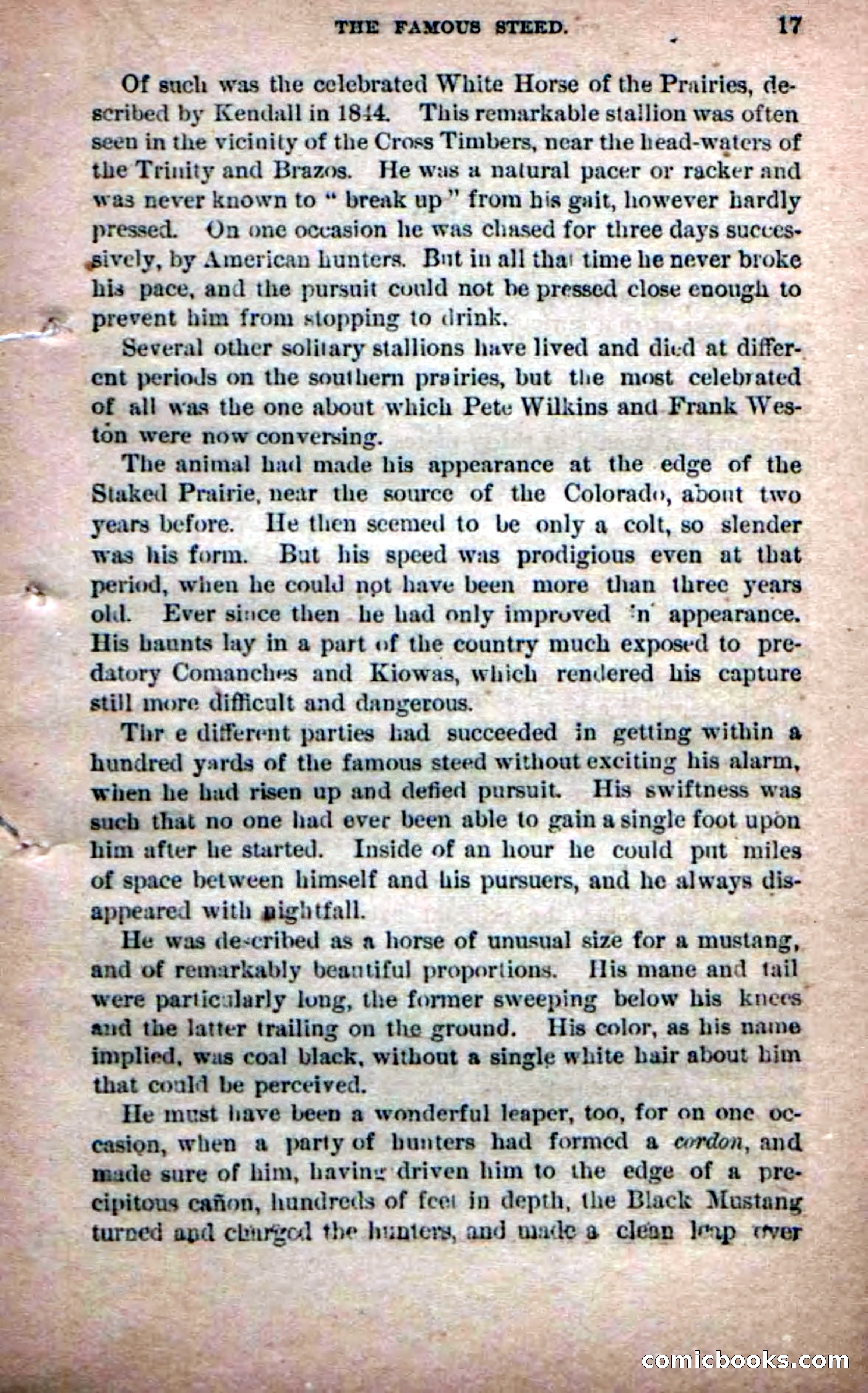
A restored page from Pulp Fiction, 1871. Page through the whole issue in the reader above.
📄 Transcribed text from this page (OCR, searchable)
Machine-transcribed from the original scan — historical spelling and the odd misread are preserved.
i = Of such was the celebrated White Horse of the Prairies, de- scribed by Kendall in 1844. This remarkable stallion was often seen in the vicinity of the Cross Timbers, near the head-waters of the Trinity and Brazos. He wus a natural pacer or racker and was never known to “ break up” from his gait, however hardly pressed. On one occasion he was Chased for three days succes- sively, by American hunters. But in all tha! time he never broke his pace, and the pursuit could not be pressed close enough to prevent him from stopping to drink. Several other solitary stallions have lived and dicd at differ- ent periods on the southern prairies, but the most celebrated of all was the one about which Pete Wilkins and Frank Wes- ton were now conversing. The animal had made his appearance at the edge of the Staked Prairie, near the source of the Colorad«, about two years before. Le then seemed to be only a colt, so slender was his form. But his speed was prodigious even at that period, when he could not have been more than three years okt. Ever since then he had only improved ‘n appearance. _ His baunts lay in a part of the country much exposed to pre- datory Comanches and Kiowas, which rendered his capture still more difficult and dangerous. Thr e different parties had succeeded in getting within a hundred yards of the famous steed without exciting his alarm, when he bad risen up and defied pursuit. His swiftness was such that no one had ever been able to gain a single foot upon him after he started. Inside of an hour he could put miles of space between himself and his pursuers, and he always dis- appeared with pightfall. He was described as a horse of unusual size for a mustang, and of remarkably beautiful proportions. His mane and tail _ were particularly long, the former sweeping below his knees" and the latter trailing on the ground. His color, as his name implied, wus coal black, without a single white hair about him that could be perceived. He must have been a wonderful leaper, too, for on one. oc- casion, when a party of bunters had formed a cordon, and made sure of him, having driven him to the edge of a pre- cipitous cafion, hundreds of feei in depth, the Black Mustang turned apd chhrgod the hunters, and made a clean lap cver