
Pulp Fiction, 1871 · page 16 of 100
Beadle's Dime Novels No. 226: The Mustang-Hunters — page 16: what you’re looking at
A restored page from Pulp Fiction, 1871. Page through the whole issue in the reader above.
📄 Transcribed text from this page (OCR, searchable)
Machine-transcribed from the original scan — historical spelling and the odd misread are preserved.
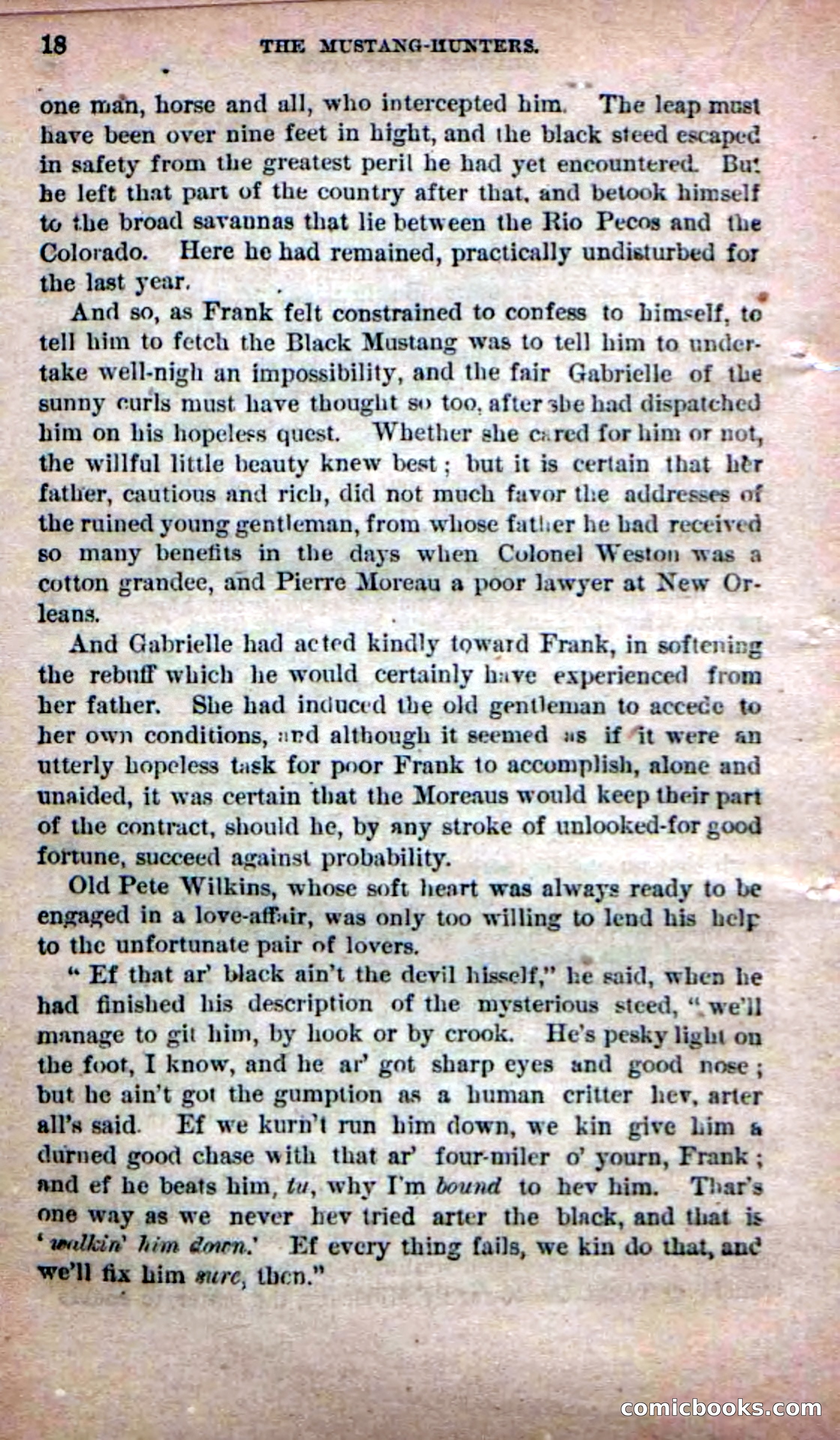
one mdn, horse and all, who intercepted him. The leap must have been over nine feet in hight, and the black steed escaped in safety from the greatest peril he had yet encountered. But he left that part of the country after that, and betook himself te the broad savannas that lie between the Rio Pecos and the Colorado. Here he had remained, practically undisturbed for the last year. And so, as Frank ‘felt constrained to confess to himself, to tell him to fetch the Black Mustang was to tel] him to under- take well-nigh an impossibility, and the fair Gabrielle of the sunny curls must have thought se too, after sbe had dispatched him on his hopeless quest. Whether she cared for him or not, the willful little beauty knew best; but it is certain that htr father, cautious and rich, did not much favor the addresses of the ruined young gentleman, from whose fatler he bad received so many benefits in the days when Colonel Weston was a cotton grandee, and Pierre Moreau a poor lawyer at New Or- leans. And Gabrielle had acted kindly toward Frank, in softening the rebuff which he would certainly have experienced from — her father. She had induced the old gentleman to accece to her own conditions, rd although it seemed «as if it were an utterly hopeless task for poor Frank to accomplish, alone and unaided, it was certain that the Moreaus would keep their part of the contract, should he, by any stroke of unlooked-for good fortune, succeed against probability. Old Pete Wilkins, whose soft heart was always ready to be engaged in a love-affair, was only too willing to lend his help to the unfortunate pair of lovers. « Ef that ar’ black ain’t the devil hisself,” he said, when he had finished his description of the mysterious steed, “ we'll manage to git him, by hook or by crook. He's pesky light on the foot, I know, and he ar’ got sharp eyes and good nose ; but he ain’t got the gumption as a human critter hev, arter all’s said. Ef we kurn’t run him down, we kin give him « _ durned good chase with that ar four-miler o’ yourn, Frank ; w. “aad ef he beats him, tu, why I'm bound to hev him. Thar’s powag se we never hev tried arter the black, and that is