
Pulp Fiction, 1929 · page 58 of 100
Air Wonder Stories, July 1929 — page 58: what you’re looking at
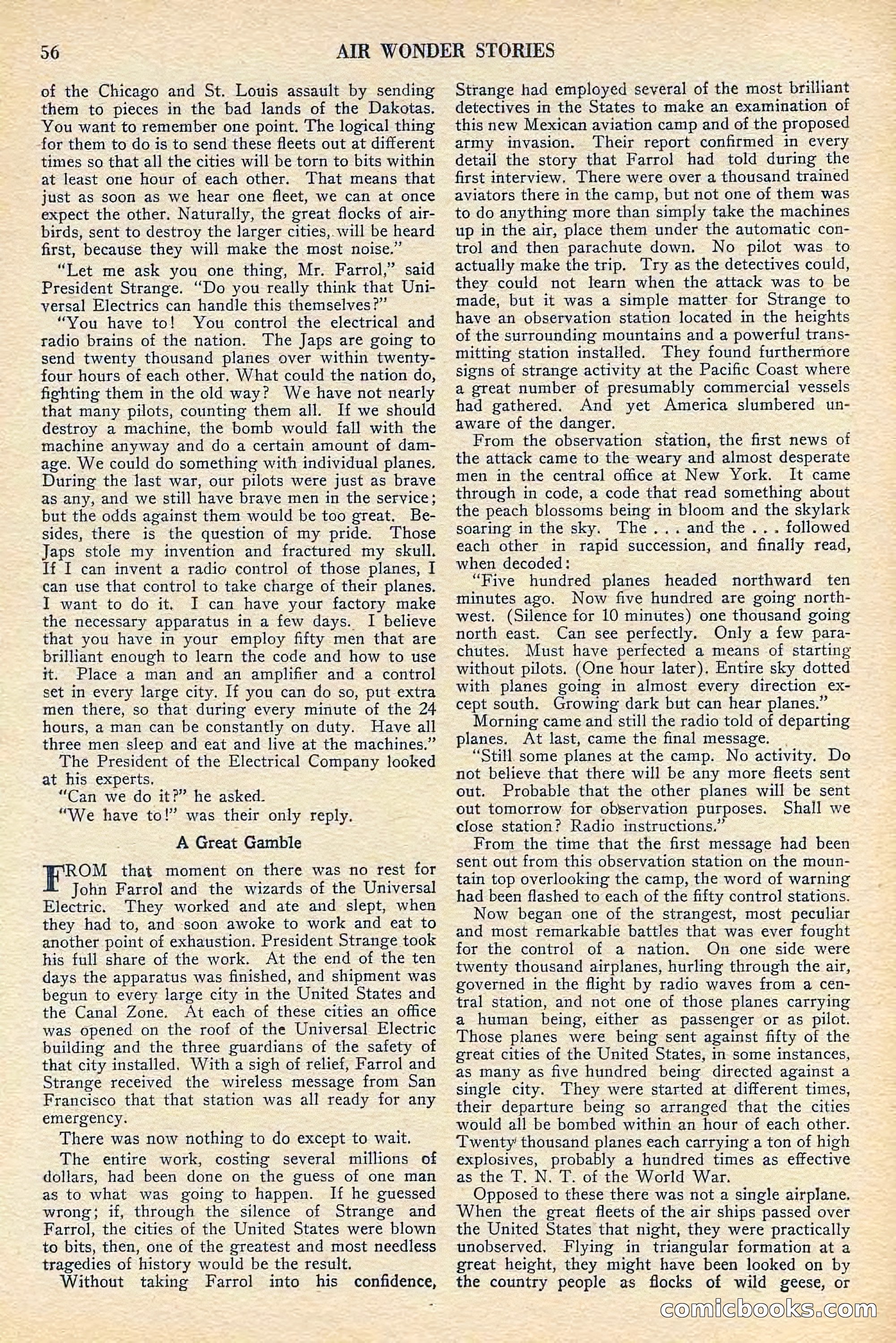
A restored page from Pulp Fiction, 1929. Page through the whole issue in the reader above.
📄 Transcribed text from this page (OCR, searchable)
Machine-transcribed from the original scan — historical spelling and the odd misread are preserved.
56 AIR WONDER STORIES of the Chicago and St. Louis assault by sending them to pieces in the bad lands of the Dakotas. You want to remember one point. The logical thing for them to do is to send these fleets out at different times so that all the cities will be torn to bits within at least one hour of each other. That means that just as soon as we hear one fleet, we can at once expect the other. Naturally, the great flocks of air- birds, sent to destroy the larger cities,.will be heard first, because they will make the most noise.” “Let me ask you one thing, Mr. Farrol,” said President Strange. “Do you really think that Uni- versal Electrics can handle this themselves?” “You have to! You control the electrical and tadio brains of the nation. The Japs are going to send twenty thousand planes over within twenty- four hours of each other, What could the nation do, fighting them in the old way? We have not nearly that many pilots, counting them all. If we should destroy a machine, the bomb would fall with the machine anyway and do a certain amount of dam- age. We could do something with individual planes, During the last war, our pilots were just as brave as any, and we still have brave men in the service; but the odds against them wotld be too great. Be- sides, there is the question of my pride. Those Japs stole my invention and fractured my skull. If I can invent a radio control of those planes, I can use that control to take charge of their planes. I want to do it, I can have your factory make the necessary apparatus in a few days. I believe that you have in your employ fifty men that are brilliant enough to learn the code and how to use it. Place a man and an amplifier and a control set in every large city. If you can do so, put extra men there, so that during every minute of the 24 hours, a man can be constantly on duty. Have all three men sleep and eat and live at the machines.” The President of the Electrical Company looked at his experts, “Can we do it?” he asked. “We have to!” was their only reply. A Great Gamble ROM that moment on there was no rest for John Farrol and the wizards of the Universal Electric. They worked and ate and slept, when they had to, and soon awoke to work and eat to another point of exhaustion. President Strange took his full share of the work. At the end of the ten days the apparatus was finished, and shipment was begun to every large city in the United States and the Canal Zone. At each of these cities an office was opened on the roof of the Universal Electric building and the three guardians of the safety of that city installed. With a sigh of relief, Farrol and Strange received the wireless message from San Francisco that that station was all ready for any emergency. There was now nothing to do except to wait. The entire work, costing several millions of dollars, had been done on the guess of one man as to what was going to happen. If he guessed wrong; if, through the silence of Strange and Farrol, the cities of the United States were blown to bits, then, one of the greatest and most needless tragedies of history would be the result. Without taking Farrol into his confidence, Strange had employed several of the most brilliant detectives in the States to make an examination of this new Mexican aviation camp and of the proposed army invasion. Their report confirmed in every detail the story that Farrol had told during the first interview. There were over a thousand trained aviators there in the camp, but not one of them was to do anything more than simply take the machines up in the air, place them under the automatic con- trol and then parachute down. No pilot was to actually make the trip. Try as the detectives could, they could not learn when the attack was to be made, but it was a simple matter for Strange to have an observation station located in the heights of the surrounding mountains and a powerful trans- mitting station installed. They found furthermore signs of strange activity at the Pacific Coast where a great number of presumably commercial vessels had gathered. And yet America slumbered un- aware of the danger. From the observation station, the first news of the attack came to the weary and almost desperate men in the central office at New York. It came through in code, a code that read something about the peach blossoms being in bloom and the skylark soaring in the sky. The...and the... followed each other in rapid succession, and finally read, when decoded: “Five hundred planes headed northward ten minutes ago. Now five hundred are going north- west. (Silence for 10 minutes) one thousand going north east. Can see perfectly. Only a few para- chutes. Must have perfected a means of starting without pilots. (One hour later). Entire sky dotted with planes going in almost every direction ex- cept south. Growing dark but can hear planes.” Morning came and still the radio told of departing planes. At last, came the final message. | “Still. some planes at the camp. No activity. Do not believe that there will be any more fleets sent out. Probable that the other planes will be sent out tomorrow for observation purposes. Shall we close station? Radio instructions.” From the titne that the first message had been sent out from this observation station on the moun- tain top overlooking the camp, the word of warning had been flashed to each of the fifty control stations. Now began one of the strangest, most peculiar and most remarkable battles that was ever fought for the control of a nation. On one side were twenty thousand airplanes, hurling through the air, governed in the flight by radio waves from a cen- tral station, and not one of those planes carrying a human being, either as passenger or as pilot. Those planes were being sent against fifty of the great cities of the United States, in some instances, as many as five hundred being directed against a single city. They were started at different times, their departure being so arranged that the cities would all be bombed within an hour of each other. ‘Twenty thousand planes each carrying a ton of high explosives, probably a hundred times as effective as the T. N. T. of the World War. Opposed to these there was not a single airplane, When the great fleets of the air ships passed over the United States that night, they were practically unobserved, Flying in triangular formation at a great height, they might have been looked on by the country people as flocks of wild geese, or comnlicloooks.com