
Pulp Fiction, 1929 · page 59 of 100
Air Wonder Stories, July 1929 — page 59: what you’re looking at
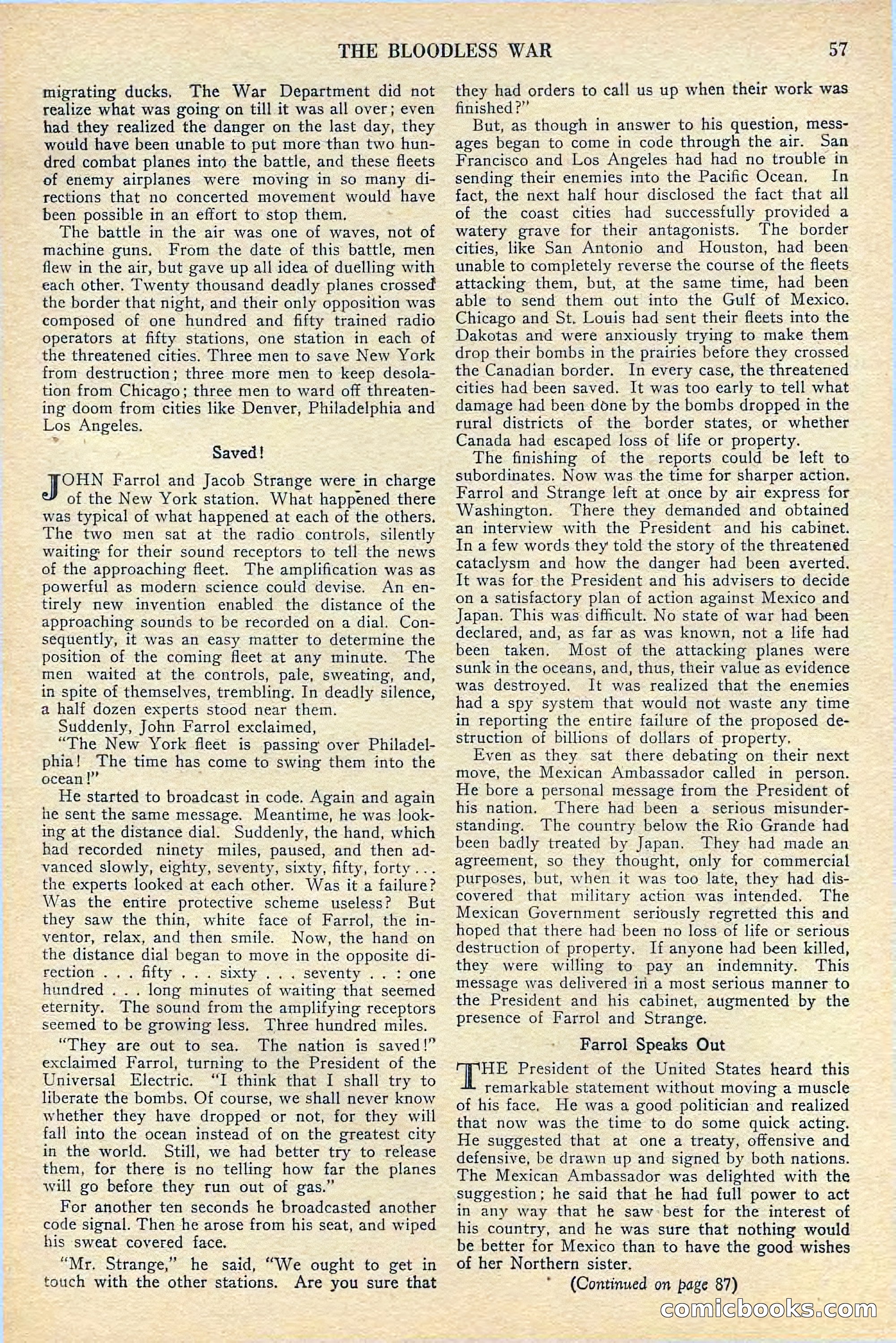
A restored page from Pulp Fiction, 1929. Page through the whole issue in the reader above.
📄 Transcribed text from this page (OCR, searchable)
Machine-transcribed from the original scan — historical spelling and the odd misread are preserved.
THE BLOODLESS WAR 57 migrating ducks, The War Department did not realize what was going on till it was all over; even had they realized the danger on the last day, they woid have been unable to put more than two hun- dred combat planes into the battle, and these fleets of enemy airplanes were moving in so many di- tections that no concerted movement would have been possible in an effort to stop them, The battle in the air was one of waves, not of machine guns. From the date of this battle, men flew in the air, but gave up all idea of duelling with each other. Twenty thousand deadly planes crossed the border that night, and their only opposition was composed of one hundred and fifty trained radio operators at fifty stations, one station in each of the threatened cities. Three men to save New York from destruction; three more men to keep desola- tion from Chicago; three men to ward off threaten- ing doom from cities like Denver, Philadelphia and Los Angeles. Saved! yor’ Farrol and Jacob Strange were in charge of the New York station. What happened there was typical of what happened at each of the others. The two men sat at the radio controls, silently waiting for their sound receptors to tell the news of the approaching fleet. The amplification was as powerful as modern science could devise. An en- tirely new invention enabled the distance of the approaching sounds to be recorded on a dial. Con- sequently, it was an easy matter to determine the position of the coming fleet at any minute. The men waited at the controls, pale, sweating, and, in spite of themselves, trembling. In deadly silence, a half dozen experts stood near them. Suddenly, John Farrol exclaimed, “The New York fleet is passing over Philadel- phia! The time has come to swing them into the ocean!” He started to broadcast in code. Again and again he sent the same message. Meantime, he was look- ing at the distance dial. Suddenly, the hand, which had recorded ninety miles, paused, and then ad- vanced slowly, eighty, seventy, sixty, fifty, forty... the experts looked at each other. Was it a failure? Was the entire protective scheme useless? But they saw the thin, white face of Farrol, the in- ventor, relax, and then smile. Now, the hand on the distance dial began to move in the opposite di- rection ... fifty . .. sixty ... seventy .. : one hundred ... long minutes of waiting that seemed eternity. The sound from the amplifying receptors seemed to be growing less. Three hundred miles. “They are out to sea. The nation is saved!” exclaimed Farrol, turning to the President of the Universal Electric. “I think that I shall try to liberate the bombs. Of course, we shall never know whether they have dropped or not, for they will fall into the ocean instead of on the greatest city in the world. Still, we had better try to release them, for there is no telling how far the planes will go before they run out of gas.” For another ten seconds he broadcasted another code signal. Then he arose from his seat, and wiped his sweat covered face. “Mr. Strange,” he said, “We ought to get in touch with the other stations. Are you sure that they had orders to call us up when their work was finished ?” But, as though in answer to his question, mess- ages began to come in code through the air. San Francisco and Los Angeles had had no trouble in sending their enemies into the Pacific Ocean, In fact, the next half hour disclosed the fact that all of the coast cities had successfully provided a watery grave for their antagonists. The border cities, like San Antonio and Houston, had been unable to completely reverse the course of the fleets attacking them, but, at the sate time, had been able to send them out into the Gulf of Mexico. Chicago and St, Louis had sent their fleets into the Dakotas and were anxiously trying to make them drop their bombs in the prairies before they crossed the Canadian border. In every case, the threatened cities had been saved. It was too early to tell what damage had been done by the bombs dropped in the rural districts of the border states, or whether Canada had escaped loss of life or property. The finishing of the reports could be left to subordinates. Now was the time for sharper action. Farrol and Strange left at once by air express for Washington. There they demanded and obtained an interview with the President and his cabinet. In a few words they’ told the story of the threatened cataclysm and how the danger had been averted. It was for the President and his advisers to decide on a satisfactory plan of action against Mexico and Japan. This was difficult. No state of war had been declared, and, as far as was known, not a life had been taken, Most of the attacking planes were sunk in the oceans, and, thus, their value as evidence was destroyed. It was realized that the enemies had a spy system that would not waste any time in reporting the entire failure of the proposed de- struction of billions of dollars of property, Even as they sat there debating on their next move, the Mexican Ambassador called in person. He bore a personal message from the President of his nation, There had been a serious misunder- standing. The country below the Rio Grande had been badly treated by Japan. They had made an agreement, so they thought, only for commercial purposes, but, when it was too late, they had dis- covered that military action was intended, The Mexican Government seriously regretted this and hoped that there had been no loss of life or serious destruction of property. If anyone had been killed, they were willing to pay an indemnity. This message was delivered in a most serious manner to the President and his cabinet, augmented by the presence of Farrol and Strange. Farrol Speaks Out HE President of the United States heard this remarkable statement without moving a muscle of his face, He was a good politician and realized that now was the time to do some quick acting. He suggested that at one a treaty, offensive and defensive, be drawn up and signed by both nations. The Mexican Ambassador was delighted with the suggestion; he said that he had full power to act in any way that he saw best for the interest of his country, and he was sure that nothing would be better for Mexico than to have the good wishes of her Northern sister. (Continued on page 87) comnliclooolks.com