
Pulp Fiction, 1929 · page 57 of 100
Air Wonder Stories, July 1929 — page 57: what you’re looking at
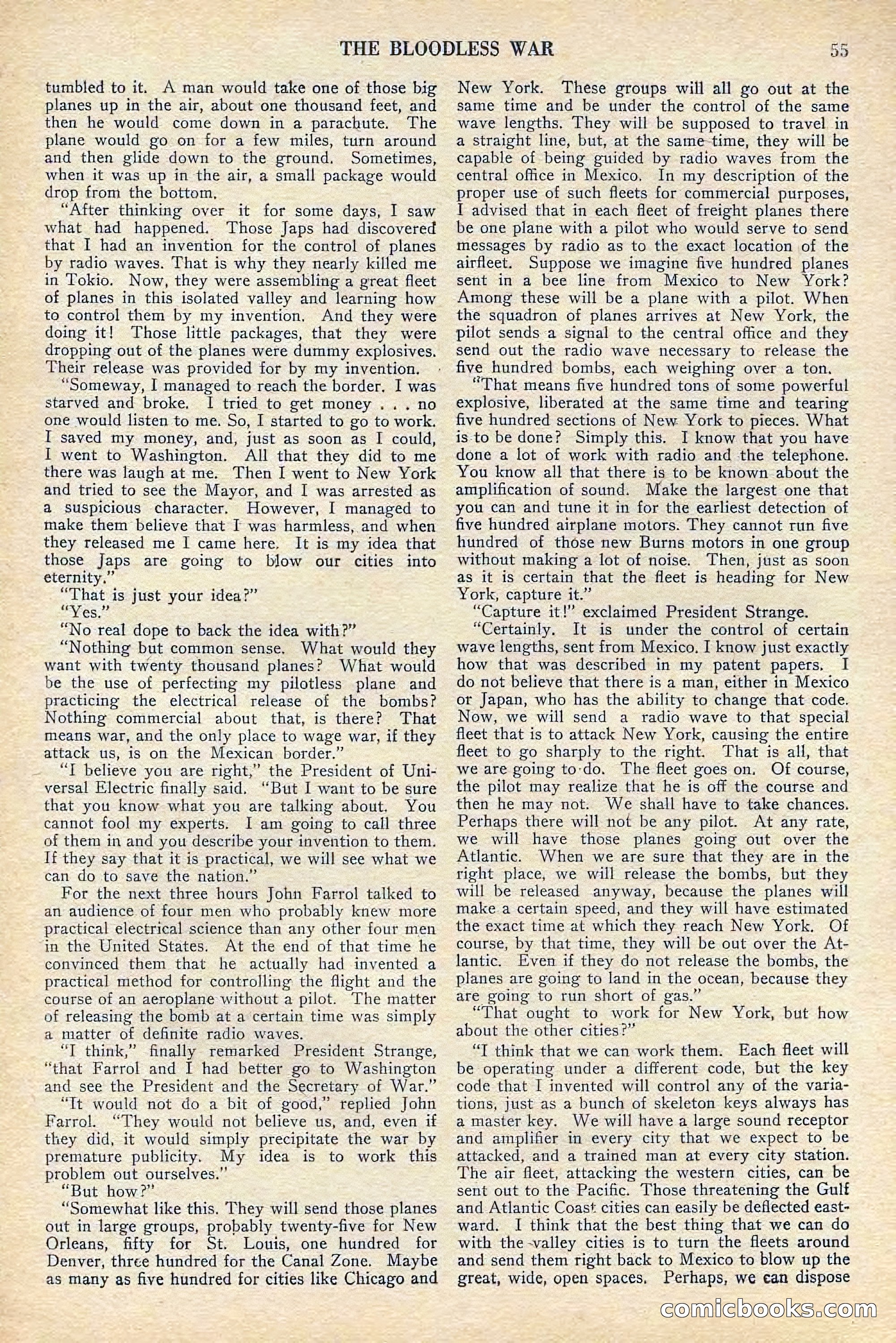
A restored page from Pulp Fiction, 1929. Page through the whole issue in the reader above.
📄 Transcribed text from this page (OCR, searchable)
Machine-transcribed from the original scan — historical spelling and the odd misread are preserved.
THE BLOODLESS WAR 55 tumbled to it. A man would take one of those big planes up in the air, about one thousand feet, and then he would come down in a parachute. The plane would go on for a few miles, turn around and then glide down to the ground. Sometimes, when it was up in the air, a small package would drop from the bottom, “After thinking over it for some days, I saw what had happened. Those Japs had discovered that I had an invention for the control of planes by radio waves. That is why they nearly killed me in Tokio. Now, they were assembling a great fleet of planes in this isolated valley and learning how to control them by my invention, And they were doing it! Those little packages, that they were dropping out of the planes were dummy explosives. Their release was provided for by my invention, “Someway, I managed to reach the border, I was starved and broke, I tried to get money ... no one would listen to me. So, I started to go to work. I saved my money, and, just as soon as I could, I went to Washington. All that they did to me there was laugh at me. Then I went to New York and tried to see the Mayor, and I was arrested as a suspicious character. However, I managed to make them believe that I was harmless, and when they released me I came here, It is my idea that those Japs ate going to blow our cities into eternity,” “That is just your idea?” Ves.” “No real dope to back the idea with?” “Nothing but common sense. What would they want with twenty thousand planes? What would be the use of perfecting my pilotless plane and practicing the electrical release of the bombs? Nothing commercial about that, is there? That means war, and the only place to wage war, if they attack us, is on the Mexican border.” “T believe you are right,” the President of Uni- versal Electric finally said. “But I want to be sure that you know what you are talking about, You cannot fool my experts. I am going to call three of them in and you describe your invention to them. If they say that it is practical, we will see what we can do to save the nation.” For the next three hours John Farrol talked to an audience of four men who probably knew more practical electrical science than any other four men in the United States. At the end of that time he convinced them that he actually had invented a practical method for controlling the flight and the course of an aeroplane without a pilot. The matter of releasing the bomb at a certain time was simply a matter of definite radio waves. “T think,” finally remarked President Strange, “that Farrol and I had better go to Washington and see the President and the Secretary of War.” “Tt would not do a bit of good,” replied John Farrol. “They would not believe us, and, even if they did, it would simply precipitate the war by premature publicity. My idea is to work this problem out ourselves.” “But how?” “Somewhat like this. They will send those planes out in large groups, probably twenty-five for New Orleans, fifty for St. Louis, one hundred for Denver, three hundred for the Canal Zone. Maybe as many as five hundred for cities like Chicago and New York. These groups will all go out at the same time and be under the control of the same wave lengths. They will be supposed to travel in a straight line, but, at the same-time, they will be capable of being guided by radio waves from the central office in Mexico, In my description of the proper use of such fleets for commercial purposes, T advised that in each fleet of freight planes there be one plane with a pilot who would serve to send messages by radio as to the exact location of the airfleet. Suppose we imagine five hundred planes sent in a bee line from Mexico to New York? Among these will be a plane with a pilot. When the squadron of planes arrives at New York, the pilot sends a signal to the central office and they send out the radio wave necessary to release the five hundred bombs, each weighing over a ton. “That means five hundred tons of some powerful explosive, liberated at the same time and tearing five hundred sections of New. York to pieces. What isto be done? Simply this. I know that you have done a lot of work with radio and the telephone. You know all that there is to be known about the amplification of sound. Make the largest one that you can and tune it in for the earliest detection of five hundred airplane motors. They cannot run five hundred of those new Burns motors in one group without making a lot of noise. Then, just as soon as it is certain that the fleet is heading for New York, capture it.” “Capture it!” exclaimed President Strange. “Certainly. It is under the control of certain wave lengths, sent from Mexico. I know just exactly how that was described in my patent papers, I do not believe that there is a man, either in Mexico ot Japan, who has the ability to change that code. Now, we will send a radio wave to that special fleet that is to attack New York, causing the entire fleet to go sharply to the right. That is all, that we are going to'do. The fleet goes on. Of course, the pilot may realize that he is off the course and then he may not. We shall have to take chances. Perhaps there will not be any pilot. At any rate, we will have those planes going out over the Atlantic. When we are sure that they are in the right place, we will release the bombs, but they will be released anyway, because the planes will make a certain speed, and they will have estimated the exact time at which they reach New York. Of course, by that time, they will be out over the At- lantic. Even if they do not release the bombs, the planes are going to land in the ocean, because they are going to run short of gas.” “That ought to work for New York, but how about the other cities?” “T think that we can work them. Each fleet will be operating under a different code, but the key code that I invented will control any of the varia- tions, just as a bunch of skeleton keys always has a master key. We will have a large sound receptor and amplifier in every city that we expect to be attacked, and a trained man at every city station. The air fleet, attacking the western cities, can be sent out to the Pacific. Those threatening the Gulf and Atlantic Coast cities can easily be deflected east- ward. I think that the best thing that we can do with the -valley cities is to turn the fleets around and send them right back to Mexico to blow up the great, wide, open spaces, Perhaps, we ean dispose comiclbooks.Com