
Pulp Fiction, 1929 · page 56 of 100
Air Wonder Stories, July 1929 — page 56: what you’re looking at
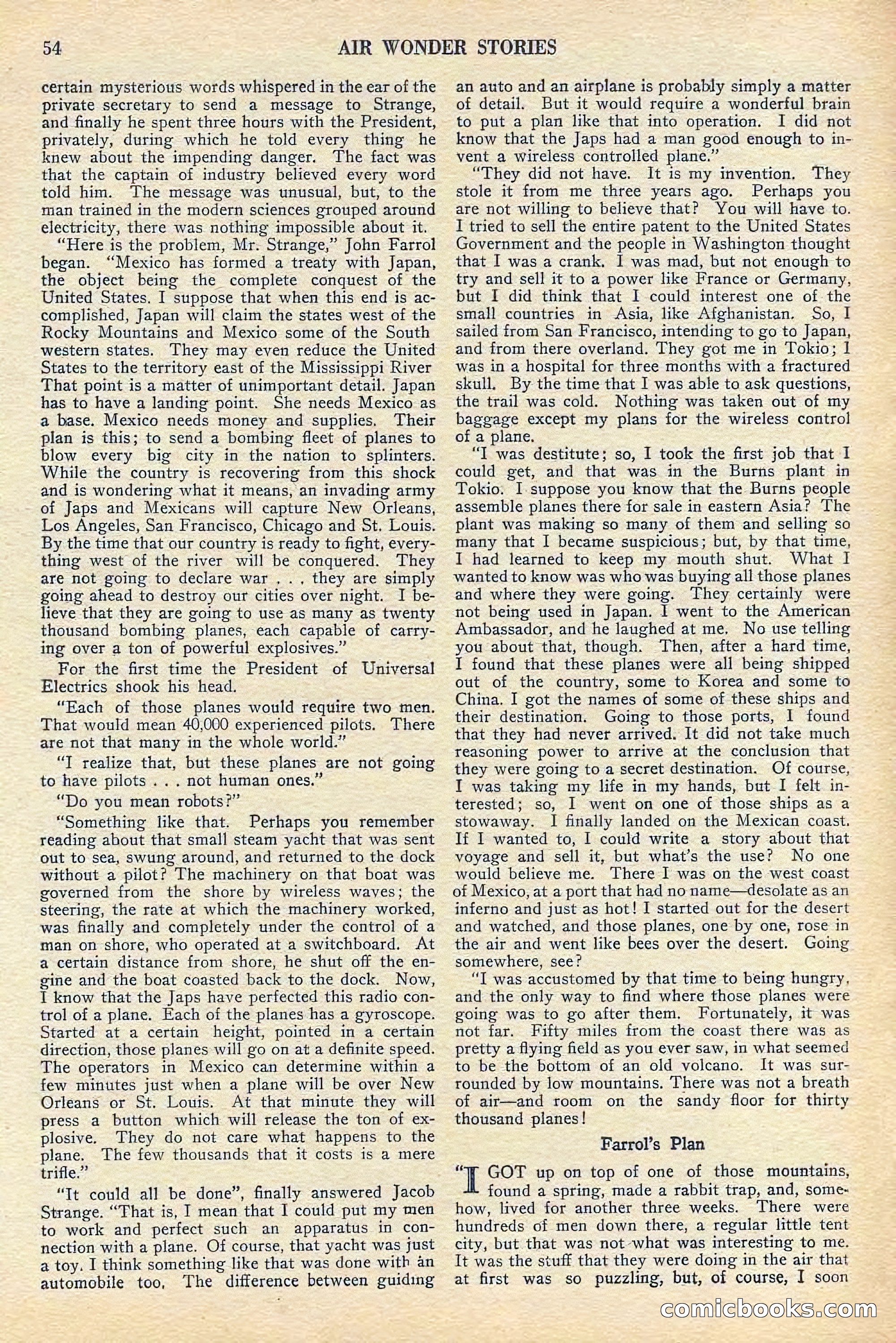
A restored page from Pulp Fiction, 1929. Page through the whole issue in the reader above.
📄 Transcribed text from this page (OCR, searchable)
Machine-transcribed from the original scan — historical spelling and the odd misread are preserved.
4, certain mysterious words whispered in the ear of the private secretary to send a message to Strange, and finally he spent three hours with the President, privately, during which he told every thing he knew about the impending danger. The fact was that the captain of industry believed every word told him. The message was unusual, but, to the man trained in the modern sciences grouped around electricity, there was nothing impossible about it. “Here is the problem, Mr. Strange,” John Farrol began. “Mexico has formed a treaty with Japan, the object being the complete conquest of the United States. I suppose that when this end is ac- complished, Japan will claim the states west of the Rocky Mountains and Mexico some of the South western states. They may even reduce the United States to the territory east of the Mississippi River That point is a matter of unimportant detail. Japan has to have a landing point. She needs Mexico as a base. Mexico needs money and supplies, Their plan is this; to send a bombing fleet of planes to blow every big city in the nation to splinters. While the country is recovering from this shock and is wondering what it means, an invading army of Japs and Mexicans will capture New Orleans, Los Angeles, San Francisco, Chicago and St, Louis. By the time that our country is ready to fight, every- thing west of the river will be conquered. They are not going to declare war , . , they are simply going ahead to destroy our cities over night. I be- lieve that they are going to use as many as twenty thousand bombing planes, each capable of carry- ing over a ton of poweriul explosives.” For the first time the President of Universal Electrics shook his head. “Each of those planes would require two men. That would mean 40,000 experienced pilots. There are not that many in the whole world.” “T realize that, but these planes are not going to have pilots . . . not human ones.” “Do you mean robots?” “Something like that. Perhaps you remember reading about that small steam yacht that was sent out to sea, swung around, and returned to the dock without a pilot? The machinery on that boat was governed from the shore by wireless waves; the steering, the rate at which the machinery worked, was fitially and completely under the control of a man on shore, who operated at a switchboard. At a certain distance from shore, he shut off the en- gine and the boat coasted back to the dock. Now, T know that the Japs have perfected this radio con- trol of a plane. Each of the planes has a gyroscope. Started at a cerfain height, pointed in a certain direction, those planes will go on at a definite speed. The operators in Mexico can determine within a few minutes just when a plane will be over New Orleans or St. Louis. At that minute they will press a button which will release the ton of ex- plosive. They do not care what happens to the plane. The few thousands that it costs is a mere trifle.” “Tt could all be done”, finally answered Jacob Strange. “That is, I mean that I could put my men to work and perfect such an apparatus in con- nection with a plane. Of course, that yacht was just a toy. I think something like that was done with an automobile too, The difference between guiding AIR WONDER STORIES an auto and an airplane is probably simply a matter of detail. But it would require a wonderful brain to put a plan like that into operation. I did not know that the Japs had a man good enough to in- vent a wireless controlled plane.” “They did not have. It is my invention. They stole it from me three years ago. Perhaps you are not willing to believe that? You will have to. I tried to sell the entire patent to the United States Government and the people in Washington thought that I was a crank, I was mad, but not enough to try and sell it to a power like France or Germany, but I did think that I could interest one of the small countries in Asia, like Afghanistan. So, I sailed from San Francisco, intending to go to Japan, and from there overland. They got me in Tokio; 1 was in a hospital for three months with a fractured skull. By the time that I was able to ask questions, the trail was cold. Nothing was taken out of my baggage except my plans for the wireless control of a plane. “T was destitute; so, I took the first job that I could get, and that was in the Burns plant in Tokio. I.suppose you know that the Burns people assemble planes there for sale in eastern Asia? The plant was making so many of them and selling so many that I became suspicious; but, by that time, I had learned to keep my mouth shut. What I wanted to know was who was buying all those planes and where they were going. They certainly were not being used in Japan. I went to the American Ambassador, and he laughed at me. No use telling you about that, though. Then, after a hard time, I found that these planes were all being shipped out of the country, some to Korea and some to China. I got the names of some of these ships and their destination. Going to those ports, I found that they had never arrived. It did not take much reasoning power to arrive at the conclusion that they were going to a secret destination. Of course, I was taking my life in my hands, but I felt in- terested; so, I went on one of those ships as a stowaway. I finally landed on the Mexican coast. If I wanted to, I could write a story about that voyage and sell it, but what’s the use? No one would believe me. There I was on the west coast of Mexico, at a port that had no name—desolate as an inferno and just as hot! I started out for the desert and watched, and those planes, one by one, rose in the air and went like bees over the desert. Going somewhere, see? “T was accustomed by that time to being hungry, and the only way to find where those planes were going was to go after them. Fortunately, it was not far. Fifty miles from the coast there was as pretty a flying field as you ever saw, in what seemed to be the bottom of an old volcano. It was sur- rounded by low mountains. There was not a breath of air—and room on the sandy floor for thirty thousand planes! ‘[ GOT up on top of one of those mountains, found a spring, made a rabbit trap, and, some- how, lived for another three weeks. There were hundreds of men down there, a regular little tent city, but that was not-what was interesting to me. It was the stuff that they were doing in the air that at first was so puzzling, but, of course, I soon Farrol’s Plan comnliclooolks.comn