
Pulp Fiction, 1929 · page 55 of 100
Air Wonder Stories, July 1929 — page 55: what you’re looking at
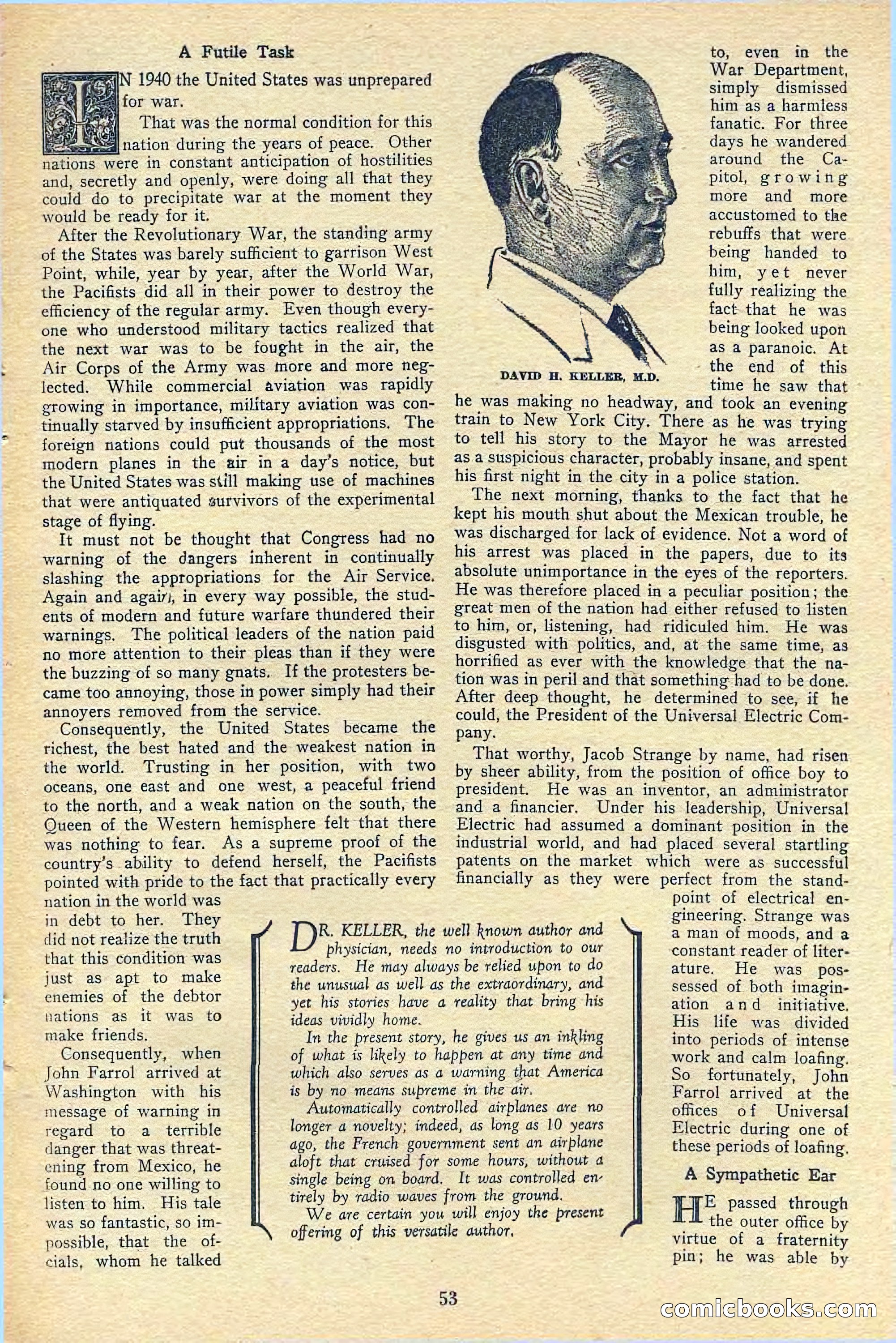
A restored page from Pulp Fiction, 1929. Page through the whole issue in the reader above.
📄 Transcribed text from this page (OCR, searchable)
Machine-transcribed from the original scan — historical spelling and the odd misread are preserved.
A Futile Task WN 1940 the United States was unprepared | for war. That was the normal condition for this ce nation during the years of peace. Other nations were in constant anticipation of hostilities and, secretly and openly, were doing all that they could do to precipitate war at the moment they would be ready for it. After the Revolutionary War, the standing army of the States was barely sufficient to garrison West Point, while, year by year, after the World War, the Pacifists did all in their power to destroy the efficiency of the regular army. Even though every- one who understood military tactics realized that the next war was to be fought in the air, the Air Corps of the Army was more and more neg- lected. While commercial aviation was rapidly growing in importance, military aviation was con- tinually starved by insufficient appropriations. The foreign nations could put thousands of the most modern planes in the air in a day’s notice, but the United States was still making use of machines that were antiquated survivors of the experimental stage of flying. It must not be thought that Congress had no warning of the dangers inherent in continually slashing the appropriations for the Air Service. Again and agairi, in every way possible, the stud- ents of modern and future warfare thundered their warnings. The political leaders of the nation paid no more attention to their pleas than if they were the buzzing of so many gnats. If the protesters be- came too annoying, those in power simply had their annoyers removed from the service. Consequently, the United States became the richest, the best hated and the weakest nation in the world. Trusting in her position, with two oceans, one east and one west, a peaceful friend to the north, and a weak nation on the south, the Queen of the Western hemisphere felt that there was nothing to fear. As a supreme proof of the country’s ability to defend herself, the Pacifists pointed with pride to the fact that practically every nation in the world was in debt to her. They did not realize the truth that this condition was just as apt to make enemies of the debtor nations as it was to make friends, Consequently, when John Farrol arrived at Washington with his message of warning in regard to a terrible danger that was threat- ening from Mexico, he found.no one willing to listen to him. His tale was so fantastic, so im- possible, that the of- cials, whom he talked ideas vividly home. D® KELLER, the well known author and physician, needs no introduction to our readers. He may always be relied upon to do the unusual as well as the extraordinary, and yet his stories have a reality that bring his In the present story, he gives us an inkling of what is likely to happen at any time and which also serves as a warning that America is by no means supreme in the air, Automatically controlled airplanes are no longer a novelty; indeed, as long as 10 years ago, the French government sent an airplane aloft that cruised for some hours, without a single being on board. It was controlled en- tirely by radio waves from the ground. We are certain you will enjoy the present offering of this versatile author, 53 to, even in the War Department, simply dismissed him as a harmless fanatic. For three days he wandered around the Ca- pitol growing more and more accustomed to the rebuffs that were being handed to him, yet never fully realizing the fact that he was being looked upon aS a paranoic. At - the end of this time he saw that he was making no headway, and took an evening train to New York City. There as he was trying to tell his story to the Mayor he was arrested as a suspicious character, probably insane, and spent his first night in the city in a police station. The next morning, thanks to the fact that he kept his mouth shut about the Mexican trouble, he was discharged for lack of evidence. Not a word of his arrest was placed in the papers, due to its absolute unimportance in the eyes of the reporters. He was therefore placed in a peculiar position; the great men of the nation had either refused to listen to him, or, listening, had ridiculed him. He was disgusted with politics, and, at the same time, as horrified as ever with the knowledge that the na- tion was in peril and that something had to be done. After deep thought, he determined to see, if he could, the President of the Universal Electric Com- pany. That worthy, Jacob Strange by name, had risen by sheer ability, from the position of office boy to president. He was an inventor, an administrator and a financier. Under his leadership, Universal Electric had assumed a dominant position in the industrial world, and had placed several startling patents on the market which were as successful financially as they were perfect from the stand- point of electrical en- gineering. Strange was a man of moods, and a constant reader of liter- ature. He was pos- sessed of both imagin- ation and _ initiative, His life was divided into periods of intense work and calm loafing. So fortunately, John Farrol arrived at the ofices of Universal Electric during one of these periods of loafing, A Sympathetic Ear HE passed through the outer office by virtue of a fraternity pin; he was able by comnliclooolks.com