
Pulp Fiction, 1956 · page 65 of 162
Authentic Science Fiction Monthly No. 72 — page 65: what you’re looking at
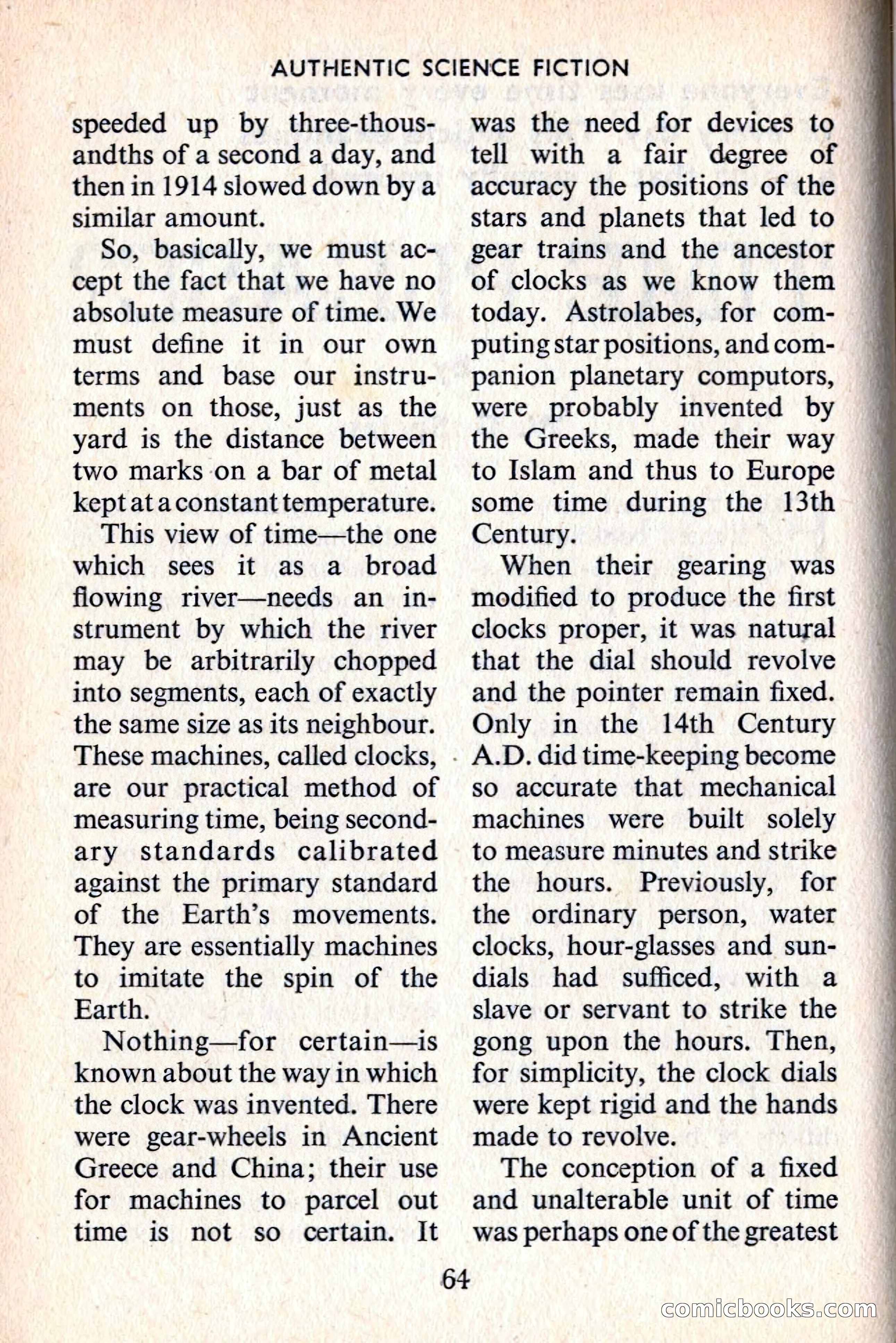
A restored page from Pulp Fiction, 1956. Page through the whole issue in the reader above.
📄 Transcribed text from this page (OCR, searchable)
Machine-transcribed from the original scan — historical spelling and the odd misread are preserved.
AUTHENTIC SCIENCE FICTION speeded up by three-thous- andths of a second a day, and then in 1914 slowed down by a similar amount. So, basically, we must ac- cept the fact that we have no absolute measure of time. We must define it in our own terms and base our instru- ments on those, just as the yard is the distance between two marks on a bar of metal kept at aconstant temperature. This view of time—the one which sees it as a_ broad flowing river—needs an in- strument by which the river may be arbitrarily chopped into segments, each of exactly the same size as its neighbour. These machines, called clocks, are our practical method of measuring time, being second- ary standards calibrated against the primary standard of the Earth’s movements. They are essentially machines to imitate the spin of the Earth. Nothing—for certain—is known about the way in which the clock was invented. There were gear-wheels in Ancient Greece and China; their use for machines to parcel out time is not so certain. It was the need for devices to tell with a fair degree of accuracy the positions of the stars and planets that led to gear trains and the ancestor of clocks as we know them today. Astrolabes, for com- puting star positions, and com- panion planetary computors, were probably invented by the Greeks, made their way to Islam and thus to Europe some time during the 13th Century. | When their gearing was modified to produce the first clocks proper, it was natural that the dial should revolve and the pointer remain fixed. Only in the 14th Century . A.D. did time-keeping become 64 so accurate that mechanical machines were built solely to measure minutes and strike the hours. Previously, for the ordinary person, water clocks, hour-glasses and sun- dials had sufficed, with a slave or servant to strike the gong upon the hours. Then, for simplicity, the clock dials were kept rigid and the hands made to revolve. The conception of a fixed and unalterable unit of time was perhaps one of the greatest | COmMICHOOKS.COM