
Pulp Fiction, 1956 · page 64 of 162
Authentic Science Fiction Monthly No. 72 — page 64: what you’re looking at
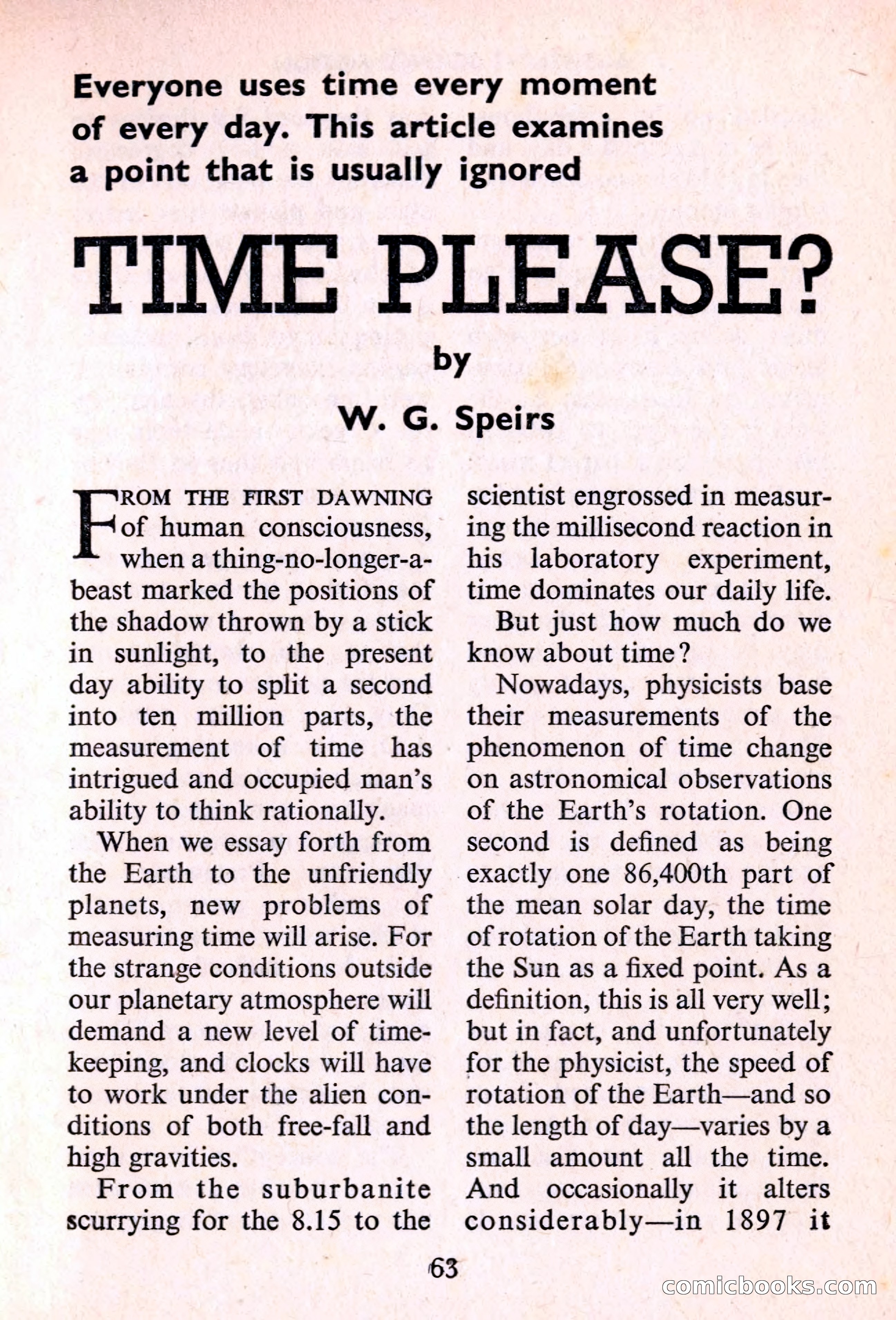
A restored page from Pulp Fiction, 1956. Page through the whole issue in the reader above.
📄 Transcribed text from this page (OCR, searchable)
Machine-transcribed from the original scan — historical spelling and the odd misread are preserved.
Everyone uses time every moment of every day. This article examines a point that is usually ignored TIME PLEASE? W. G. Speirs ROM THE FIRST DAWNING ) Be human consciousness, when a thing-no-longer-a- beast marked the positions of the shadow thrown by a stick in sunlight, to the present day ability to split a second into ten million parts, the measurement of time has intrigued and occupied man’s ability to think rationally. When we essay forth from the Earth to the unfriendly planets, new problems of measuring time will arise. For the strange conditions outside our planetary atmosphere will demand a new level of time- keeping, and clocks will have to work under the alien con- ditions of both free-fall and high gravities. From the suburbanite scurrying for the 8.15 to the 63 scientist engrossed in measur- ing the millisecond reaction in his laboratory experiment, time dominates our daily life. But just how much do we know about time? Nowadays, physicists base their measurements of the phenomenon of time change on astronomical observations of the Earth’s rotation. One second is defined as being exactly one 86,400th part of the mean solar day, the time of rotation of the Earth taking the Sun as a fixed point. As a definition, this is all very well; but in fact, and unfortunately for the physicist, the speed of rotation of the Earth—and so the length of day—varies by a small amount all the time. And occasionally it alters considerably—in 1897 it connicloooks.com