
Pulp Fiction, 1956 · page 66 of 162
Authentic Science Fiction Monthly No. 72 — page 66: what you’re looking at
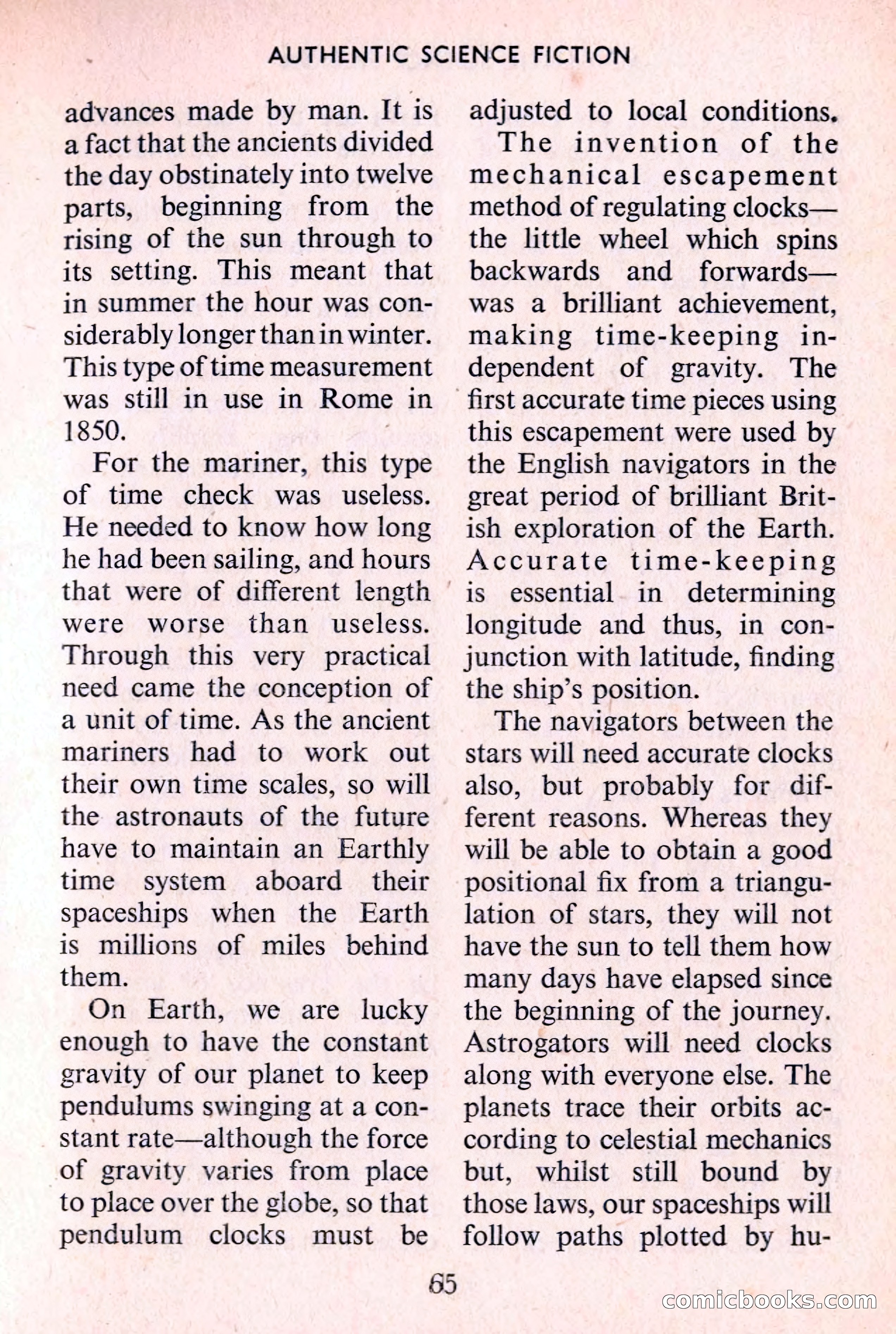
A restored page from Pulp Fiction, 1956. Page through the whole issue in the reader above.
📄 Transcribed text from this page (OCR, searchable)
Machine-transcribed from the original scan — historical spelling and the odd misread are preserved.
AUTHENTIC SCIENCE FICTION advances made by man. It is a fact that the ancients divided the day obstinately into twelve parts, beginning from the rising of the sun through to its setting. This meant that in summer the hour was con- siderably longer than in winter. This type of time measurement was still in use in Rome in 1850. / For the mariner, this type of time check was _ useless. He needed to know how long he had been sailing, and hours that were of different length were worse than _ useless. Through this very practical need came the conception of a unit of time. As the ancient mariners had to work out their own time scales, so will the astronauts of the future have to maintain an Earthly time system aboard their spaceships when the Earth is millions of miles behind them. On Earth, we are lucky enough to have the constant gravity of our planet to keep pendulums swinging at a con- stant rate—although the force of gravity varies from place to place over the globe, so that pendulum clocks must be 65 adjusted to local conditions, The invention of the mechanical escapement method of regulating clocks— the little wheel which spins backwards and forwards— was a brilliant achievement, making time-keeping in- dependent of gravity. The first accurate time pieces using this escapement were used by the English navigators in the great period of brilliant Brit- ish exploration of the Earth. Accurate time-keeping is essential in determining longitude and thus, in con- junction with latitude, finding the ship’s position. The navigators between the stars will need accurate clocks also, but probably for dif- ferent reasons. Whereas they will be able to obtain a good positional fix from a triangu- lation of stars, they will not have the sun to tell them how many days have elapsed since the beginning of the journey. Astrogators will need clocks along with everyone else. The planets trace their orbits ac- cording to celestial mechanics but, whilst still bound by those laws, our spaceships will follow paths plotted by hu- comicloooks.cormn