
Pulp Fiction, 1956 · page 117 of 162
Authentic Science Fiction Monthly, No. 66 — page 117: what you’re looking at
A restored page from Pulp Fiction, 1956. Page through the whole issue in the reader above.
📄 Transcribed text from this page (OCR, searchable)
Machine-transcribed from the original scan — historical spelling and the odd misread are preserved.
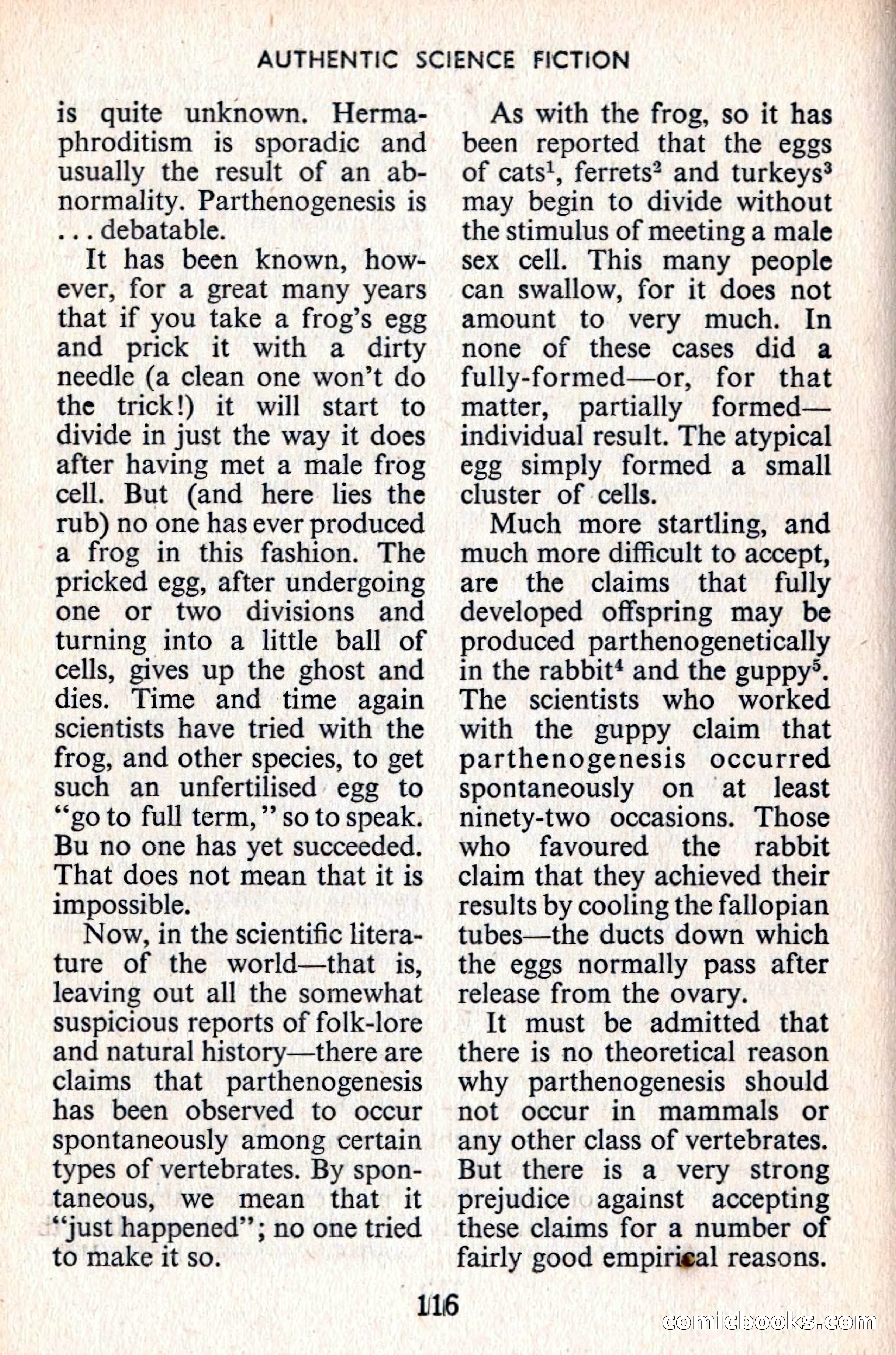
AUTHENTIC SCIENCE FICTION is quite unknown. Herma- phroditism is sporadic and usually the result of an ab- normality. Parthenogenesis is ... debatable. It has been known, how- ever, for a great many years that if you take a frog’s egg and prick it with a dirty needle (a clean one won’t do the trick!) it will start to divide in just the way it does after having met a male frog cell. But (and here lies the rub) no one has ever produced a frog in this fashion. The pricked egg, after undergoing one or two divisions and turning into a little ball of cells, gives up the ghost and dies. Time and time again scientists have tried with the frog, and other species, to get such an unfertilised egg to **go to full term, ’’ so to speak. Bu no one has yet succeeded. That does not mean that it is impossible. Now, in the scientific litera- ture of the world—that is, leaving out all the somewhat suspicious reports of folk-lore and natural history—there are claims that parthenogenesis has been observed to occur spontaneously among certain types of vertebrates. By spon- taneous, we mean that it “just happened’’; no one tried to make it so. 116 As with the frog, so it has been reported that the eggs of cats, ferrets? and turkeys may begin to divide without the stimulus of meeting a male sex cell. This many people can swallow, for it does not amount to very much. In none of these cases did a fully-formed—or, for that matter, partially formed— individual result. The atypical ege simply formed a small cluster of cells. Much more startling, and much more difficult to accept, are the claims that fully developed offspring may be produced parthenogenetically in the rabbit* and the guppy’. The scientists who worked with the guppy claim that parthenogenesis occurred spontaneously on at least ninety-two occasions. Those who favoured the rabbit claim that they achieved their results by cooling the fallopian tubes—the ducts down which the eggs normally pass after release from the ovary. It must be admitted that there is no theoretical reason why parthenogenesis should not occur in mammals or any other class of vertebrates. But there is a very strong prejudice against accepting these claims for a number of fairly good empirigal reasons. comicloooks.corn