
Pulp Fiction, 1956 · page 118 of 162
Authentic Science Fiction Monthly, No. 66 — page 118: what you’re looking at
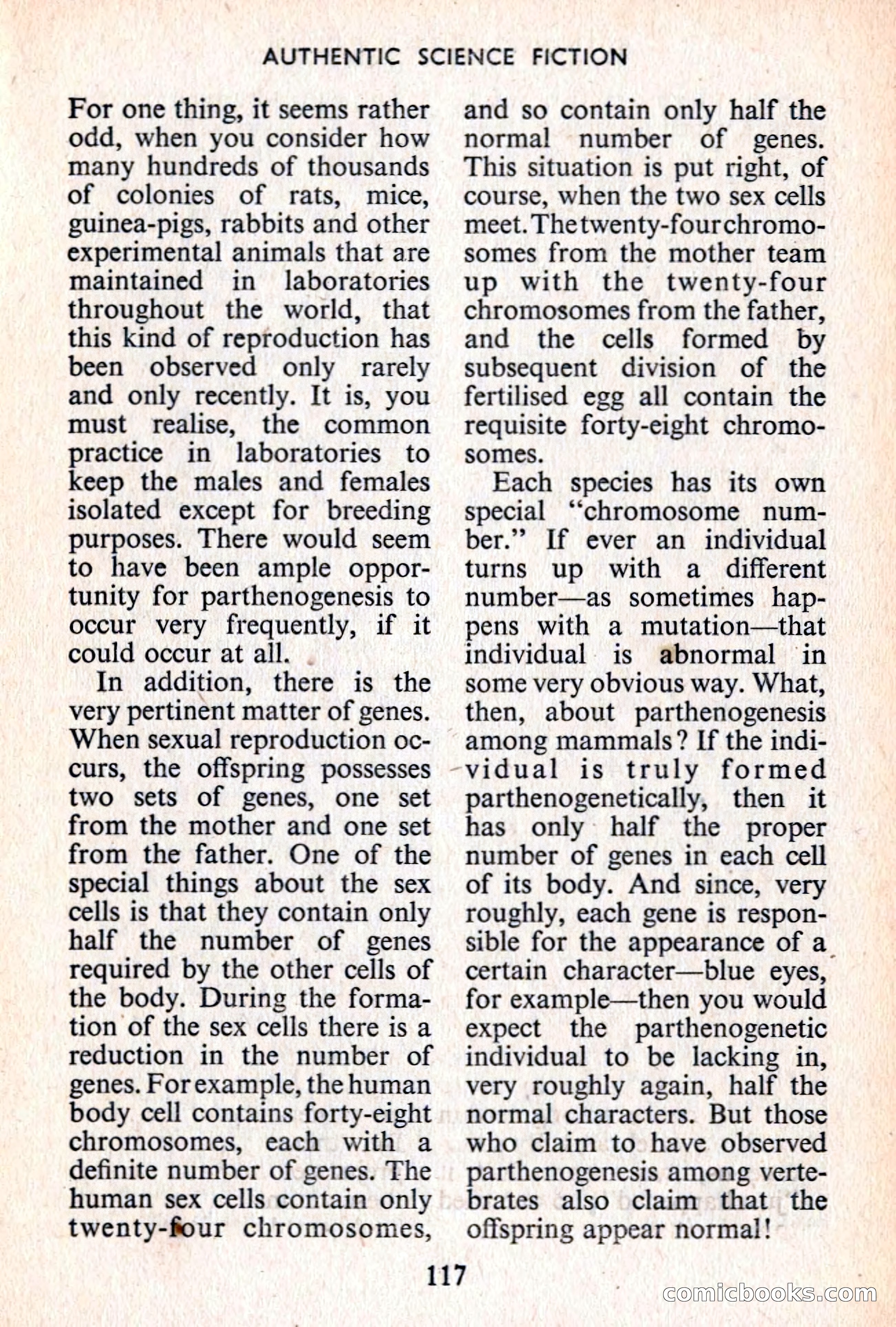
A restored page from Pulp Fiction, 1956. Page through the whole issue in the reader above.
📄 Transcribed text from this page (OCR, searchable)
Machine-transcribed from the original scan — historical spelling and the odd misread are preserved.
AUTHENTIC SCIENCE FICTION For one thing, it seems rather odd, when you consider how many hundreds of thousands of colonies of rats, mice, guinea-pigs, rabbits and other experimental animals that are maintained in laboratories throughout the world, that this kind of reproduction has been observed only rarely and only recently. It is, you must realise, the common practice in laboratories to keep the males and females isolated except for breeding purposes. There would seem to have been ample oppor- tunity for parthenogenesis to occur very frequently, if it could occur at all. . In addition, there is the very pertinent matter of genes. When sexual reproduction oc- curs, the offspring possesses two sets of genes, one set from the mother and one set from the father. One of the special things about the sex cells is that they contain only half the number of genes required by the other cells of the body. During the forma- tion of the sex cells there is a reduction in the number of genes. Forexample, the human body cell contains forty-eight chromosomes, each with a definite number of genes. The human sex cells contain only twenty-four chromosomes, 117 and so contain only half the normal number of genes. This situation is put right, of course, when the two sex cells meet. Thetwenty-fourchromo- somes from the mother team up with the twenty-four chromosomes from the father, and the cells formed by subsequent division of the fertilised egg all contain the requisite forty-eight chromo- somes. Each species has its own special “‘chromosome num- ber.” If ever an individual turns up with a different number—as sometimes hap- pens with a mutation—that individual. is abnormal in some very obvious way. What, then, about parthenogenesis among mammals? If the indi- ‘vidual is truly formed parthenogenetically, then it has only half the proper number of genes in each cell of its body. And since, very roughly, each gene is respon- sible for the appearance of a_ certain character—blue eyes, for example—then you would expect the parthenogenetic individual to be lacking in, very roughly again, half the normal characters. But those who claim to have observed parthenogenesis among verte- brates also claim that the offspring appear normal! comicloooks.conm