
Pulp Fiction, 1956 · page 116 of 162
Authentic Science Fiction Monthly, No. 66 — page 116: what you’re looking at
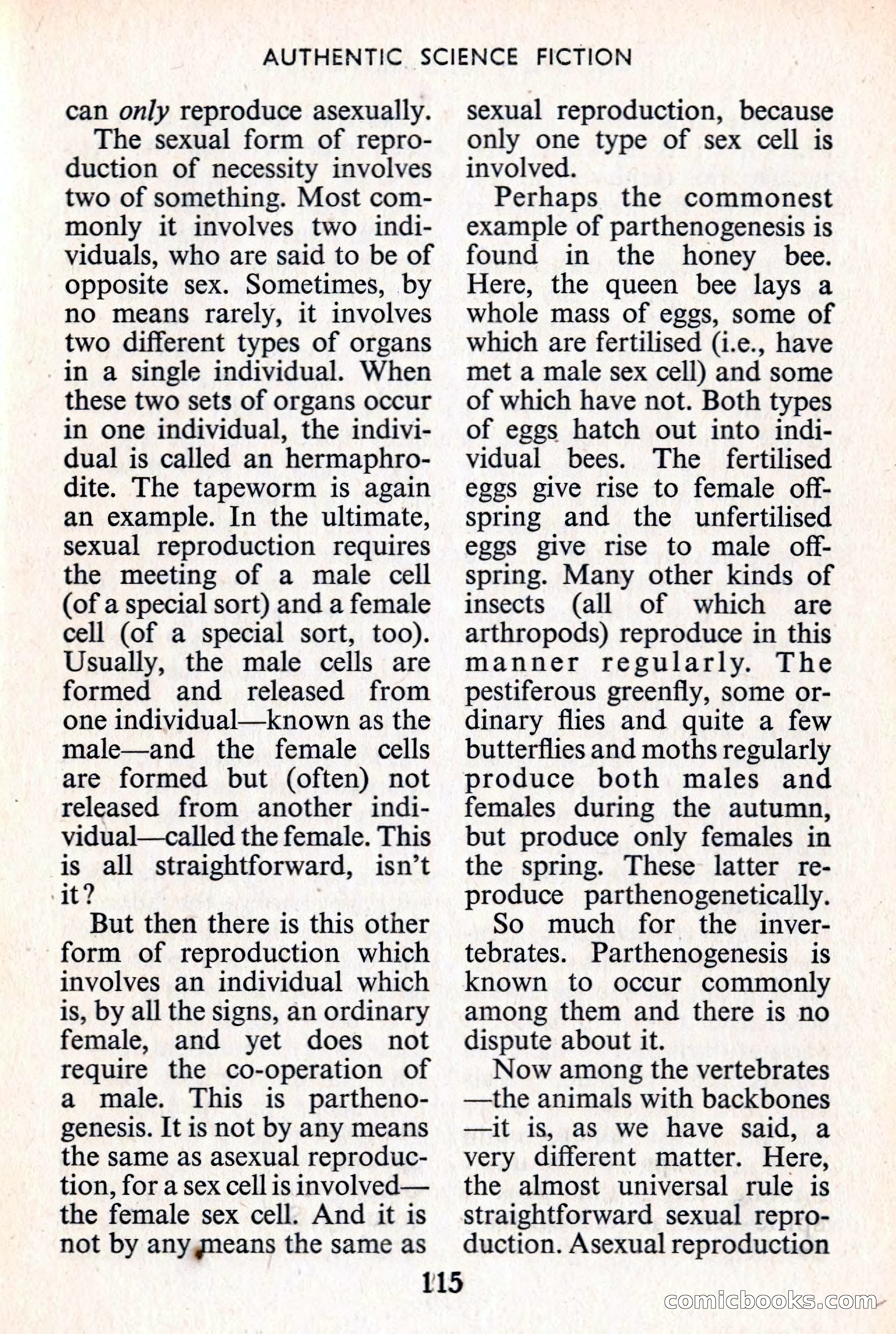
A restored page from Pulp Fiction, 1956. Page through the whole issue in the reader above.
📄 Transcribed text from this page (OCR, searchable)
Machine-transcribed from the original scan — historical spelling and the odd misread are preserved.
AUTHENTIC SCIENCE FICTION can only reproduce asexually. The sexual form of repro- duction of necessity involves two of something. Most com- monly it involves two indi- viduals, who are said to be of opposite sex. Sometimes, by no means rarely, it involves two different types of organs in a single individual. When these two sets of organs occur in one individual, the indivi- dual is called an hermaphro- dite. The tapeworm is again an example. In the ultimate, sexual reproduction requires the meeting of a male cell (of a special sort) and a female cell (of a special sort, too). Usually, the male cells are formed and released from one individual—known as the male—and the female cells are formed but (often) not released from another indi- vidual—called the female. This is all straightforward, isn’t it? But then there is this other form of reproduction which involves an individual which is, by all the signs, an ordinary female, and yet does not require the co-operation of a male. This is partheno- genesis. It is not by any means the same as asexual reproduc- tion, for a sex cell is involved— the female sex cell. And it is not by anyygmeans the same as sexual reproduction, because only one type of sex cell is involved. Perhaps the commonest example of parthenogenesis is found in the honey bee. Here, the queen bee lays a whole mass of eggs, some of which are fertilised (i.e., have met a male sex cell) and some of which have not. Both types of eggs hatch out into indi- vidual bees. The fertilised eggs give rise to female off- spring and the unfertilised eggs give rise to male off- spring. Many other kinds of insects (all of which are arthropods) reproduce in this manner regularly. The pestiferous greenfly, some or- dinary flies and quite a few butterflies and moths regularly produce both males and females during the autumn, but produce only females in the spring. These latter re- produce parthenogenetically. So much for the inver- tebrates. Parthenogenesis is known to occur commonly among them and there is no dispute about it. Now among the vertebrates —the animals with backbones —it is, as we have said, a very different matter. Here, the almost universal rule is straightforward sexual repro- duction. Asexual reproduction 115 comiclbooks.com-