
Pulp Fiction, 1956 · page 115 of 162
Authentic Science Fiction Monthly, No. 66 — page 115: what you’re looking at
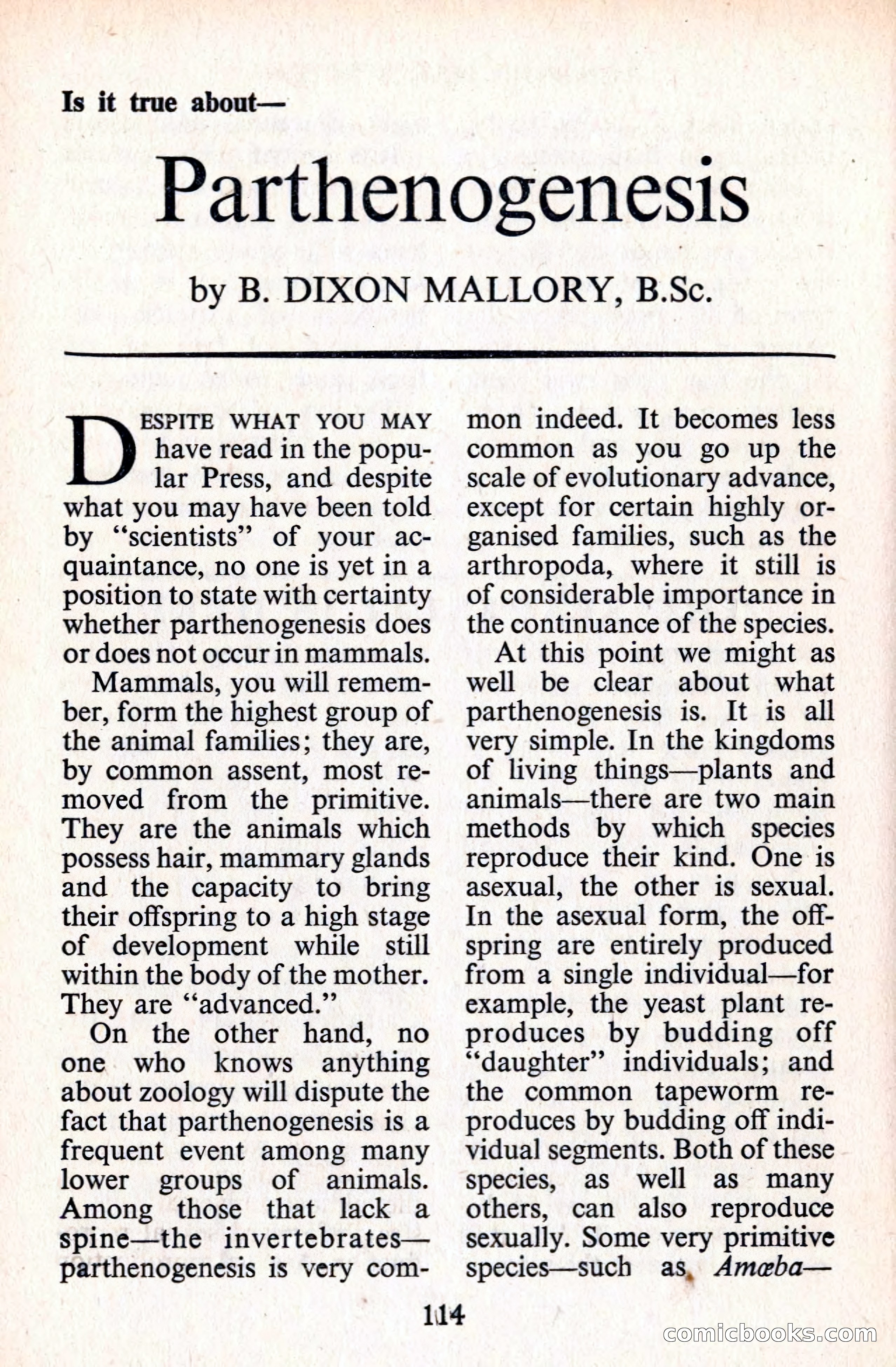
A restored page from Pulp Fiction, 1956. Page through the whole issue in the reader above.
📄 Transcribed text from this page (OCR, searchable)
Machine-transcribed from the original scan — historical spelling and the odd misread are preserved.
Is it true about— Parthenogenesis by B. DIXON MALLORY, B.Sc. ESPITE WHAT YOU MAY 1) have read in the popu- lar Press, and despite what you may have been told by “scientists” of your ac- quaintance, no one is yet ina position to state with certainty whether parthenogenesis does or does not occur in mammals. Mammals, you will remem- ber, form the highest group of the animal families; they are, by common assent, most re- moved from the primitive. They are the animals which possess hair, mammary glands and the capacity to bring their offspring to a high stage of development while still within the body of the mother. They are “advanced.” On the other hand, no one who knows anything about zoology will dispute the fact that parthenogenesis is a frequent event among many lower groups of animals. Among those that lack a spine—the invertebrates— parthenogenesis is very com- mon indeed. It becomes less common as you go up the scale of evolutionary advance, except for certain highly or- ganised families, such as the arthropoda, where it still is of considerable importance in the continuance of the species. At this point we might as well be clear about what parthenogenesis is. It is all very simple. In the kingdoms of living things—plants and animals—there are two main methods by which species reproduce their kind. One is asexual, the other is sexual. In the asexual form, the off- spring are entirely produced from a single individual—for example, the yeast plant re- produces by budding off ‘daughter’ individuals; and the common tapeworm re- produces by budding off indi- vidual segments. Both of these species, as well as many others, can also reproduce sexually. Some very primitive species—such as, Ameba— 114 comiclooks.cormn