
Pulp Fiction, 1956 · page 5 of 162
Authentic Science Fiction Monthly, No. 65 — page 5: what you’re looking at
A restored page from Pulp Fiction, 1956. Page through the whole issue in the reader above.
📄 Transcribed text from this page (OCR, searchable)
Machine-transcribed from the original scan — historical spelling and the odd misread are preserved.
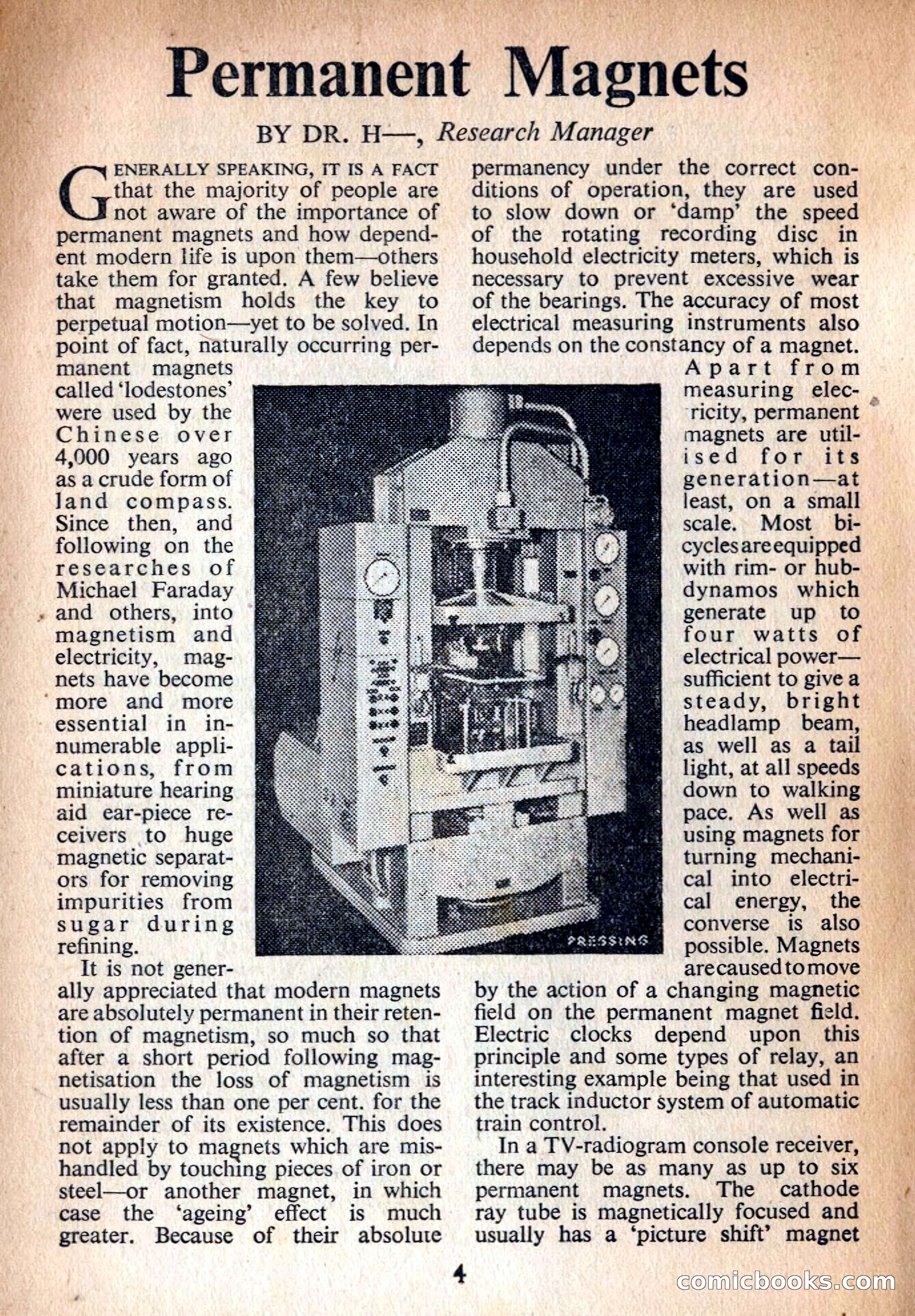
that the majority of people are not aware of the importance of permanent magnets and how depend- ent modern life is upon them—others take them for granted. A few believe that magnetism holds the key to perpetual motion—yet to be solved. In point of fact, naturally occurring per- manent magnets called ‘lodestones’ were used by the Chinese over 4,000 years ago as a crude form of land compass. Since then, and following on the researches of Michael Faraday » and others, into magnetism and electricity, mag- nets have become “more and more essential in in- numerable appli- cations, from miniature hearing aid ear-piece re- ceivers to huge magnetic separat- ors for removing impurities from sugar during refining. It is not gener- ally appreciated that modern magnets are absolutely permanent in their reten- tion of magnetism, so much so that after a short period following mag- netisation the loss of magnetism is usually less than one per cent. for the remainder of its existence. This does not apply to magnets which are mis- handled by touching pieces of iron or steel—or another magnet, in which case the ‘ageing’ effect is much greater. Because of their absolute Cy te: SPEAKING, IT IS A FACT Pepe Mt eck es EAE Se NSA 2 Peniancit Mathers BY DR. H—, Research Manager permanency under the correct con- ditions of operation, they are used to slow down or ‘damp’ the speed of the rotating recording disc in household electricity meters, which is necessary to prevent excessive wear of the bearings. The accuracy of most electrical measuring instruments also depends on the constancy of a magnet. Apart from magnets are util- ised for its generation—at least, on a small scale. Most bi- cycles areequipped with rim- or hub- dynamos_ which generate up to four watts of electrical power— sufficient to give a steady, bright headlamp beam, as well as a tail light, at all speeds down to walking pace. As well as using magnets for turning mechani- cal into electri- cal energy, the converse is also possible. Magnets arecaused tomove by the action of a changing magnetic field on the permanent magnet field. Electric clocks depend upon this principle and some types of relay, an © interesting example being that used in the track inductor system of automatic train control. In a TV-radiogram console receiver, there may be as many as up to six permanent magnets. The cathode ray tube is magnetically focused and usually has a ‘picture shift’ magnet commicloooks: com ; at measuring elec- . ‘icity, permanent — en oe? ee Se ek? - . WS 10) | Pun ee . ib iy: we A} . ‘ igen ~ Phe ks A ny ¢