
Pulp Fiction, 1956 · page 4 of 162
Authentic Science Fiction Monthly, No. 65 — page 4: what you’re looking at
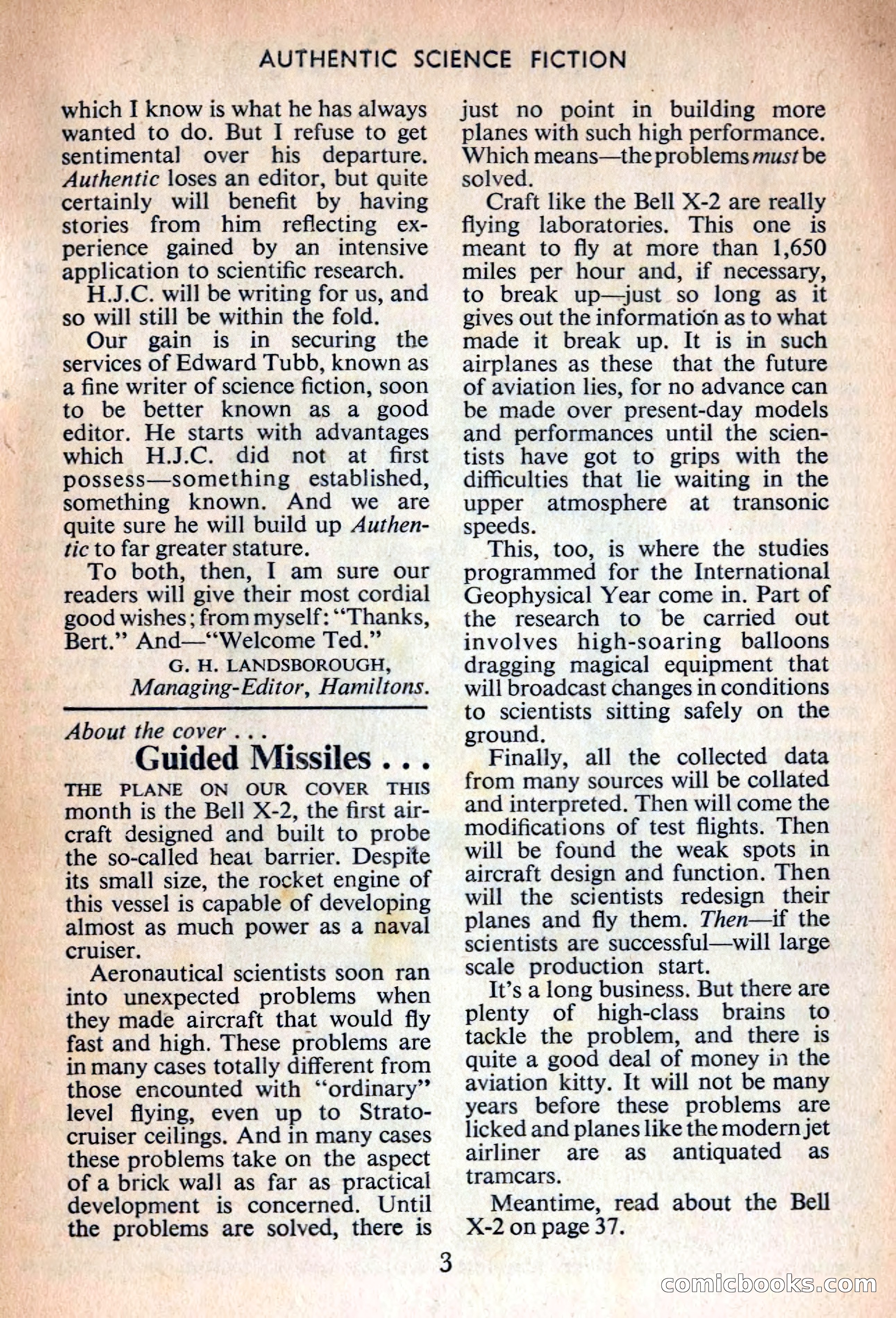
A restored page from Pulp Fiction, 1956. Page through the whole issue in the reader above.
📄 Transcribed text from this page (OCR, searchable)
Machine-transcribed from the original scan — historical spelling and the odd misread are preserved.
ay AUTHENTIC SCIENCE FICTION which I know is what he has always wanted to do. But I refuse to get sentimental over his departure. Authentic loses an editor, but quite certainly will benefit by having stories from him reflecting ex- perience gained by an intensive application to scientific research. H.J.C. will be writing for us, and so will still be within the fold. Our gain is in securing the services of Edward Tubb, known as a fine writer of science fiction, soon to be better known as a good editor. He starts with advantages which H.J.C. did not at first possess—something established, something known. And we are quite sure he will build up Authen- tic to far greater stature. To both, then, I am sure our readers will give their most cordial good wishes; from myself: ““Thanks, Bert.”? And—‘‘Welcome Ted.” G. H. LANDSBOROUGH, Managing-Editor, Hamiltons. About the cover... Guided Missiles... THE PLANE ON OUR COVER THIS month is the Bell X-2, the first air- craft designed and built to probe the so-called heat barrier. Despite its small size, the rocket engine of this vessel is capable of developing almost as much power as a naval cruiser. Aeronautical scientists soon ran into unexpected problems when they made aircraft that would fly fast and high. These problems are ’ jnmany cases totally different from those encounted with “ordinary” level flying, even up to Strato- cruiser ceilings, And in many cases these problems take on the aspect of a brick wall as far as practical development is concerned. Until the problems are solved, there is just no point in building more planes with such high performance. Which means—the problems must be solved. Craft like the Bell X-2 are really flying laboratories. This one is meant to fly at more than 1,650 miles per hour and, if necessary, to break up—just so long as it gives out the information as to what made it break up. It is in such airplanes as these that the future of aviation lies, for no advance can be made over present-day models and performances until the scien- tists have got to grips with the difficulties that lie waiting in the upper atmosphere at transonic speeds. This, too, is where the studies programmed for the International Geophysical Year come in. Part of the research to be carried out involves high-soaring balloons dragging magical equipment that will broadcast changes in conditions to scientists sitting safely on the ground. Finally, all the collected data from many sources will be collated and interpreted. Then will come the modifications of test flights. Then will be found the weak spots in aircraft design and function. Then will the scientists redesign their planes and fly them. Then—if the scientists are successful—will large scale production start. It’s a long business. But there are plenty of high-class brains to tackle the problem, and there is quite a good deal of money in the aviation kitty. It will not be many years before these problems are licked and planes like the modern jet airliner are as amtiquated as tramcars. Meantime, read about the Bell X-2 on page 37. comicloooks.comnn