
Pulp Fiction, 1956 · page 37 of 162
Authentic Science Fiction Monthly, No. 65 — page 37: what you’re looking at
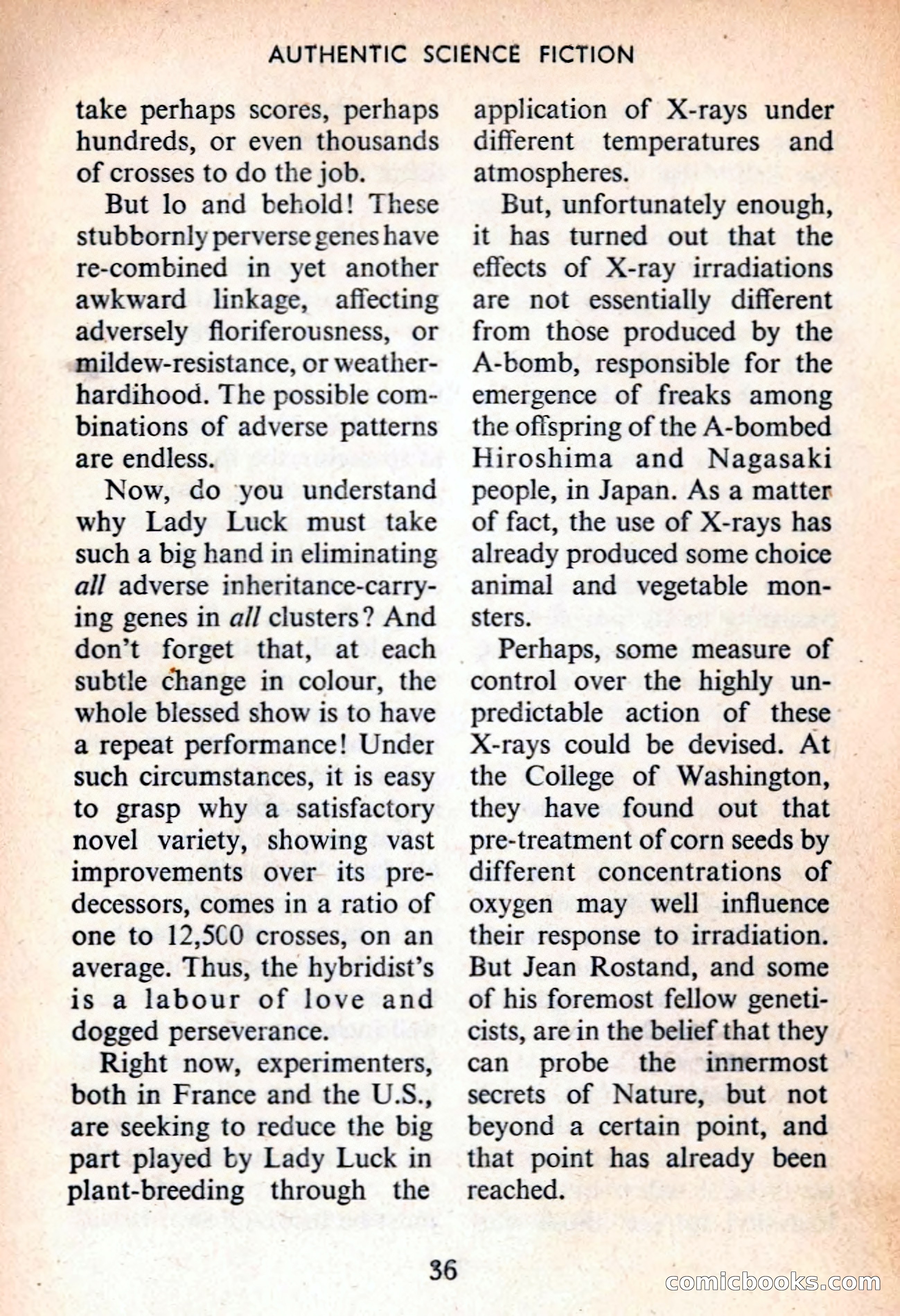
A restored page from Pulp Fiction, 1956. Page through the whole issue in the reader above.
📄 Transcribed text from this page (OCR, searchable)
Machine-transcribed from the original scan — historical spelling and the odd misread are preserved.
AUTHENTIC SCIENCE FICTION take perhaps scores, perhaps hundreds, or even thousands of crosses to do the job. But lo and behold! These stubbornly perverse genes have re-combined in yet another awkward linkage, affecting adversely floriferousness, or mildew-resistance, or weather- hardihood. The possible com- binations of adverse patterns are endless. Now, do you understand why Lady Luck must take such a big hand in eliminating all adverse inheritance-carry- ing genes in a// clusters? And don’t forget that, at each subtle change in colour, the whole blessed show is to have a repeat performance! Under such circumstances, it is easy to grasp why a satisfactory novel variety, showing vast improvements over its pre- decessors, comes in a ratio of one to 12,5C0 crosses, on an average. Thus, the hybridist’s is a labour of love and dogged perseverance. Right now, experimenters, both in France and the U.S., are seeking to reduce the big part played by Lady Luck in plant-breeding through the 36 application of X-rays under different temperatures and atmospheres. But, unfortunately enough, it has turned out that the effects of X-ray irradiations are not essentially different from those produced by the A-bomb, responsible for the emergence of freaks among the offspring of the A-bombed Hiroshima and Nagasaki people, in Japan. As a matter of fact, the use of X-rays has already produced some choice animal and vegetable mon- Ssters. Perhaps, some measure of control over the highly un- predictable action of these X-rays could be devised. At the Coilege of Washington, they have found out that pre-treatment of corn seeds by different concentrations of oxygen may well influence their response to irradiation. But Jean Rostand, and some of his foremost fellow geneti- cists, are in the belief that they can probe the innermost secrets of Nature, but not beyond a certain point, and that point has already been reached. conmicloooks.comnn