
Pulp Fiction, 1956 · page 36 of 162
Authentic Science Fiction Monthly, No. 65 — page 36: what you’re looking at
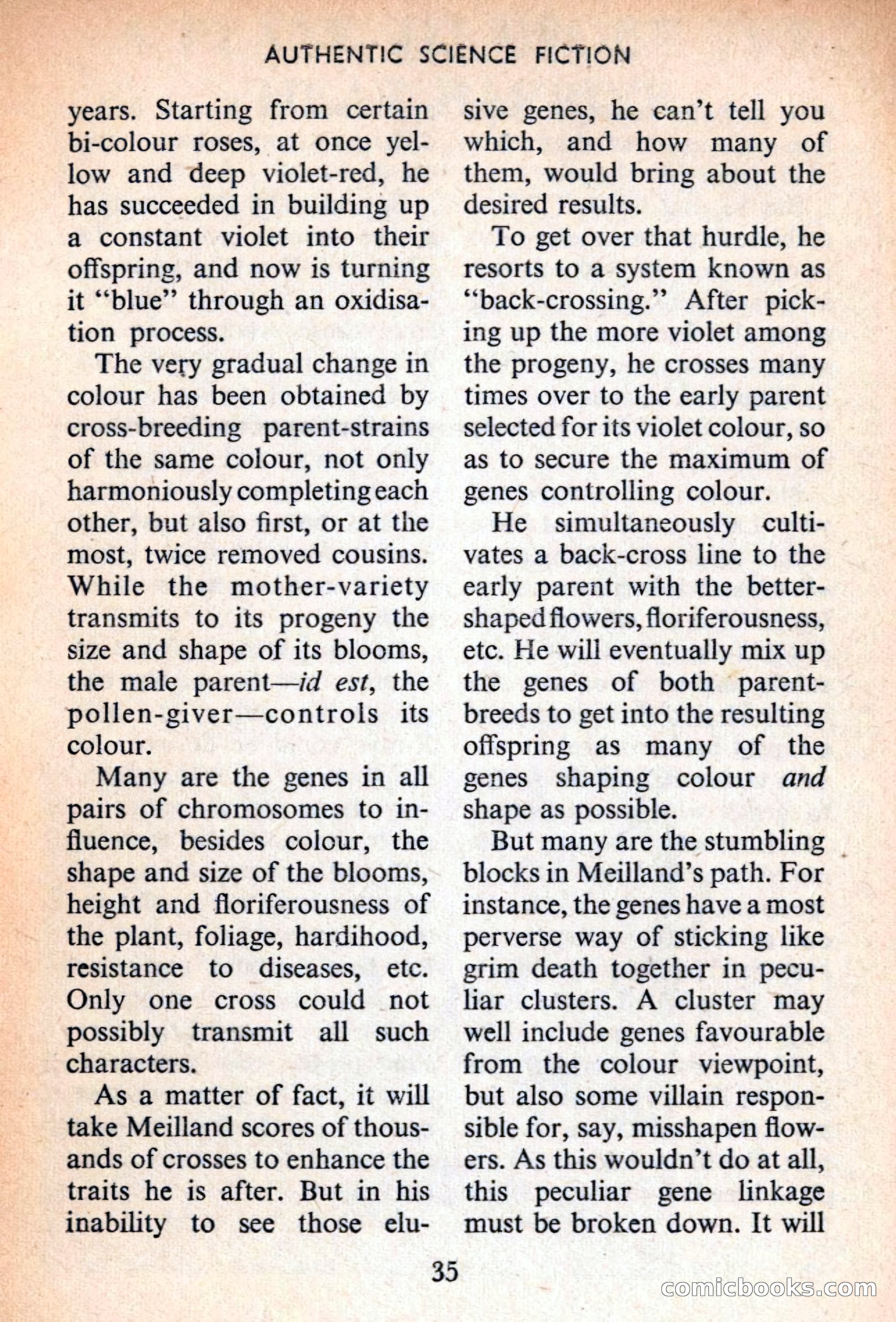
A restored page from Pulp Fiction, 1956. Page through the whole issue in the reader above.
📄 Transcribed text from this page (OCR, searchable)
Machine-transcribed from the original scan — historical spelling and the odd misread are preserved.
AUTHENTIC SCIENCE FICTION years. Starting from certain bi-colour roses, at once yel- low and deep violet-red, he has succeeded in building up a constant violet into their offspring, and now is turning it “blue” through an oxidisa- tion process. The very gradual change in colour has been obtained by cross-breeding parent-strains of the same colour, not only harmoniously completing each other, but also first, or at the most, twice removed cousins. While the mother-variety transmits to its progeny the size and shape of its blooms, the male parent—id est, the pollen-giver—controls its colour. Many are the genes in all pairs of chromosomes to in- fluence, besides colour, the shape and size of the blooms, height and floriferousness of the plant, foliage, hardihood, resistance to diseases, etc. Only one cross could not possibly transmit all such characters. As a matter of fact, it will take Meilland scores of thous- ands of crosses to enhance the traits he is after. But in his inability to see those elu- 35 sive genes, he can’t tell you which, and how many of them, would bring about the desired results. To get over that hurdle, he resorts to a system known as “‘back-crossing.”” After pick- ing up the more violet among the progeny, he crosses many times over to the early parent selected for its violet colour, so as to secure the maximum of genes controlling colour. He simultaneously culti- vates a back-cross line to the early parent with the better- shaped flowers, floriferousness, etc. He will eventually mix up the genes of both parent- breeds to get into the resulting offspring as many of the genes shaping colour and shape as possible. But many are the stumbling _ blocks in Meilland’s path. For instance, the genes have a most perverse way of sticking like grim death together in pecu- liar clusters. A cluster may well include genes favourable from the colour viewpoint, but also some villain respon- sible for, say, misshapen flow- ers. As this wouldn’t do at all, this peculiar gene linkage must be broken down. It will comicloooks.conm