
Pulp Fiction, 1956 · page 38 of 162
Authentic Science Fiction Monthly, No. 65 — page 38: what you’re looking at
A restored page from Pulp Fiction, 1956. Page through the whole issue in the reader above.
📄 Transcribed text from this page (OCR, searchable)
Machine-transcribed from the original scan — historical spelling and the odd misread are preserved.
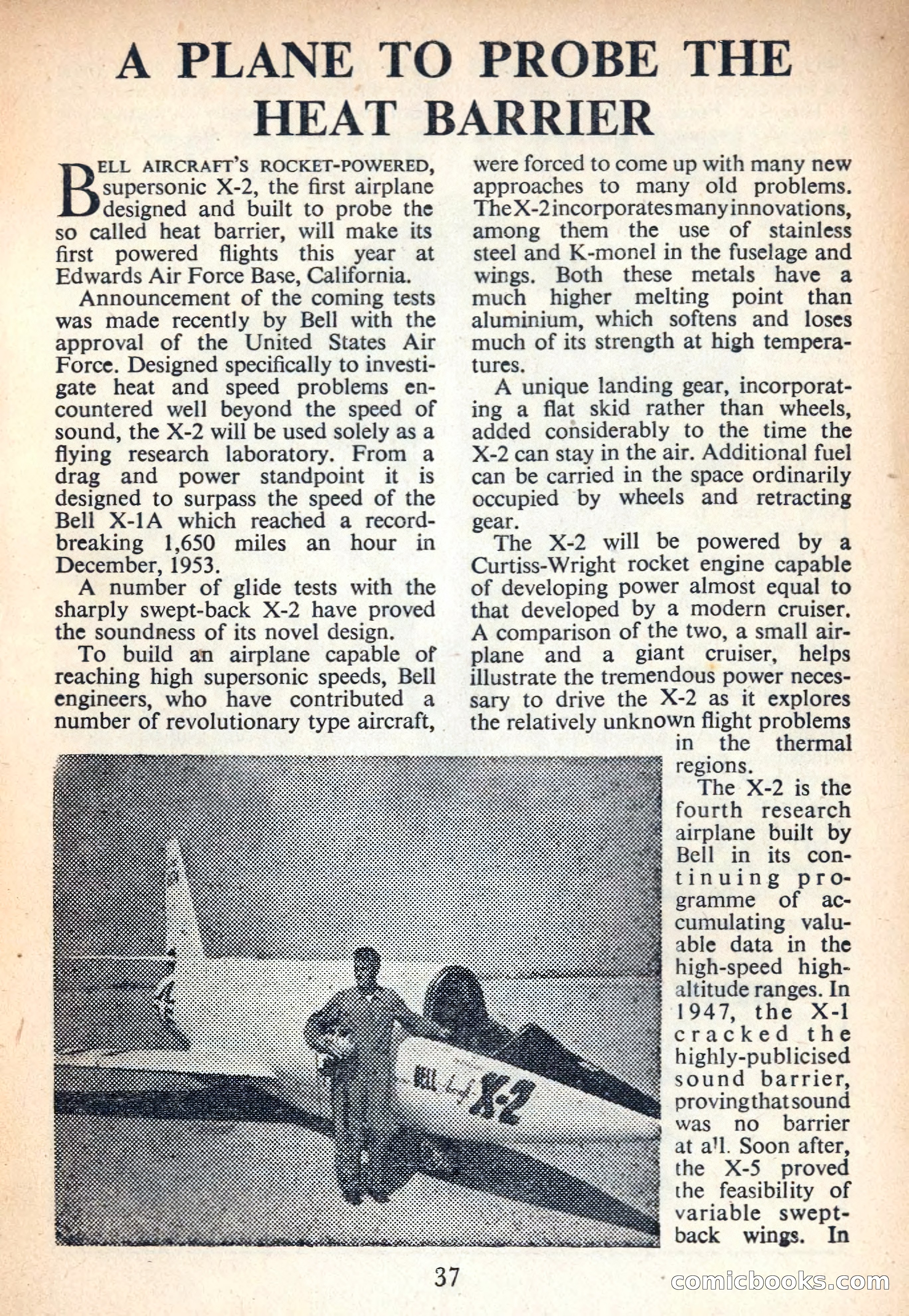
A PLANE TO PROBE THE HEAT BARRIER supersonic X-2, the first airplane designed and built to probe the so called heat barrier, will make its first powered flights this year at Edwards Air Force Base, California. Announcement of the coming tests was made recently by Bell with the approval of the United States Air Force. Designed specifically to investi- gate heat and speed problems en- countered well beyond the speed of sound, the X-2 will be used solely as a flying research laboratory. From a drag and power standpoint it is designed to surpass the speed of the Bell X-1A which reached a record- breaking 1,650 miles an hour in December, 1953. A number of glide tests with the sharply swept-back X-2 have proved the soundness of its novel design. To build an airplane capable of reaching high supersonic speeds, Bell engineers, who have contributed a number of revolutionary type aircraft, B: AIRCRAFT'S ROCKET-POWERED, 37 were forced to come up with many new approaches to many old problems. The X-2incorporatesmany innovations, among them the use of stainless steel and K-monel in the fuselage and wings. Both these metals have a much higher melting point than aluminium, which softens and loses much of its strength at high tempera- tures. A unique landing gear, incorporat- ing a flat skid rather than wheels, added considerably to the time the X-2 can stay in the air. Additional fuel can be carried in the space ordinarily occupied by wheels and retracting gear. The X-2 will be powered by a Curtiss-Wright rocket engine capable of developing power almost equal to that developed by a modern cruiser. A comparison of the two, a small air- plane and a giant cruiser, helps illustrate the tremendous power neces- sary to drive the X-2 as it explores the relatively unknown flight problems in the thermal regions. The X-2 is the fourth research airplane built by Bell in its con- tinuing pro- gramme of ac- cumulating valu- able data in the high-speed high- altitude ranges. In 1947, the X-l cracked the highly-publicised sound barrier, provingthatsound was no_ barrier at a'l. Soon after, the X-5 proved the feasibility of variable swept- back wings. In comicbooks.com