
Pulp Fiction, 1955 · page 84 of 146
Authentic Science Fiction Monthly No. 54 — page 84: what you’re looking at
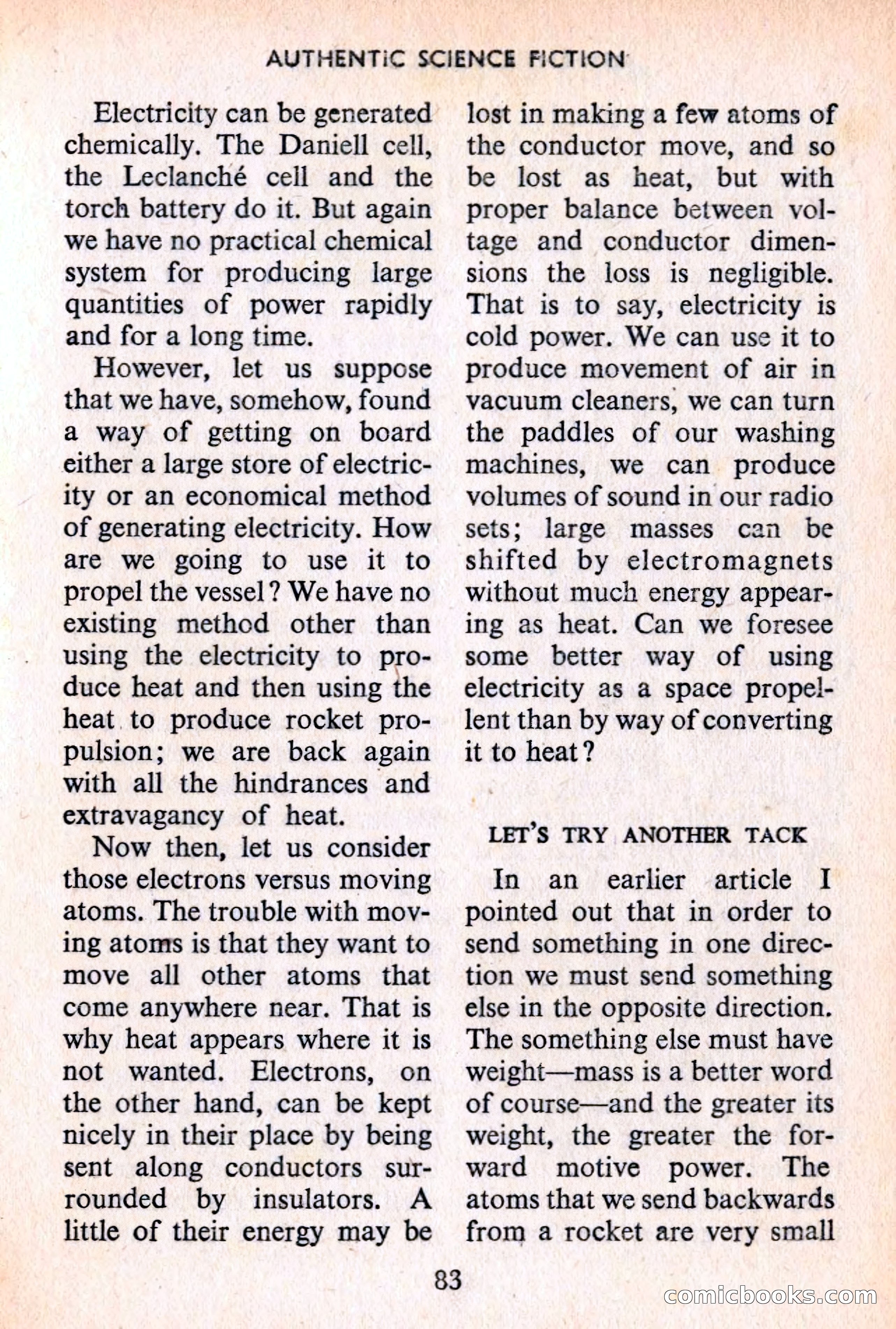
A restored page from Pulp Fiction, 1955. Page through the whole issue in the reader above.
📄 Transcribed text from this page (OCR, searchable)
Machine-transcribed from the original scan — historical spelling and the odd misread are preserved.
AUTHENTiC SCIENCE FICTION’ Electricity can be generated chemically. The Daniell cell, the Leclanché cell and the torch battery do it. But again we have no practical chemical system for producing large quantities of power rapidly and for a long time. However, let us suppose that we have, somehow, found a way of getting on board either a large store of electric- ity or an economical method of generating electricity. How are we going to use it to propel the vessel? We have no existing method other than using the electricity to pro- duce heat and then using the heat to produce rocket pro- pulsion; we are back again with all the hindrances and extravagancy of heat. Now then, let us consider those electrons versus moving atoms. The trouble with mov- ing atoms is that they want to move all other atoms that come anywhere near. That is why heat appears where it is not wanted. Electrons, on the other hand, can be kept nicely in their place by being sent along conductors sur- rounded by insulators. A little of their energy may be 83 lost in making a few atoms of the conductor move, and so be lost as heat, but with proper balance between vol- tage and conductor dimen- sions the loss is negligible. That is to say, electricity is cold power. We can use it to produce movement of air in vacuum cleaners, we can turn the paddles of our washing machines, we can produce volumes of sound in our radio sets; large masses can be shifted by electromagnets without much energy appear- ing as heat. Can we foresee some better way of using electricity as a space propel- lent than by way of converting it to heat? LET’S TRY ANOTHER TACK In an earlier article I pointed out that in order to send something in one direc- tion we must send something else in the opposite direction. The something else must have weight—mass is a better word of course—and the greater its weight, the greater the for- ward motive power. The atoms that we send backwards from a rocket are very small comicloooks.corn