
Pulp Fiction, 1955 · page 85 of 146
Authentic Science Fiction Monthly No. 54 — page 85: what you’re looking at
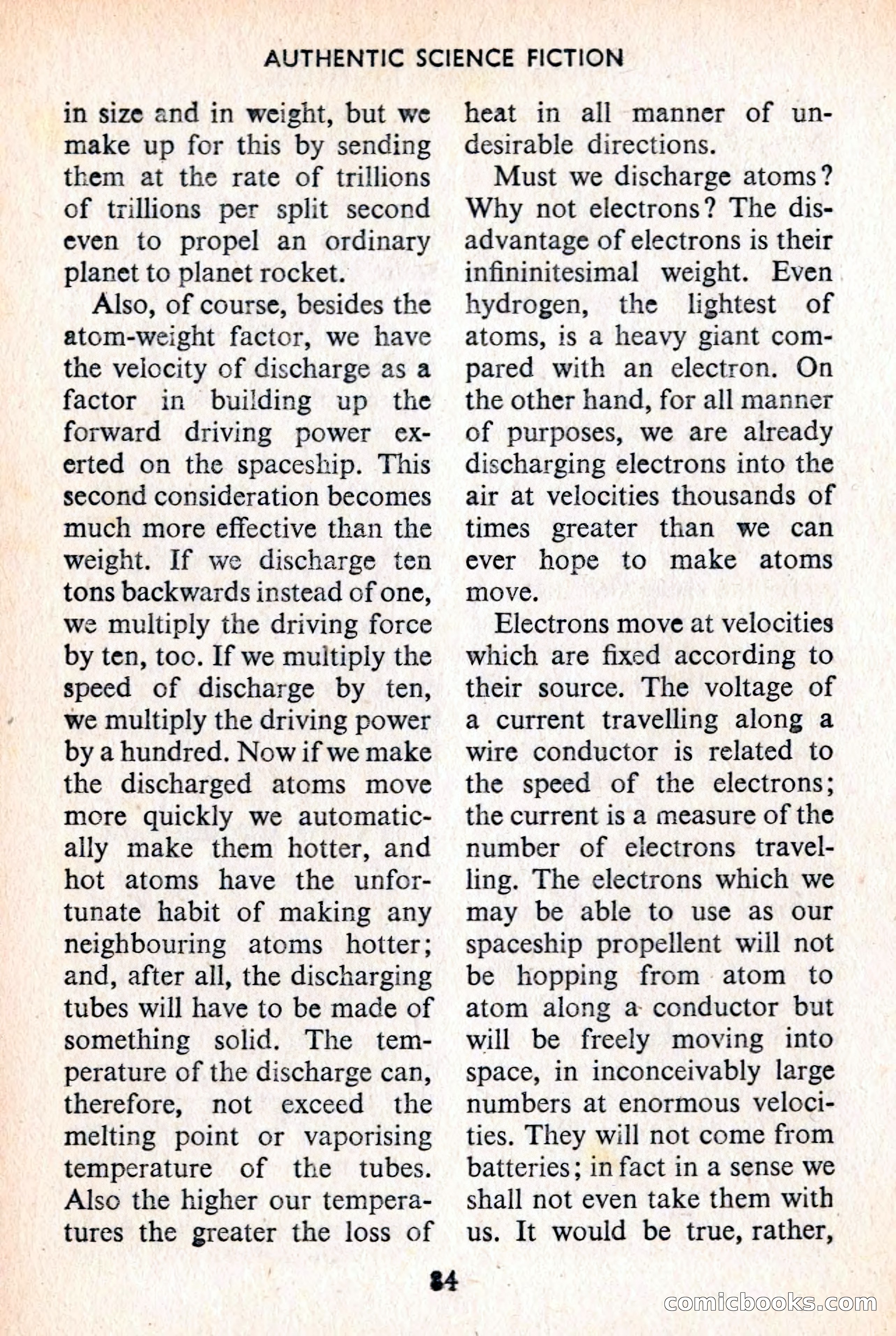
A restored page from Pulp Fiction, 1955. Page through the whole issue in the reader above.
📄 Transcribed text from this page (OCR, searchable)
Machine-transcribed from the original scan — historical spelling and the odd misread are preserved.
AUTHENTIC SCIENCE FICTION in size and in weight, but we make up for this by sending them at the rate of trillions of trillions per split second even to propel an ordinary planet to planet rocket. Also, of course, besides the atom-weight factor, we have the velocity of discharge as a factor in building up the forward driving power ex- erted on the spaceship. This second consideration becomes much more effective than the weight. If we discharge ten tons backwards instead of one, we multiply the driving force by ten, toc. If we multiply the speed of discharge by ten, we multiply the driving power by a hundred. Now if we make the discharged atoms move mere quickly we automatic- ally make them hotter, and hot atoms have the unfor- tunate habit of making any neighbouring atoms hotter; and, after all, the discharging tubes will have to be made of something solid. The tem- perature of the discharge can, therefore, mot exceed the melting point or vaporising temperature of the tubes. Also the higher our tempera- tures the greater the loss of $4 heat in all manner of un- desirable directions. Must we discharge atoms? Why not electrons? The dis- advantage of electrons is their infininitesimal weight. Even hydrogen, the lightest of atoms, is a heavy giant com- pared with an electron. On the other hand, for all manner of purposes, we are already discharging electrons into the air at velocities thousands of times greater than we can ever hope to make atoms move. Electrons move at velocities which are fixed according to their source. The voltage of a current travelling along a wire conductor is related to the speed of the electrons; the current is a measure of the number of electrons travel- ling. The electrons which we may be able to use as our spaceship propellent will not be hopping from atom to atom along a conductor but will be freely moving into space, in inconceivably large numbers at enormous veloci- ties. They will not come from batteries; infact in a sense we shall not even take them with us. It would be true, rather, comiclooks.corn