
Pulp Fiction, 1955 · page 76 of 146
Authentic Science Fiction Monthly No. 54 — page 76: what you’re looking at
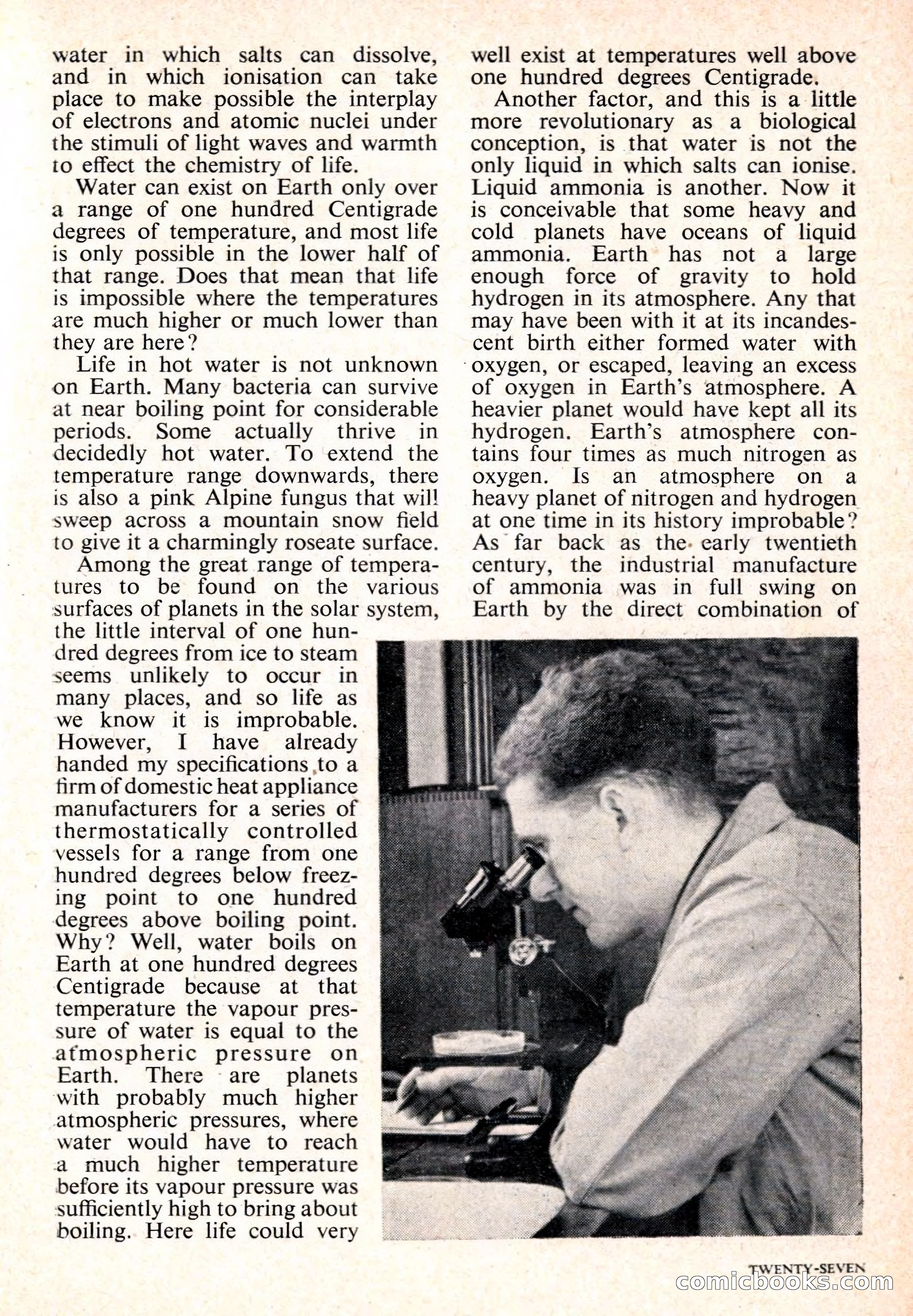
A restored page from Pulp Fiction, 1955. Page through the whole issue in the reader above.
📄 Transcribed text from this page (OCR, searchable)
Machine-transcribed from the original scan — historical spelling and the odd misread are preserved.
water in which salts can dissolve, and in which ionisation can take place to make possible the interplay of electrons and atomic nuclei under the stimuli of light waves and warmth to effect the chemistry of life. Water can exist on Earth only over a range of one hundred Centigrade degrees of temperature, and most life is only possible in the lower half of that range. Does that mean that life is impossible where the temperatures are much higher or much lower than they are here? Life in hot water is not unknown on Earth. Many bacteria can survive at near boiling point for considerable periods. Some actually thrive in decidedly hot water. To extend the temperature range downwards, there is also a pink Alpine fungus that wil! sweep across a mountain snow field to give it a charmingly roseate surface. Among the great range of tempera- tures to be found on the various surfaces of planets in the solar system, the little interval of one hun- dred degrees from ice to steam seems unlikely to occur in many places, and so life as we know it is improbable. However, I have already handed my specifications ,to a tirm of domestic heat appliance manufacturers for a series of thermostatically controlled vessels for a range from one hundred degrees below freez- ing point to one hundred degrees above boiling point. Why? Well, water boils on Earth at one hundred degrees Centigrade because at that temperature the vapour pres- sure of water is equal to the atmospheric pressure on Earth. There -are_ planets with probably much higher atmospheric pressures, where water would have to reach a much higher temperature before its vapour pressure was sufficiently high to bring about boiling. Here life could very well exist at temperatures well above one hundred degrees Centigrade. Another factor, and this is a little more revolutionary as a_ biological conception, is that water is not the only liquid in which salts can ionise. Liquid ammonia is another. Now it is conceivable that some heavy and cold planets have oceans of liquid ammonia. Earth has not a large enough force of gravity to hold hydrogen in its atmosphere. Any that may have been with it at its incandes- cent birth either formed water with “oxygen, or escaped, leaving an excess of oxygen in Earth’s atmosphere. A heavier planet would have kept all its hydrogen. Earth’s atmosphere con- tains four times as much nitrogen as oxygen. Is an atmosphere on a heavy planet of nitrogen and hydrogen at one time in its history improbable? As far back as the- early twentieth century, the industrial manufacture of ammonia was in full swing on Earth by the direct combination of oO WENTY-SEVEN comicoolks. conn