
Pulp Fiction, 1955 · page 77 of 146
Authentic Science Fiction Monthly No. 54 — page 77: what you’re looking at
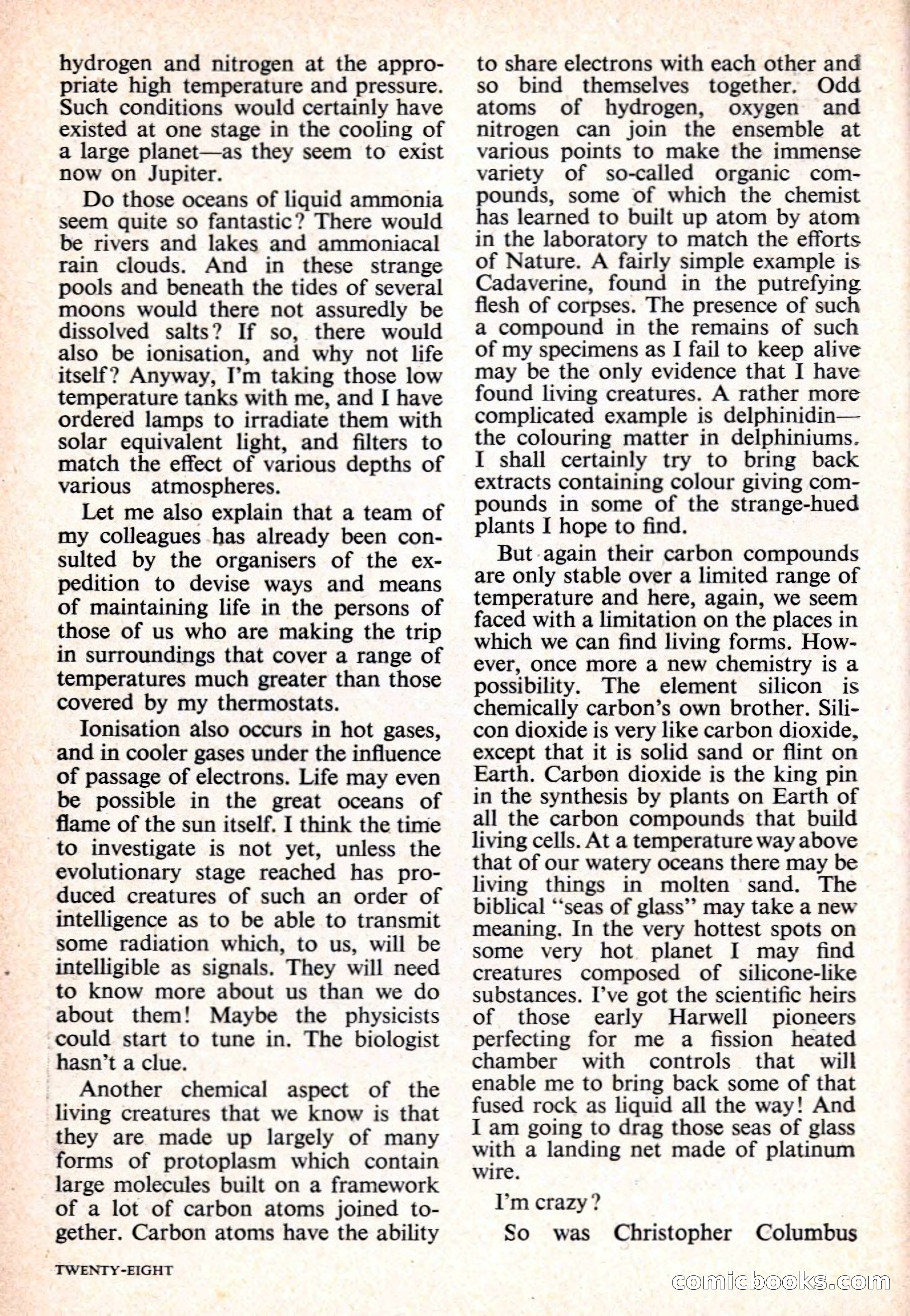
A restored page from Pulp Fiction, 1955. Page through the whole issue in the reader above.
📄 Transcribed text from this page (OCR, searchable)
Machine-transcribed from the original scan — historical spelling and the odd misread are preserved.
hydrogen and nitrogen at the appro- priate high temperature and pressure. Such conditions would certainly have existed at one stage in the cooling of a large planet—as they seem to exist now on Jupiter. Do those oceans of liquid ammonia seem quite so fantastic? There would be rivers and lakes and ammoniacal rain clouds. And in these strange pools and beneath the tides of several moons would there not assuredly be dissolved salts? If so, there would also be ionisation, and why not life itself? Anyway, I’m taking those low temperature tanks with me, and I have ordered lamps to irradiate them with solar equivalent light, and filters to match the effect of various depths of various atmospheres. Let me also explain that a team of my colleagues has already been con- sulted by the organisers of the ex- pedition to devise ways and means of maintaining life in the persons of those of us who are making the trip in surroundings that cover a range of temperatures much greater than those covered by my thermostats. Ionisation also occurs in hot gases, and in cooler gases under the influence of passage of electrons. Life may even be possible in the great oceans of flame of the sun itself. I think the time to investigate is not yet, unless the evolutionary stage reached has pro- duced creatures of such an order of intelligence as to be able to transmit some radiation which, to us, will be intelligible as signals. They will need to know more about us than we do about them! Maybe the physicists could start to tune in. The biologist hasn’t a clue. Another chemical aspect of the living creatures that we know is that they are made up largely of many forms of protoplasm which contain large molecules built on a framework of a lot of carbon atoms joined to- gether. Carbon atoms have the ability TWENTY-EIGHT to share electrons with each other and so bind themselves together. Odd atoms of hydrogen, oxygen and nitrogen can join the ensemble at various points to make the immense variety of so-called organic com- pounds, some of which the chemist has learned to built up atom by atom in the laboratory to match the efforts of Nature. A fairly simple example is Cadaverine, found in the putrefying flesh of corpses. The presence of such a compound in the remains of such of my specimens as I fail to keep alive may be the only evidence that I have found living creatures. A rather more complicated example is delphinidin— the colouring matter in delphiniums. I shall certainly try to bring back extracts containing colour giving com- pounds in some of the strange-hued plants I hope to find. But again their carbon compounds are only stable over a limited range of temperature and here, again, we seem faced with a limitation on the places in which we can find living forms. How- ever, once more a new chemistry is a possibility. The element silicon is chemically carbon’s own brother. Sili- con dioxide is very like carbon dioxide, except that it is solid sand or flint on Earth. Carbon dioxide is the king pin in the synthesis by plants on Earth of all the carbon compounds that build living cells. At a temperature way above that of our watery oceans there may be living things in molten sand. The biblical “seas of glass’ may take a new meaning. In the very hottest spots on some very hot planet I may find creatures composed of silicone-like substances. I’ve got the scientific heirs of those early Harwell pioneers perfecting for me a fission heated chamber with controls that will enable me to bring back some of that fused rock as liquid all the way! And I am going to drag those seas of glass with a landing net made of platinum wire. I’m crazy? So was Christopher Columbus comicbooks.com