
Pulp Fiction, 1955 · page 75 of 146
Authentic Science Fiction Monthly No. 54 — page 75: what you’re looking at
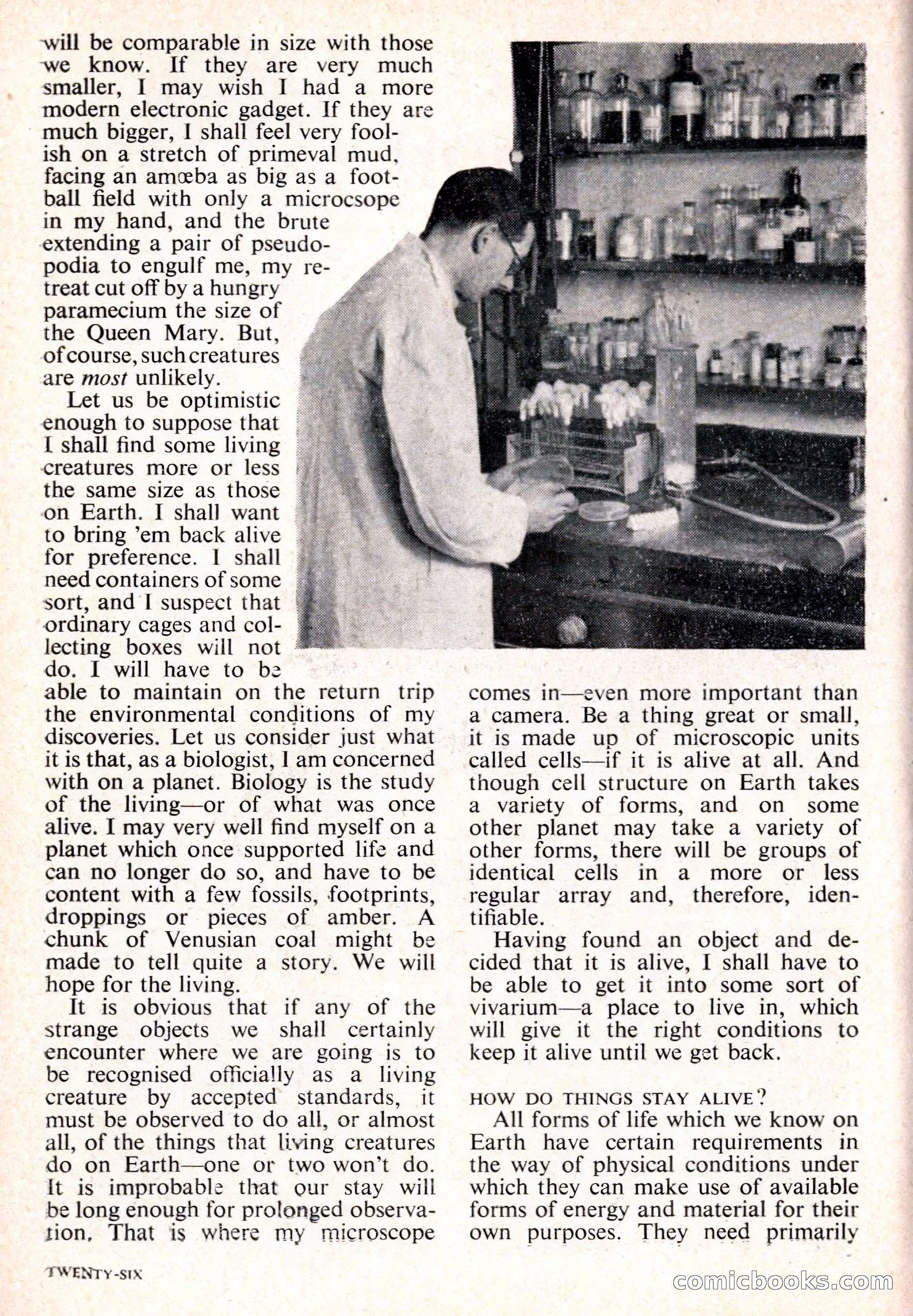
A restored page from Pulp Fiction, 1955. Page through the whole issue in the reader above.
📄 Transcribed text from this page (OCR, searchable)
Machine-transcribed from the original scan — historical spelling and the odd misread are preserved.
‘will be comparable in size with those we know. If they are very much smaller, I may wish I had a more modern electronic gadget. If they are much bigger, I shall feel very fool- ish on a stretch of primeval mud, facing an amceba as big as a foot- ball field with only a microcsope in my hand, and the brute extending a pair of pseudo- podia to engulf me, my re- treat cut off by a hungry paramecium the size of the Queen Mary. But, ofcourse, suchcreatures are most unlikely. Let us be optimistic enough to suppose that { shall find some living creatures more or less the same size as those on Earth. I shall want to bring ’em back alive for preference. I shall need containers of some sort, and I suspect that ordinary cages and col- lecting boxes will not - do. I will have to be able to maintain on the return trip the environmental conditions of my discoveries. Let us consider just what it is that, as a biologist, | am concerned with on a planet. Biology is the study of the living—or of what was once alive. I may very well find myself on a planet which once supported life and can no longer do so, and have to be content with a few fossils, footprints, droppings or pieces of amber. A chunk of Venusian coal might be made to tell quite a story. We will hope for the living. It is obvious that if any of the strange objects we shall certainly encounter where we are going is to be recognised officially as a living creature by accepted standards, it must be observed to do all, or almost all, of the things that living creatures do on Earth—one or two won’t do. It is improbable that our stay will be long enough for prolonged observa- tion, That is where my microscope TWENTY-SIX comes in—even more important than a camera. Be a thing great or small, it is made up of microscopic units called cells—if it is alive at all. And though cell structure on Earth takes a variety of forms, and on some other planet may take a variety of other forms, there will be groups of identical cells in a more or less regular array and, therefore, iden- tifiable. Having found an object and de- cided that it is alive, I shall have to be able to get it into some sort of vivarium—a place to live in, which will give it the right conditions to keep it alive until we get back. HOW DO THINGS STAY ALIVE? All forms of life which we know on Earth have certain requirements in the way of physical conditions under which they can make use of available forms of energy and material for their own purposes. They need primarily comliclooks.com