
Pulp Fiction, 1955 · page 68 of 146
Authentic Science Fiction Monthly No. 53 — page 68: what you’re looking at
A restored page from Pulp Fiction, 1955. Page through the whole issue in the reader above.
📄 Transcribed text from this page (OCR, searchable)
Machine-transcribed from the original scan — historical spelling and the odd misread are preserved.
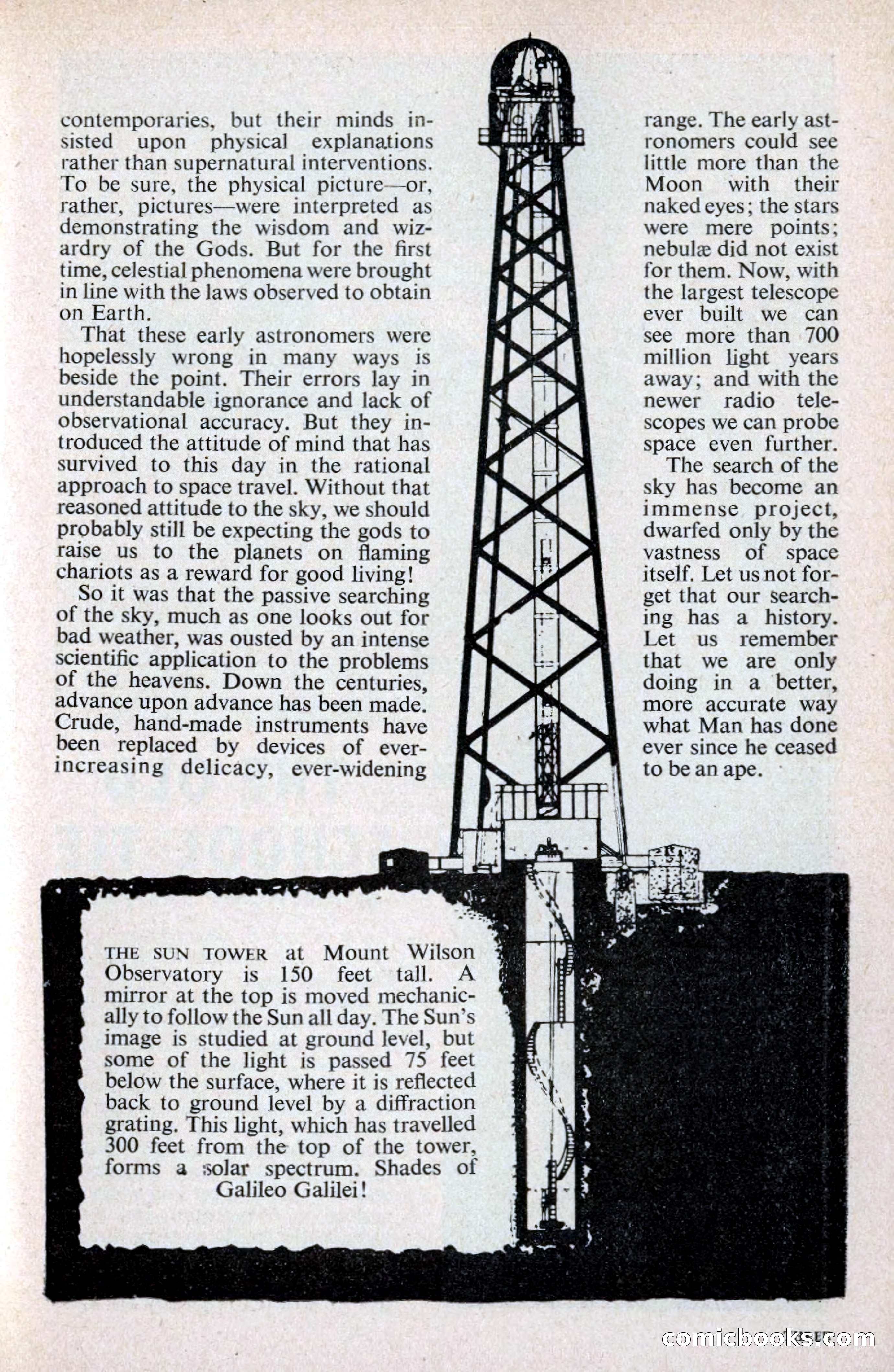
contemporaries, but their minds in- sisted upon. physical explanations rather than supernatural interventions. To be sure, the physical picture—or, rather, pictures—were interpreted as demonstrating the wisdom and wiz- ardry of the Gods. But for the first time, celestial phenomena were brought in line with the laws observed to obtain on Earth. That these early astronomers were hopelessly wrong in many ways is beside the point. Their errors lay in understandable ignorance and lack of observational accuracy. But they in- troduced the attitude of mind that has survived to this day in the rational approach to space travel. Without that reasoned attitude to the sky, we should probably still be expecting the gods to raise us to the planets on flaming chariots as a reward for good living! So it was that the passive searching of the sky, much as one looks out for bad weather, was ousted by an intense scientific application to the problems of the heavens. Down the centuries, advance upon advance has been made. Crude, hand-made instruments have been replaced by devices of ever- increasing delicacy, ever-widening Observatory is 150 feet tall. Galileo Galilei! THE SUN TOWER at Mount Wilson mirror at the top is moved mechanic- ally to follow the Sun all day. The Sun’s image is studied at ground level, but some of the light is passed 75 feet below the surface, where it is reflected back to ground level by a diffraction grating. This light, which has travelled 300 feet from the top of the tower, forms a solar spectrum. Shades of - Ps 2 iI" > il —_ PEO =~ — ° “Toke . Vy. we. “SU . we A range. The early ast- ronomers could see little more than the Moon with their naked eyes; the stars were mere points; nebulz did not exist for them. Now, with the largest telescope ever built we can see more than 700 million light years away; and with the newer radio tele- scopes we can probe space even further. The search of the sky has become an immense project, dwarfed only by the vastness of space itself. Let us not for- get that our Search- ing has a history. Let us remember that we are only doing in a better, more accurate way what Man has done ever since he ceased to be an ape. COnmmiclo Oc 3keornn