
Pulp Fiction, 1955 · page 67 of 146
Authentic Science Fiction Monthly No. 53 — page 67: what you’re looking at
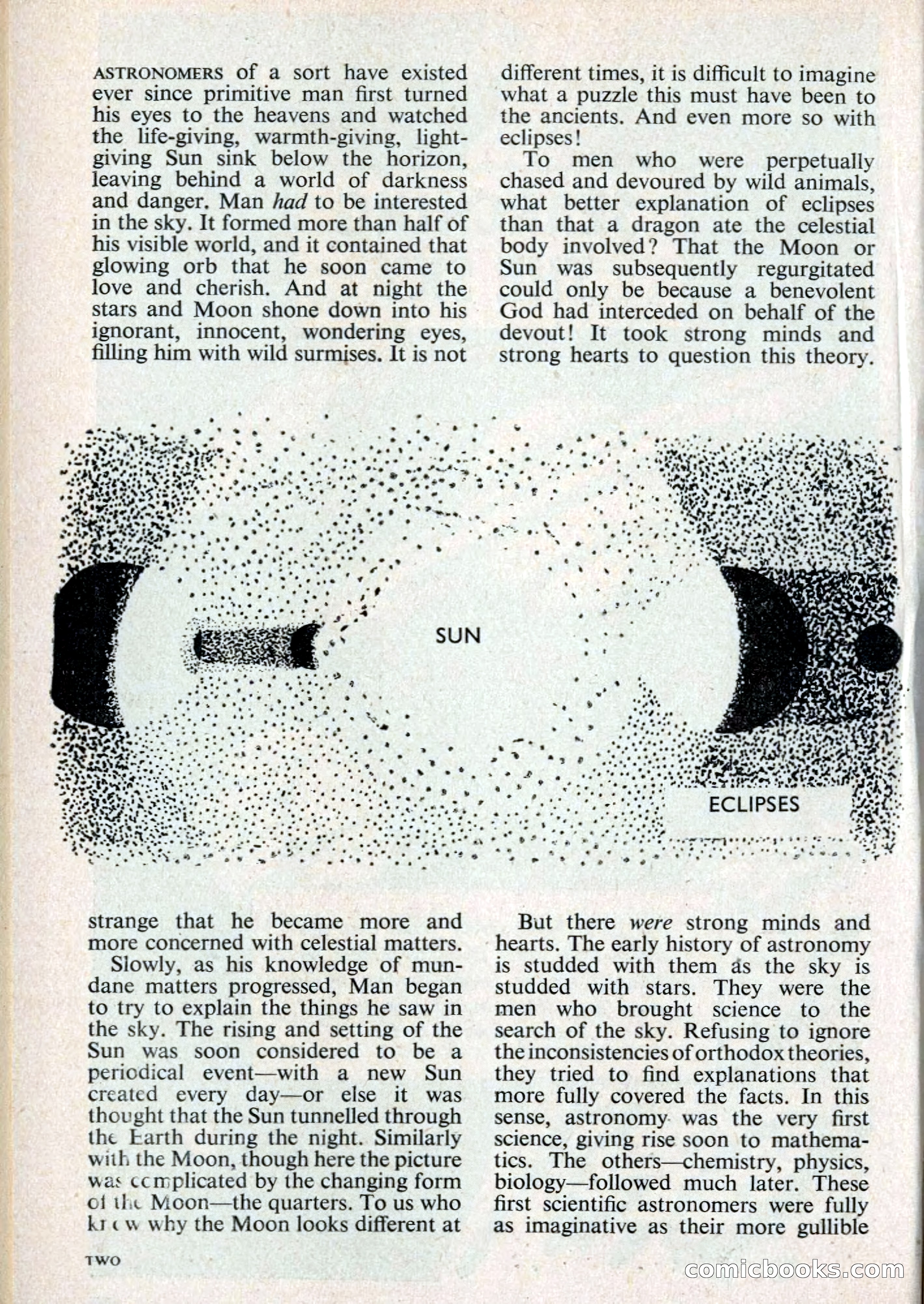
A restored page from Pulp Fiction, 1955. Page through the whole issue in the reader above.
📄 Transcribed text from this page (OCR, searchable)
Machine-transcribed from the original scan — historical spelling and the odd misread are preserved.
ASTRONOMERS Of a sort have existed ever since primitive man first turned his eyes to the heavens and watched the life-giving, warmth-giving, light- giving Sun sink below the horizon, leaving behind a world of darkness and danger. Man had to be interested in the sky. It formed more than half of his visible world, and it contained that glowing orb that he soon came to love and cherish. And at night the stars and Moon shone down into his ignorant, innocent, wondering eyes, filling him with wild surmises. It is not SUN strange that he became more and more concerned with celestial matters. Slowly, as his knowledge of mun- dane matters progressed, Man began to try to explain the things he saw in the sky. The rising and setting of the Sun was soon considered to be a periodical event—with a new Sun created every day—or else it was thought that the Sun tunnelled through the Earth during the night. Similarly wiih the Moon, though here the picture was ccmplicated by the changing form oi ihe Moon—the quarters. To us who ki cw why the Moon looks different at TWO different times, it is difficult to imagine what a puzzle this must have been to the ancients. And even more so with eclipses! To men who were perpetually chased and devoured by wild animals, what better explanation of eclipses than that a dragon ate the celestial body involved? That the Moon or Sun was subsequently regurgitated could only be because a benevolent God had interceded on behalf of the devout! It took strong minds and strong hearts to question this theory. a o*, . * mi ss ope, tale * x “* MPS oye per 1 oaqelex . a ‘es be. , % ECLIPSES a *." ez @ Piet od Dh ae oe se, #2 5? ve , 7 . But there were strong minds and hearts. The early history of astronomy ) is studded with them ds the sky is studded with stars. They were the men who brought science to the search of the sky. Refusing to ignore the inconsistencies of orthodox theories, they tried to find explanations that more fully covered the facts. In this sense, astronomy. was the very first science, giving rise soon to mathema- tics. The others—chemistry, physics, biology—followed much later. These first scientific astronomers were fully as imaginative as their more gullible conmiclooks.conn