
Pulp Fiction, 1954 · page 71 of 146
Authentic Science Fiction Monthly No. 52 — page 71: what you’re looking at
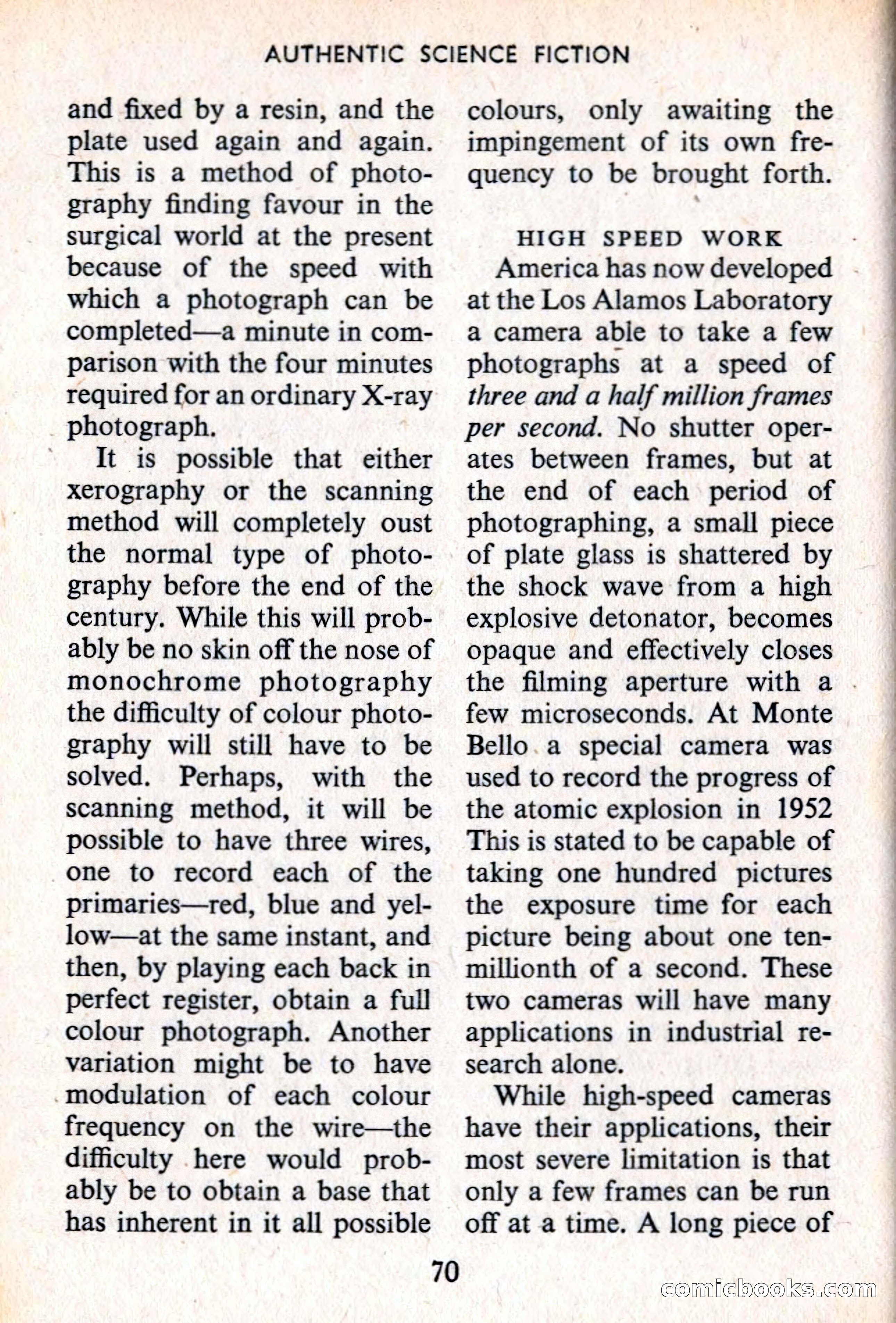
A restored page from Pulp Fiction, 1954. Page through the whole issue in the reader above.
📄 Transcribed text from this page (OCR, searchable)
Machine-transcribed from the original scan — historical spelling and the odd misread are preserved.
AUTHENTIC SCIENCE FICTION and fixed by a resin, and the plate used again and again. This is a method of photo- graphy finding favour in the surgical world at the present because of the speed with which a photograph can be completed—a minute in com- parison with the four minutes required for an ordinary X-ray photograph. ' It is possible that either xerography or the scanning method will completely oust the normal type of photo- graphy before the end of the century. While this will prob- ably be no skin off the nose of monochrome photography the difficulty of colour photo- graphy will still have to be solved. Perhaps, with the scanning method, it will be possible to have three wires, one to record each of the primaries—red, blue and yel- low—at the same instant, and then, by playing each back in perfect register, obtain a full colour photograph. Another variation might be to have modulation of each colour frequency on the wire—the difficulty here would prob- ably be to obtain a base that has inherent in it all possible 70 colours, only awaiting the impingement of its own fre- quency to be brought forth. HIGH SPEED WORK America has now developed . at the Los Alamos Laboratory a camera able to take a few photographs at a speed of three and a half million frames per second. No shutter oper- ates between frames, but at the end of each period of photographing, a small piece of plate glass is shattered by the shock wave from a high explosive detonator, becomes opaque and effectively closes the filming aperture with a . few microseconds. At Monte Bello. a special camera was used to record the progress of the atomic explosion in 1952 This is stated to be capable of taking one hundred pictures the exposure time for each picture being about one ten- millionth of a second. These two cameras will have many applications in industrial re- search alone. While high-speed cameras have their applications, their most severe limitation is that only a few frames can be run off at a time. A long piece of comiclooks.com ——————— ee eee oe fn