
Pulp Fiction, 1954 · page 72 of 146
Authentic Science Fiction Monthly No. 52 — page 72: what you’re looking at
A restored page from Pulp Fiction, 1954. Page through the whole issue in the reader above.
📄 Transcribed text from this page (OCR, searchable)
Machine-transcribed from the original scan — historical spelling and the odd misread are preserved.
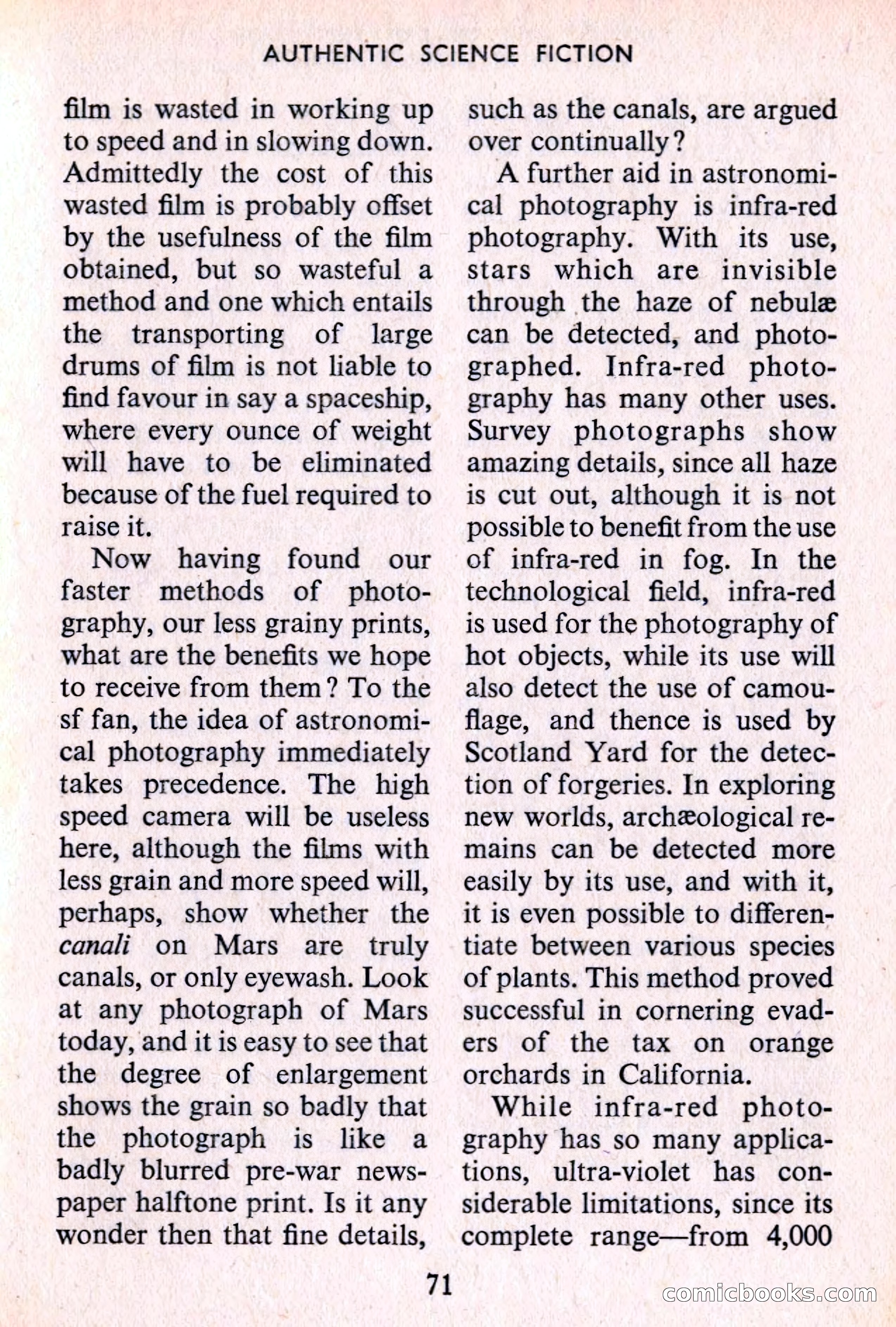
AUTHENTIC SCIENCE FICTION film is wasted in working up to speed and in slowing down. Admittedly the cost of this wasted film is probably offset by the usefulness of the film obtained, but so wasteful a method and one which entails the transporting of large drums of film is not liable to find favour in say a spaceship, where every ounce of weight will have to be eliminated because of the fuel required to raise it. Now having found our faster methods of photo- graphy, our less grainy prints, what are the benefits we hope to receive from them? To the sf fan, the idea of astronomi- cal photography immediately takes precedence. The high speed camera will be useless here, although the films with less grain and more speed will, perhaps, show whether the canali on Mars are truly canals, or only eyewash. Look at any photograph of Mars today, and it is easy to see that the degree of enlargement shows the grain so badly that the photograph is like a badly blurred pre-war news- paper halftone print. Is it any wonder then that fine details, 71 such as the canals, are argued over continually? A further aid in astronomi- cal photography is infra-red photography. With its use, stars which are invisible through the haze of nebule can be detected, and photo- graphed. Infra-red photo- graphy has many other uses. Survey photographs show amazing details, since all haze is cut out, although it is not possible to benefit from the use of infra-red in fog. In the technological field, infra-red is used for the photography of hot objects, while its use will also detect the use of camou- flage, and thence is used by Scotland Yard for the detec- tion of forgeries. In exploring new worlds, archeological re- mains can be detected more easily by its use, and with it, it is even possible to differen- tiate between various species of plants. This method proved successful in cornering evad- ers of the tax on orange orchards in California. While infra-red photo- graphy has so many applica- tions, ultra-violet has con- siderable limitations, since its complete range—from 4,000 comicloooks.cormn