
Pulp Fiction, 1954 · page 70 of 146
Authentic Science Fiction Monthly No. 52 — page 70: what you’re looking at
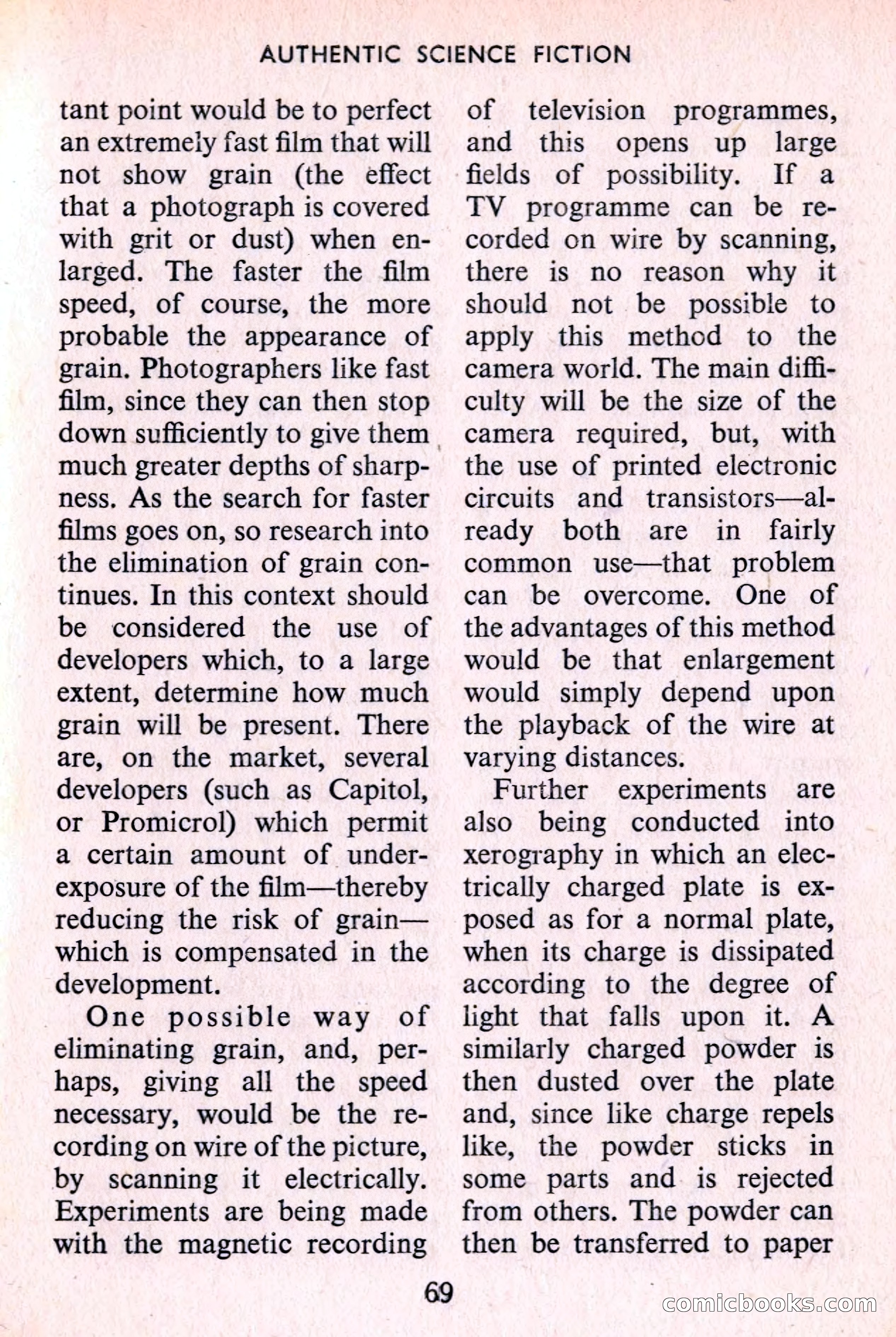
A restored page from Pulp Fiction, 1954. Page through the whole issue in the reader above.
📄 Transcribed text from this page (OCR, searchable)
Machine-transcribed from the original scan — historical spelling and the odd misread are preserved.
AUTHENTIC SCIENCE FICTION tant point would be to perfect an extremely fast film that will not show grain (the effect that a photograph is covered with grit or dust) when en- larged. The faster the film speed, of course, the more probable the appearance of grain. Photographers like fast film, since they can then stop down sufficiently to give them. much greater depths of sharp- ness. As the search for faster films goes on, so research into the elimination of grain con- tinues. In this context should be considered the use of developers which, to a large extent, determine how much grain will be present. There are, on the market, several developers (such as Capitol, or Promicrol) which permit a certain amount of under- exposure of the film—thereby reducing the risk of grain— which is compensated in the development. One possible way of eliminating grain, and, per- haps, giving all the speed necessary, would be the re- cording on wire of the picture, by scanning it electrically. Experiments are being made with the magnetic recording 69 of television programmes, and this opens up large fields of possibility. If a TV programme can be re- corded on wire by scanning, there is no reason why it should not be possible to apply this method to the camera world. The main diffi- culty will be the size of the camera required, but, with the use of printed electronic circuits and transistors—al- ready both are in fairly common use—that problem can be overcome. One of the advantages of this method would be that enlargement would simply depend upon the playback of the wire at varying distances. Further experiments are also being conducted into xerography in which an elec- trically charged plate is ex- posed as for a normal plate, when its charge is dissipated according to the degree of light that falls upon it. A similarly charged powder is then dusted over the plate and, since like charge repels like, the powder sticks in some parts and is rejected from others. The powder can then be transferred to paper commiclooolkks.com