
Pulp Fiction, 1954 · page 94 of 146
Authentic Science Fiction Monthly No. 50 — page 94: what you’re looking at
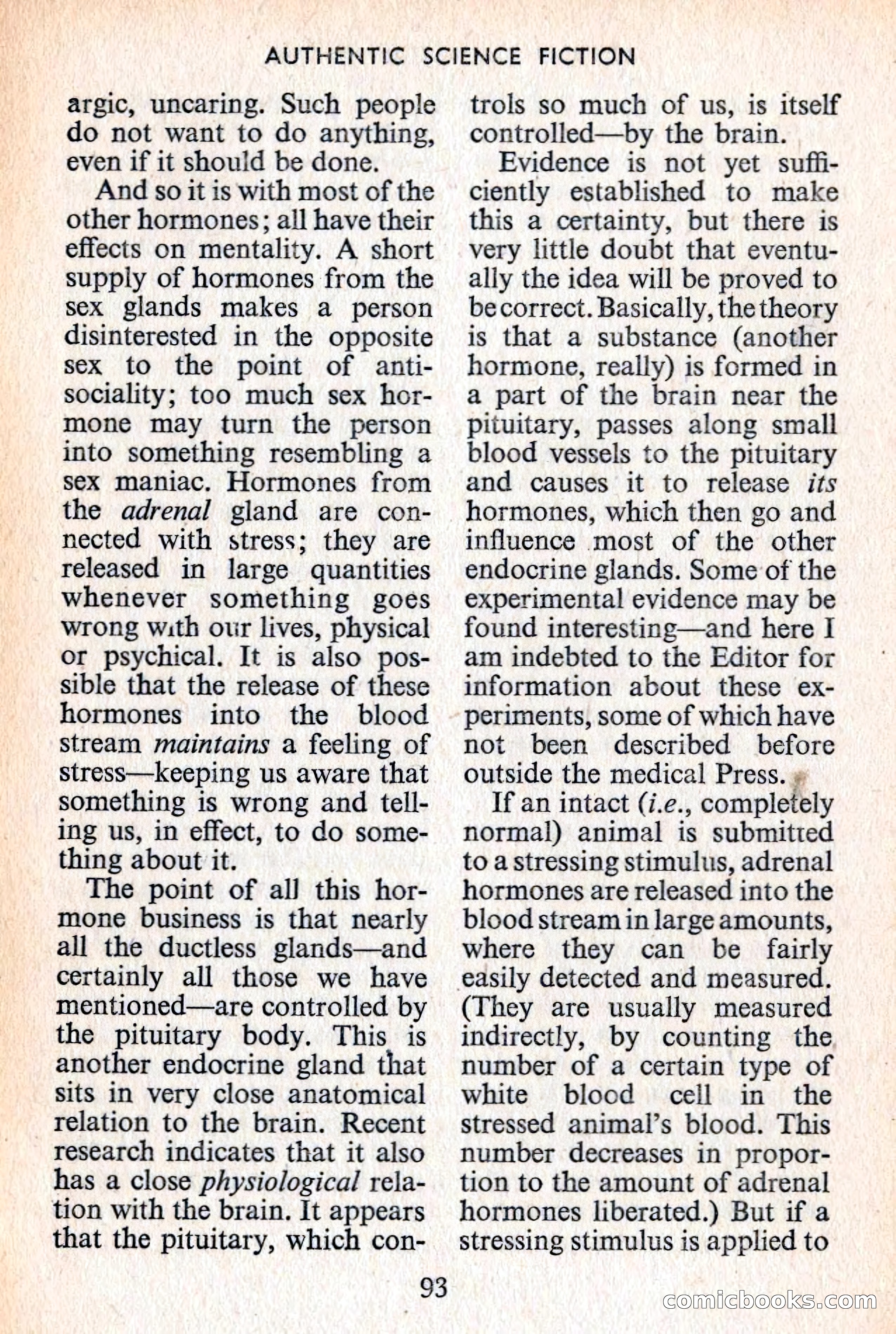
A restored page from Pulp Fiction, 1954. Page through the whole issue in the reader above.
📄 Transcribed text from this page (OCR, searchable)
Machine-transcribed from the original scan — historical spelling and the odd misread are preserved.
AUTHENTIC SCIENCE FICTION argic, uncaring. Such people do not want to do anything, even if it should be done. And so it is with most of the other hormones; all have their effects on mentality. A short supply of hormones from the sex glands makes a person disinterested in the opposite sex to the point of anti- sociality; too much sex hor- mone may turn the person into something resembling a sex maniac. Hormones from the adrenal gland are con- nected with stress; they are released in large quantities Whenever something goes wrong with our lives, physical or psychical. It is also pos- sible that the release of these hormones into the blood stream maintains a feeling of stress—keeping us aware that something is wrong and tell- ing us, in effect, to do some- thing about it. The point of alJ this hor- mone business is that nearly all the ductless glands—and certainly all those we have mentioned—are controlled by the pituitary body. This is another endocrine gland that sits in very close anatomical relation to the brain. Recent research indicates that it also has a close physiological rela- tion with the brain. It appears that the pituitary, which con- 93 trols so much of us, is itself controlled—by the brain. Evidence is not yet suffi- ciently established to make this a certainty, but there is very little doubt that eventu- ally the idea will be proved to becorrect. Basically, the theory is that a substance (another hormone, really) is formed in a part of the brain near the pituitary, passes along small blood vessels to the pituitary and causes it to release its hormones, which then go and influence most of the other endocrine glands. Some of the experimental evidence may be found interesting—and here I am indebted to the Editor for information about these ex- periments, some of which have not been described before outside the medical Press. » If an intact (i.e., completely normal) animal is submitted to a stressing stimulus, adrenal hormones are released into the blood stream in large amounts, where they can be fairly easily detected and measured. (They are usually measured indirectly, by counting the number of a certain type of white blood cell in the stressed animal’s blood. This number decreases in propor- tion to the amount of adrenal hormones liberated.) But if a stressing stimulus is applied to comiclbooks.conn