
Pulp Fiction, 1954 · page 93 of 146
Authentic Science Fiction Monthly No. 50 — page 93: what you’re looking at
A restored page from Pulp Fiction, 1954. Page through the whole issue in the reader above.
📄 Transcribed text from this page (OCR, searchable)
Machine-transcribed from the original scan — historical spelling and the odd misread are preserved.
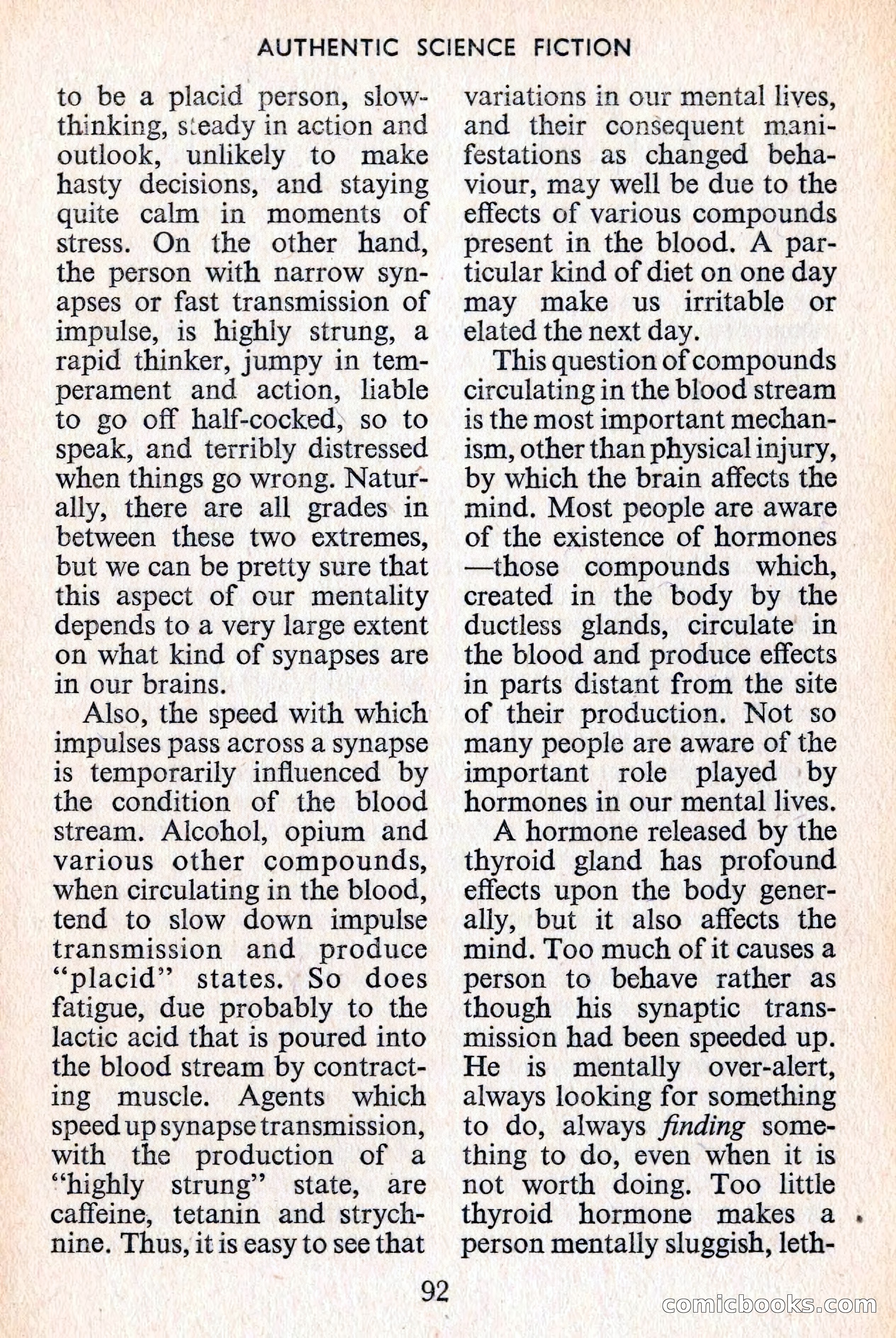
AUTHENTIC SCIENCE FICTION to be a placid person, slow- thinking, steady in action and outlook, unlikely to make hasty decisions, and staying quite calm in moments of stress. On the other hand, the person with narrow syn- apses or fast transmission of impulse, is highly strung, a rapid thinker, jumpy in tem- perament and action, liable to go off half-cocked, so to speak, and terribly distressed when things go wrong. Natur- ally, there are all grades in between these two extremes, but we can be pretty sure that this aspect of our mentality depends to a very large extent on what kind of synapses are in our brains. Also, the speed with which impulses pass across a synapse is temporarily influenced by the condition of the blood stream. Alcohol, opium and various other compounds, when circulating in the blood, tend to slow down impulse transmission and produce “placid” states. So does fatigue, due probably to the lactic acid that is poured into the blood stream by contract- ing muscle. Agents which speed up synapse transmission, with the production of a “highly strung’ state, are caffeine, tetanin and strych- nine. Thus, it is easy to see that 92 variations in our mental lives, and their consequent mani- festations as changed beha- viour, may well be due to the effects of various compounds present in the blood. A par- ticular kind of diet on one day may make us irritable or elated the next day. This question of compounds circulating in the blood stream is the most important mechan- ism, other than physical injury, by which the brain affects the mind. Most people are aware of the existence of hormones —those compounds which, created in the body by the ductless glands, circulate in the blood and produce effects in parts distant from the site of their production. Not so many people are aware of the important role played by hormones in our mental lives. A hormone released by the thyroid gland has profound effects upon the body gener- ally, but it also affects the mind. Too much of it causes a person to behave rather as though his synaptic trans- mission had been speeded up. He is mentally over-alert, always looking for something to do, always finding some- thing to do, even when it is not worth doing. Too little thyroid hormone makes a person mentally sluggish, leth- comicloolkks.com