
Pulp Fiction, 1954 · page 95 of 146
Authentic Science Fiction Monthly No. 50 — page 95: what you’re looking at
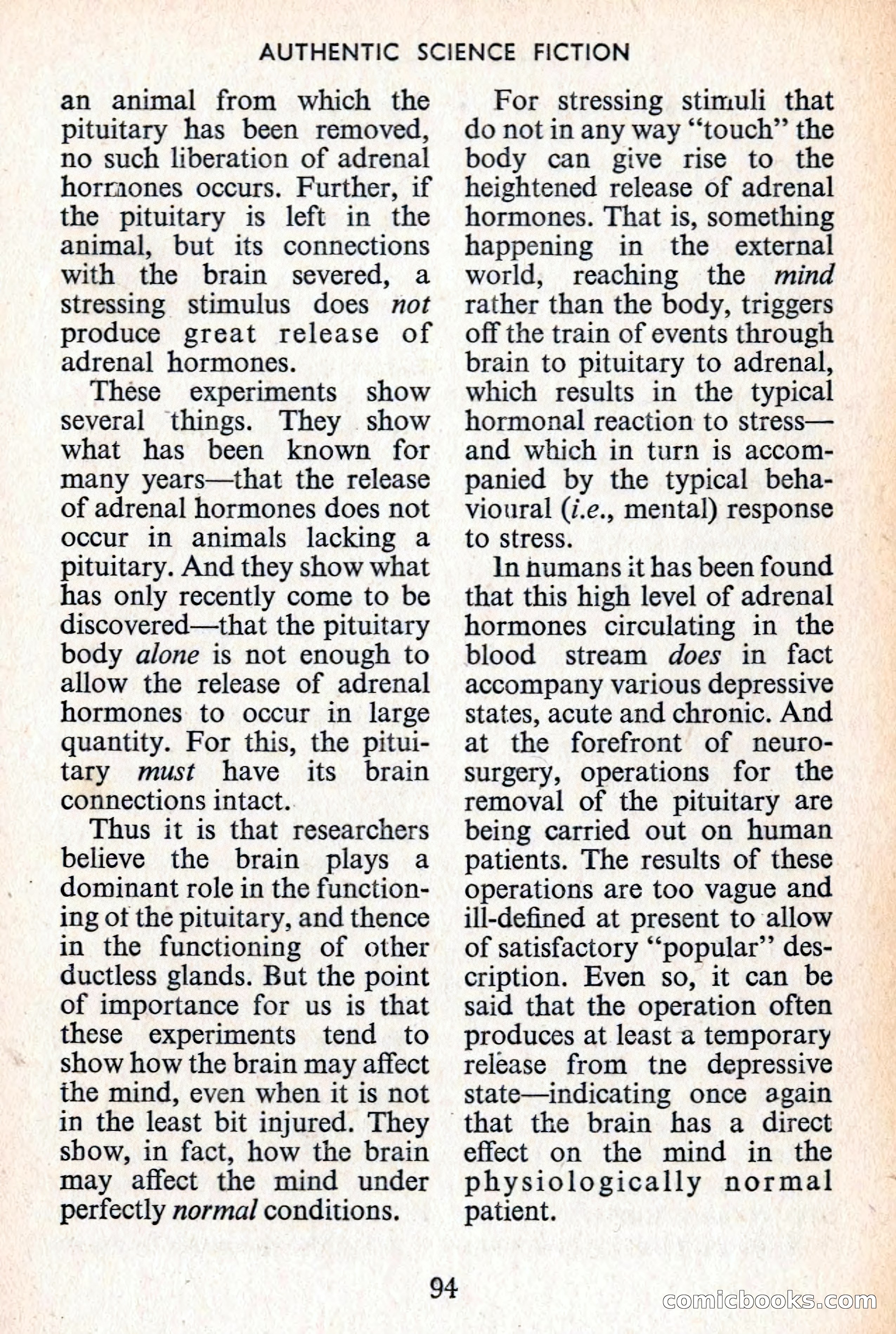
A restored page from Pulp Fiction, 1954. Page through the whole issue in the reader above.
📄 Transcribed text from this page (OCR, searchable)
Machine-transcribed from the original scan — historical spelling and the odd misread are preserved.
AUTHENTIC SCIENCE FICTION an animal from which the pituitary has been removed, no such liberation of adrenal hormones occurs. Further, if the pituitary is left in the animal, but its connections with the brain severed, a Stressing stimulus does not produce great release of adrenal hormones. Thése experiments show several things. They show what has been known for many years—that the release of adrenal hormones does not occur in animals lacking a pituitary. And they show what has only recently come to be discovered—that the pituitary body alone is not enough to allow the release of adrenal hormones to occur in large quantity. For this, the pitui- tary must have its brain connections intact. Thus it is that researchers believe the brain plays a dominant role in the function- ing of the pituitary, and thence in the functioning of other ductless glands. But the point of importance for us is that these experiments tend to show how the brain may affect the mind, even when it is not in the least bit injured. They show, in fact, how the brain may affect the mind under perfectly normal conditions. 94 For stressing stimuli that do not in any way “touch” the body can give rise to the heightened release of adrenal hormones. That is, something happening in the external world, reaching the mind rather than the body, triggers off the train of events through brain to pituitary to adrenal, which results in the typical hormonal reaction to stress— and which in turn is accom- panied by the typical beha- vioural (i.e., mental) response to stress. In humans it has been found that this high level of adrenal hormones circulating in the blood stream does in fact accompany various depressive states, acute and chronic. And at the forefront of neuro- surgery, operations for the removal of the pituitary are being carried out on human patients. The results of these operations are too vague and ill-defined at present to allow of satisfactory “‘popular’’ des- cription. Even so, it can be said that the operation often produces at least a temporary release from tne depressive state—indicating once again that the brain has a direct effect on the mind in the physiologically normal patient. comiclbooks.cormn