
Pulp Fiction, 1954 · page 125 of 146
Authentic Science Fiction Monthly No. 50 — page 125: what you’re looking at
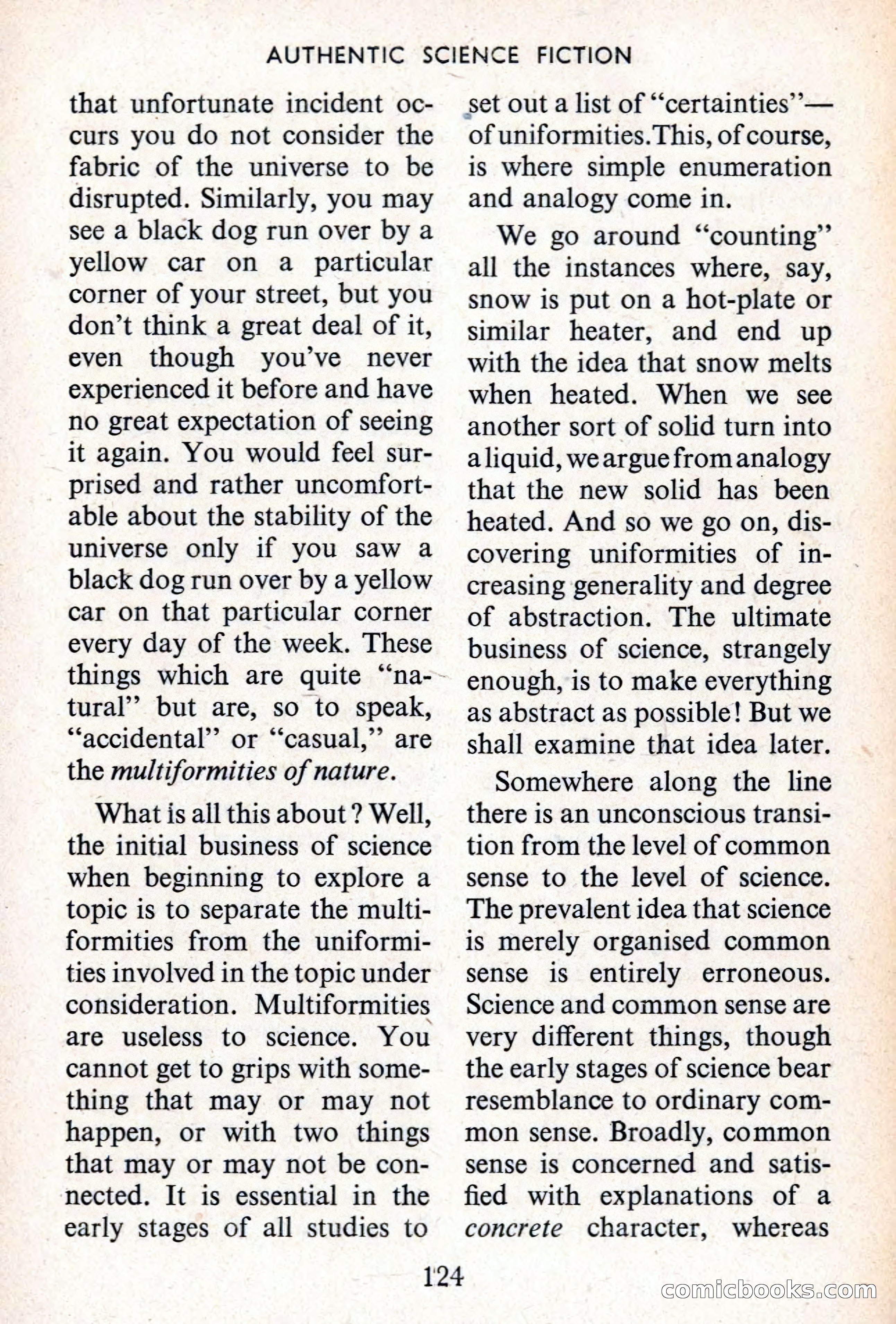
A restored page from Pulp Fiction, 1954. Page through the whole issue in the reader above.
📄 Transcribed text from this page (OCR, searchable)
Machine-transcribed from the original scan — historical spelling and the odd misread are preserved.
AUTHENTIC SCIENCE FICTION that unfortunate incident oc- curs you do not consider the fabric of the universe to be disrupted. Similarly, you may see a black dog run over by a yellow car on a particular corner of your street, but you don’t think a great deal of it, even though you’ve never experienced it before and have no great expectation of seeing it again. You would feel sur- prised and rather uncomfort- able about the stability of the universe only if you saw a black dog run over by a yellow car on that particular corner every day of the week. These things which are quite “na-- tural’’ but are, so to speak, “‘accidental’’ or “‘casual,”’ are the multiformities of nature. What is all this about ? Well, the initial business of science when beginning to explore a topic is to separate the multi- formities from the uniformi- ties involved in the topic under consideration. Multiformities are useless to science. You cannot get to grips with some- thing that may or may not happen, or with two things that may or may not be con- nected. It is essential in the early stages of all studies to 124 set out a list of “‘certainties’”— of uniformities. This, of course, is where simple enumeration and analogy come in. We go around “counting” all the instances where, say, snow is put on a hot-plate or similar heater, and end up with the idea that snow melts when heated. When we see another sort of solid turn into aliquid, we argue fromanalogy that the new solid has been heated. And so we go on, dis- covering uniformities of in- creasing generality and degree of abstraction. The ultimate business of science, strangely enough, is to make everything as abstract as possible! But we shall examine that idea later. Somewhere along the line there is an unconscious transi- tion from the level of common sense to the level of science. The prevalent idea that science is merely organised common sense is entirely erroneous. Science and common sense are very different things, though the early stages of science bear resemblance to ordinary com- mon sense. Broadly, common sense is concerned and satis- fied with explanations of a concrete character, whereas comicloooks.com