
Pulp Fiction, 1954 · page 126 of 146
Authentic Science Fiction Monthly No. 50 — page 126: what you’re looking at
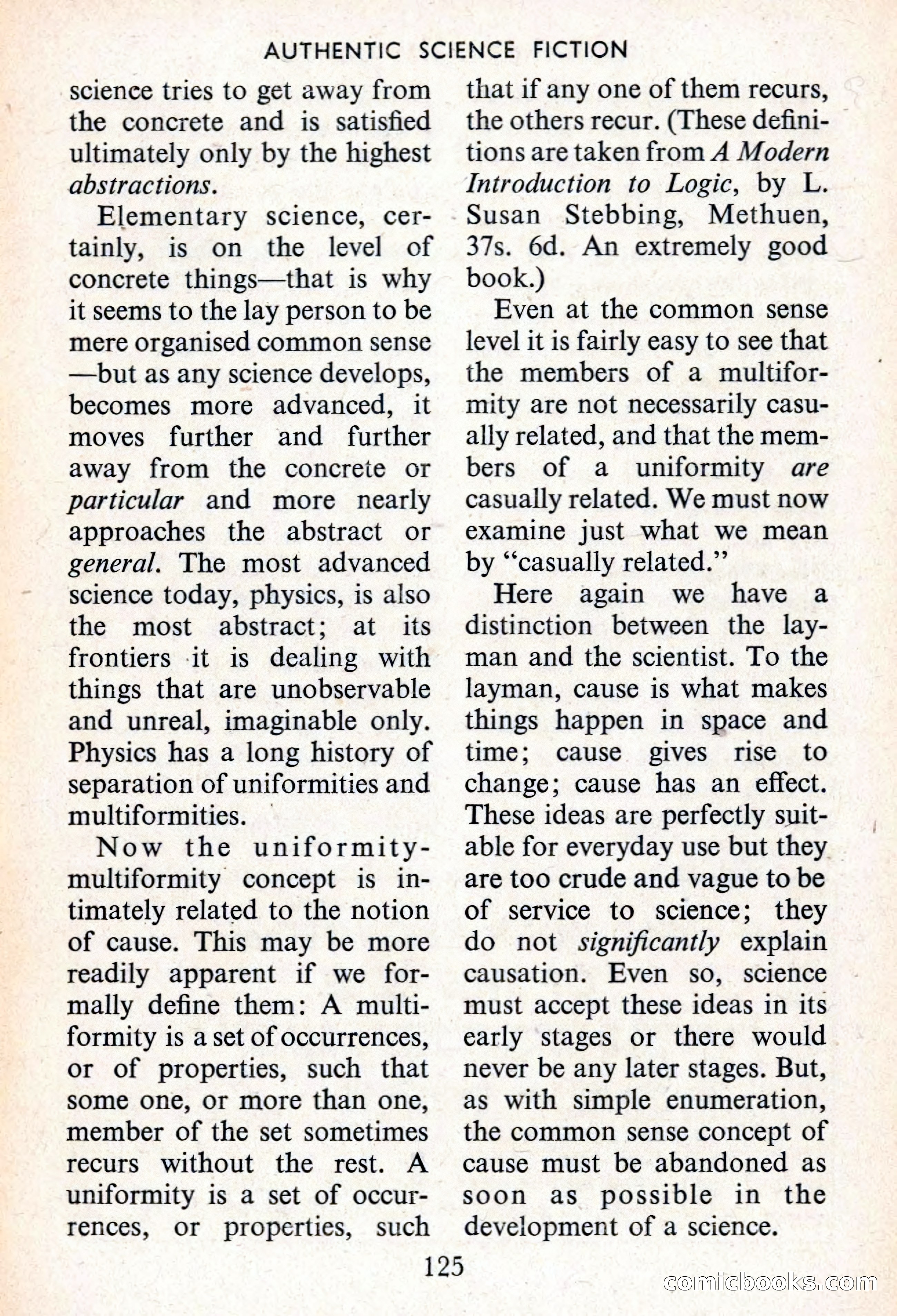
A restored page from Pulp Fiction, 1954. Page through the whole issue in the reader above.
📄 Transcribed text from this page (OCR, searchable)
Machine-transcribed from the original scan — historical spelling and the odd misread are preserved.
AUTHENTIC SCIENCE FICTION science tries to get away from the concrete and is satisfied ultimately only by the highest abstractions. Elementary science, cer- tainly, is on the level of concrete things—that is why it seems to the lay person to be mere organised common sense —but as any science develops, becomes more advanced, it moves further and further away from the concrete or particular and more nearly approaches the abstract or general. The most advanced science today, physics, is also the most abstract; at its frontiers it is dealing with things that are unobservable and unreal, imaginable only. Physics has a long history of separation of uniformities and multiformities. — Now the uniformity- multiformity concept is in- timately related to the notion of cause. This may be more readily apparent if we for- mally define them: A multi- formity is a set of occurrences, or of properties, such that some one, or more than one, member of the set sometimes recurs without the rest. A uniformity is a set of occur- rences, or properties, such 125 that if any one of them recurs, the others recur. (These defini- tions are taken from A Modern Introduction to Logic, by L. Susan Stebbing, Methuen, 37s. 6d. An extremely good book.) Even at the common sense level it is fairly easy to see that the members of a multifor- mity are not necessarily casu- ally related, and that the mem- bers of a uniformity are casually related. We must now examine just what we mean by “‘casually related.” Here again we have a distinction between the lay- man and the scientist. To the layman, cause is what makes things happen in space and time; cause gives rise to change; cause has an effect. These ideas are perfectly suit- able for everyday use but they are too crude and vague to be of service to science; they do not significantly explain causation. Even so, science must accept these ideas in its early stages or there would never be any later stages. But, as with simple enumeration, the common sense concept of cause must be abandoned as soon as possible in the development of a science. comicloooks.com