
Pulp Fiction, 1954 · page 124 of 146
Authentic Science Fiction Monthly No. 50 — page 124: what you’re looking at
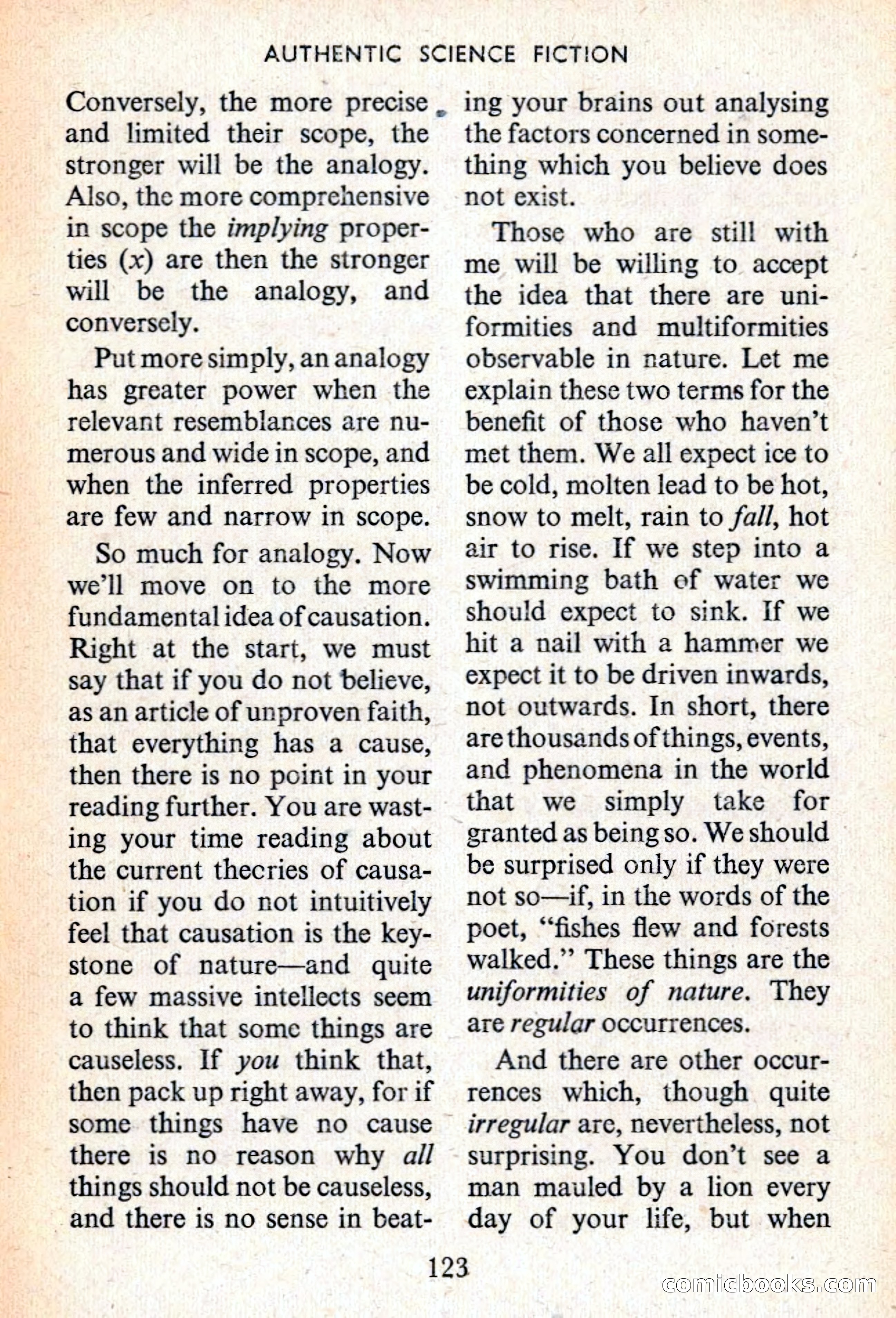
A restored page from Pulp Fiction, 1954. Page through the whole issue in the reader above.
📄 Transcribed text from this page (OCR, searchable)
Machine-transcribed from the original scan — historical spelling and the odd misread are preserved.
AUTHENTIC SCIENCE FICTION Conversely, the more precise . and limited their scope, the stronger will be the analogy. Also, the more comprehensive in scope the implying proper- ties (x) are then the stronger will be the analogy, and conversely. Put more simply, an analogy has greater power when the relevant resemblances are nu- merous and wide in scope, and when the inferred properties are few and narrow in scope. So much for analogy. Now we'll move on to the more fundamental idea of causation. Right at the start, we must say that if you do not believe, as an article of unproven faith, that everything has a cause, then there is no point in your reading further. You are wast- ing your time reading about the current thecries of causa- tion if you do not intuitively feel that causation is the key- stone of nature—and quite a few massive intellects seem to think that some things are causeless. If you think that, then pack up right away, for if some things have no cause there is no reason why ail things should not be causeless, _and there is no sense in beat- ing your brains out analysing the factors concerned in some- thing which you believe does not exist. Those who are still with me will be willing to accept the idea that there are uni- formities and multiformities observable in nature. Let me explain these two terms for the benefit of those who haven’t met them. We all expect ice to be cold, molten lead to be hot, snow to melt, rain to fall, hot air to rise. If we step into a swimming bath ef water we should expect to sink. If we hit a nail with a hammer we expect it to be driven inwards, not outwards. In short, there are thousands of things, events, and phenomena in the world that we simply take for granted as being so. We should be surprised only if they were not so—if, in the words of the poet, “fishes flew and forests walked.” These things are the uniformities of nature. They are regular occurrences. And there are other occur- rences which, though quite irregular are, nevertheless, not surprising. You don’t see a man mauled by a lion every day of your life, but when 123 comicloooks.conm