
Pulp Fiction, 1954 · page 92 of 146
Authentic Science Fiction Monthly No. 48 — page 92: what you’re looking at
A restored page from Pulp Fiction, 1954. Page through the whole issue in the reader above.
📄 Transcribed text from this page (OCR, searchable)
Machine-transcribed from the original scan — historical spelling and the odd misread are preserved.
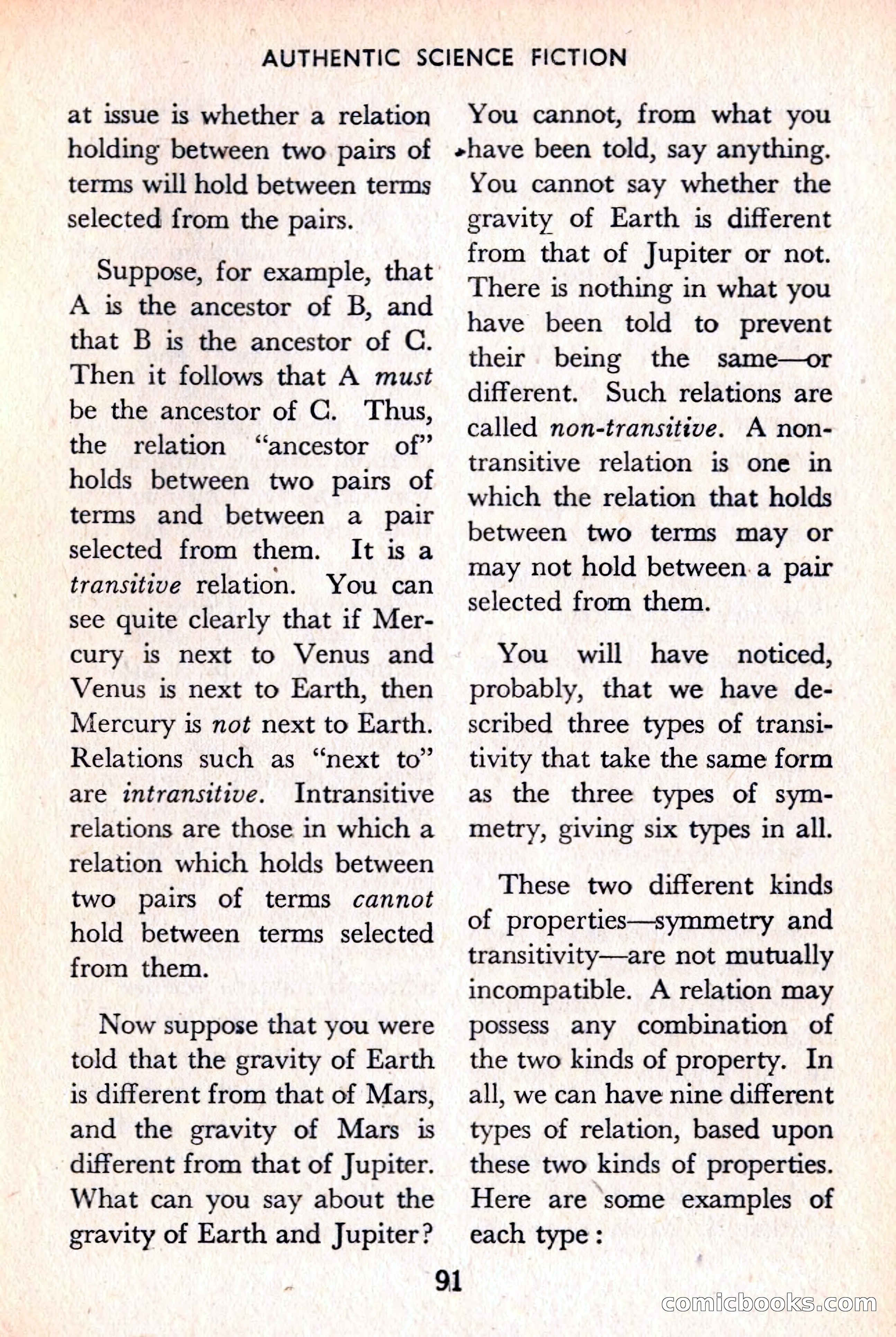
AUTHENTIC SCIENCE FICTION at issue is whether a relation holding between two pairs of terms will hold between terms selected from the pairs. Suppose, for example, that A is the ancestor of B, and that B is the ancestor of C. Then it follows that A must be the ancestor of C. Thus, the relation ‘ancestor of” holds between two pairs of terms and between a pair selected from them. It is a transitive relation. You can see quite clearly that if Mer- cury is next to Venus and Venus is next to Earth, then Mercury is not next to Earth. Relations such as ‘“‘next to” are intransitive. Intransitive relations are those in which a relation which holds between two pairs of terms cannot hold between terms selected from them. Now suppose that you were told that the gravity of Earth is different from that of Mars, and the gravity of Mars is different from that of Jupiter. What can you say about the gravity of Earth and Jupiter? 91 You cannot, from what you +have been told, say anything. You cannot say whether the gravity of Earth is different from that of Jupiter or not. There is nothing in what you have been told to prevent their being the same—or different. Such relations are called non-transitive. A non- transitive relation is one in which the relation that holds between two terms may or may not hold between.a pair selected from them. You will have noticed, probably, that we have de- scribed three types of transi- tivity that take the same form as the three types of sym- metry, giving six types in all. These two different kinds of properties—symmetry and transitivity—are not mutually incompatible. A relation may possess any combination of the two kinds of property. In all, we can have nine different types of relation, based upon these two kinds of properties. Here are some examples of each type: comicloooks.com