
Pulp Fiction, 1954 · page 91 of 146
Authentic Science Fiction Monthly No. 48 — page 91: what you’re looking at
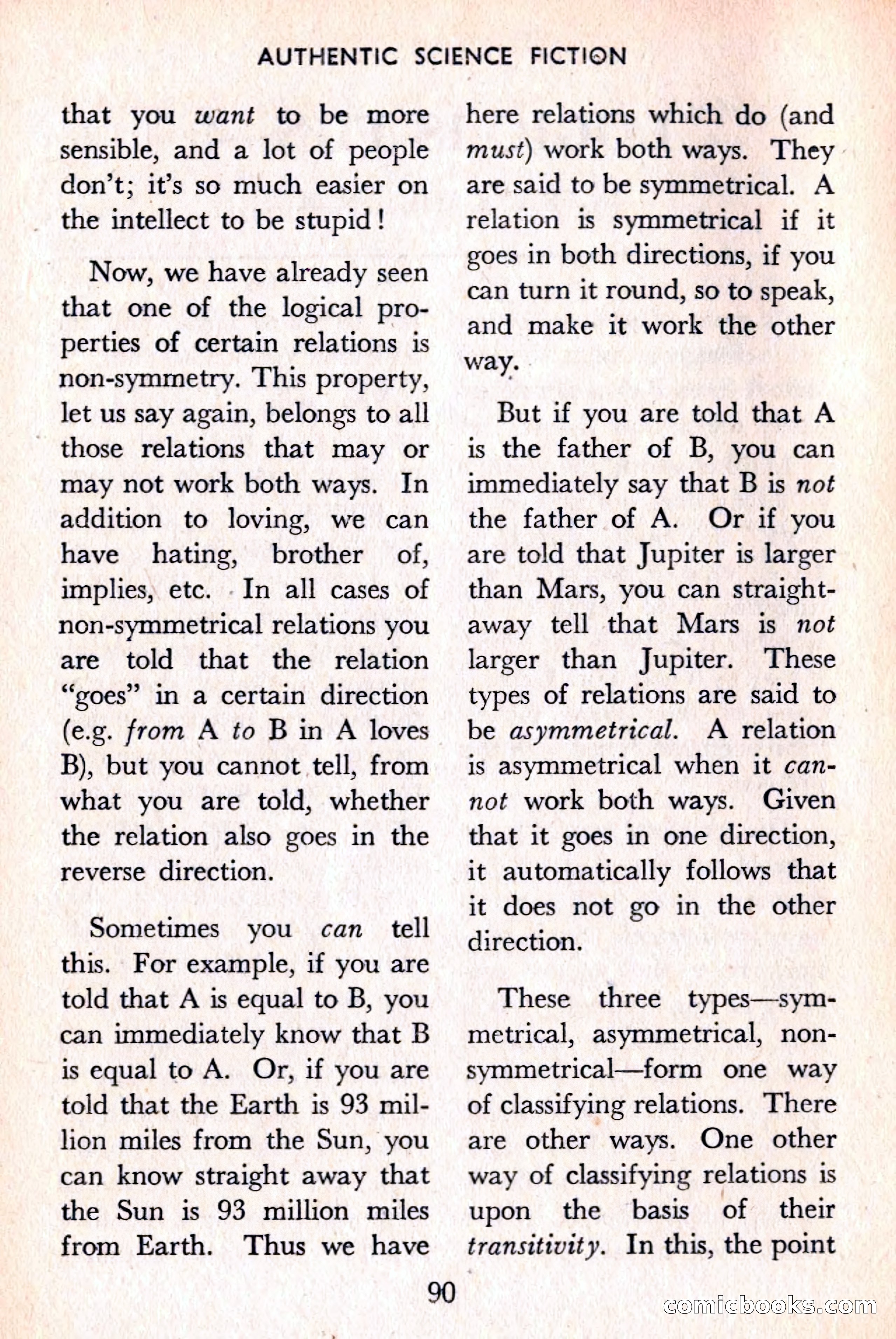
A restored page from Pulp Fiction, 1954. Page through the whole issue in the reader above.
📄 Transcribed text from this page (OCR, searchable)
Machine-transcribed from the original scan — historical spelling and the odd misread are preserved.
AUTHENTIC SCIENCE FICTION that you want to be more sensible, and a lot of people don’t; it’s so much easier on the intellect to be stupid! Now, we have already seen that one of the logical pro- perties of certain relations is non-symmetry. This property, let us say again, belongs to all those relations that may or may not work both ways. In addition to loving, we can have hating, brother of, implies, etc. .In all cases of non-symmetrical relations you are told that the relation “goes” in a certain direction (e.g. from A to B in A loves B), but you cannot tell, from what you are told, whether the relation also goes in the reverse direction. Sometimes you can tell this. For example, if you are told that A is equal to B, you can immediately know that B is equal to A. Or, if you are told that the Earth is 93 mil- lion miles from the Sun, you can know straight away that the Sun is 93 million miles from Earth. Thus we have 90 here relations which do (and must) work both ways. They are said to be symmetrical. A relation is symmetrical if it goes in both directions, if you can turn it round, so to speak, and make it work the other way. But if you are told that A is the father of B, you can immediately say that B is not the father of A. Or if you are told that Jupiter is larger than Mars, you can straight- away tell that Mars is not larger than Jupiter. These types of relations are said to be asymmetrical. A relation is asymmetrical when it can- not work both ways. Given that it goes in one direction, it automatically follows that it does not go in the other direction. These three types—sym- metrical, asymmetrical, non- symmetrical—form one way of classifying relations. There are other ways. One other way of classifying relations is upon the basis of their transitivity. In this, the point comiclooks.corn