
Pulp Fiction, 1954 · page 93 of 146
Authentic Science Fiction Monthly No. 48 — page 93: what you’re looking at
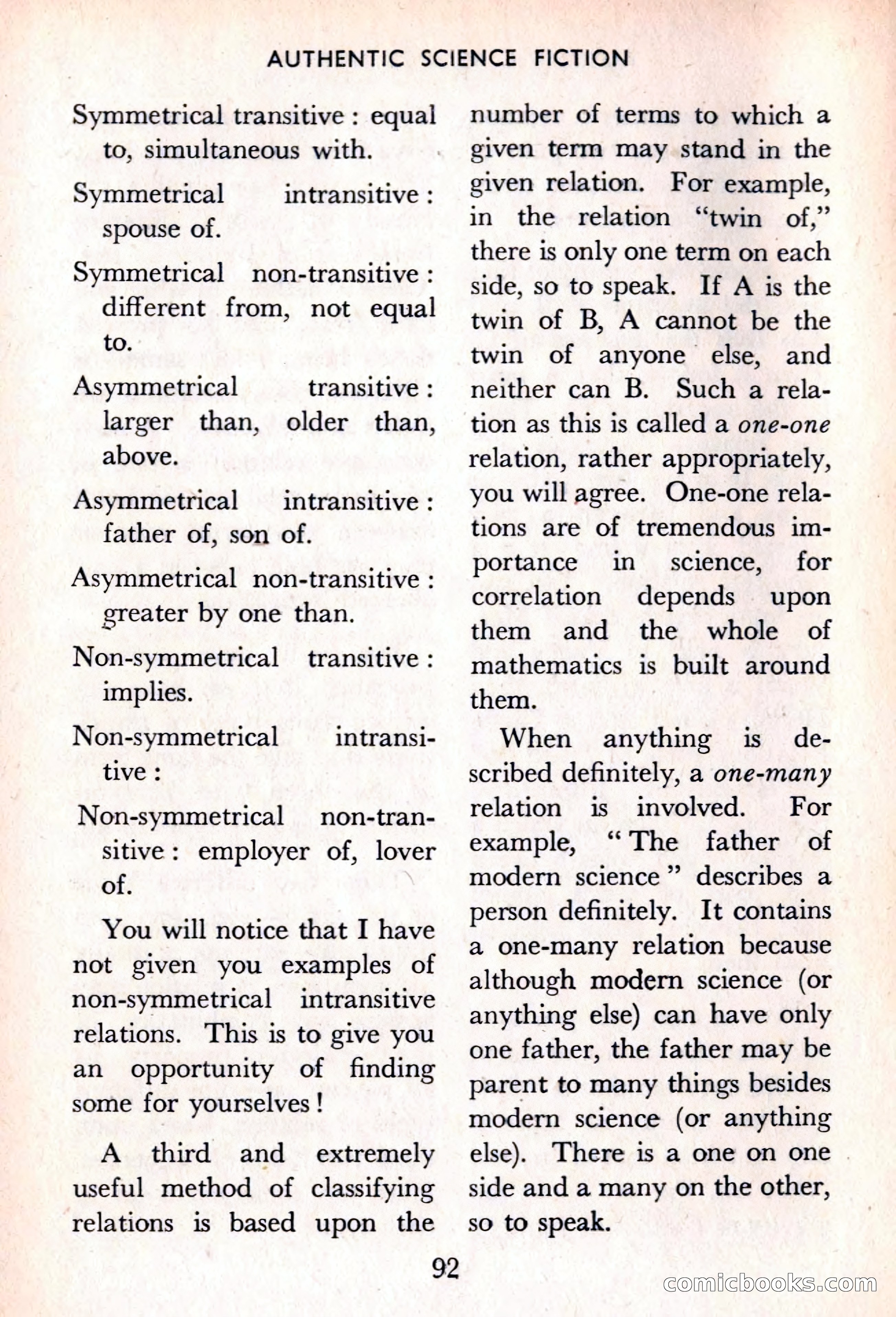
A restored page from Pulp Fiction, 1954. Page through the whole issue in the reader above.
📄 Transcribed text from this page (OCR, searchable)
Machine-transcribed from the original scan — historical spelling and the odd misread are preserved.
AUTHENTIC SCIENCE FICTION Symmetrical transitive : equal to, simultaneous with. Symmetrical intransitive : spouse of. Symmetrical non-transitive : different from, not equal to. Asymmetrical transitive : larger than, older than, above. Asymmetrical intransitive : father of, son of. Asymmetrical non-transitive : greater by one than. Non-symmetrical transitive : implies. Non-symmetrical intransi- tive : Non-symmetrical non-tran- sitive: employer of, lover of. You will notice that I have not given you examples of non-symmetrical intransitive relations. This is to give you an opportunity of finding some for yourselves ! A third and_ extremely useful method of classifying relations is based upon the 92 number of terms to which a given term may stand in the given relation. For example, in the relation “twin of,” there is only one term on each side, so to speak. If A is the twin of B, A cannot be the twin of anyone else, and neither can B. Such a rela- tion as this is called a one-one relation, rather appropriately, you will agree. One-one rela- tions are of tremendous im- portance in science, for correlation depends upon them and the whole of mathematics is built around them. When anything is_ de- scribed definitely, a one-many relation is involved. For example, “The father of modern science” describes a person definitely. It contains a one-many relation because although modern science (or anything else) can have only one father, the father may be parent to many things besides modern science (or anything else). There is a one on one side and a many on the other, so to speak. comicloooks.com