
Pulp Fiction, 1954 · page 120 of 146
Authentic Science Fiction Monthly No. 48 — page 120: what you’re looking at
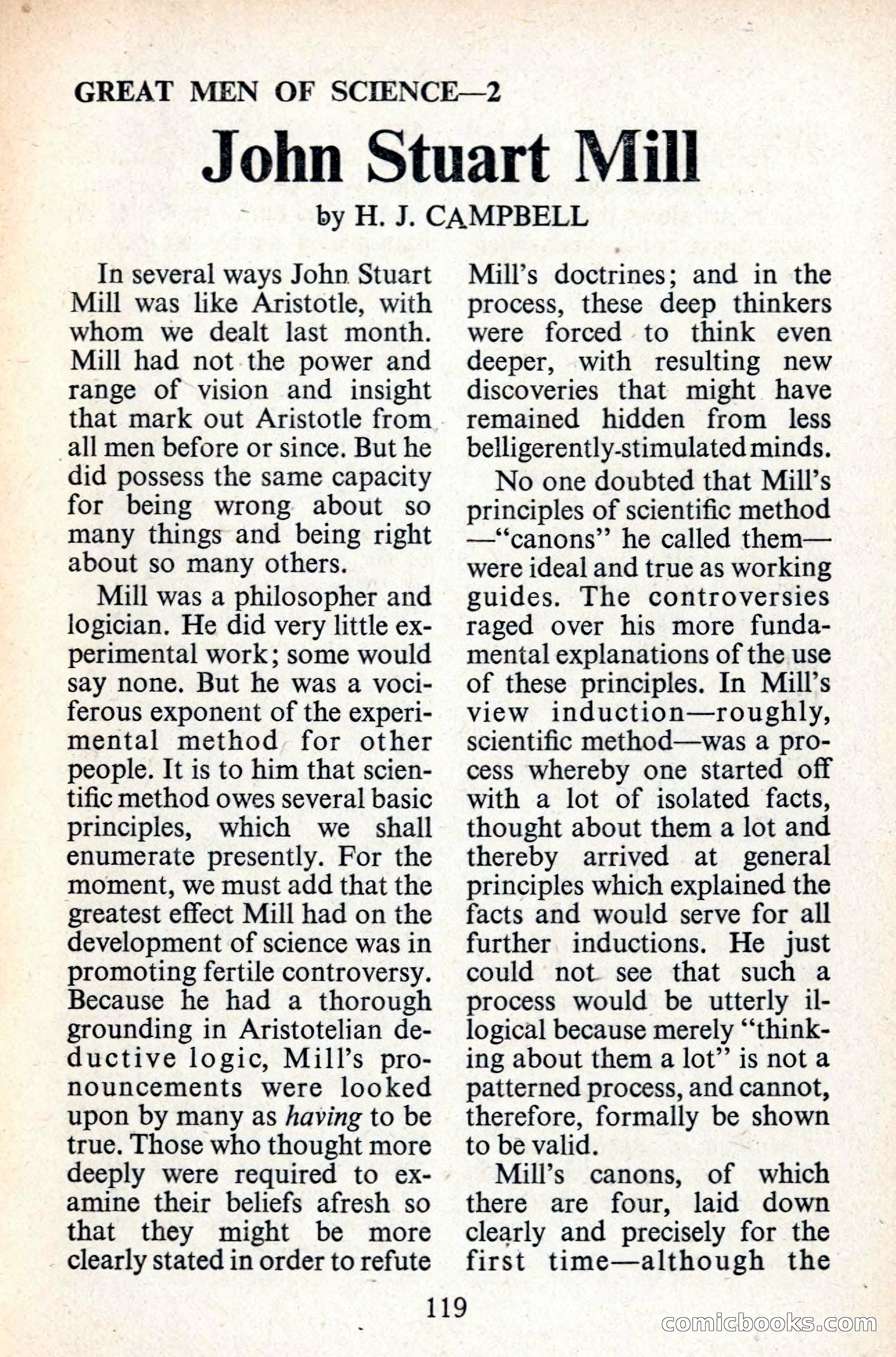
A restored page from Pulp Fiction, 1954. Page through the whole issue in the reader above.
📄 Transcribed text from this page (OCR, searchable)
Machine-transcribed from the original scan — historical spelling and the odd misread are preserved.
GREAT MEN OF SCIENCE—2 John Stuart Mill — by H. J. CAMPBELL In several ways John Stuart Mill was like Aristotle, with whom we dealt last month. Mill had not the power and range of vision and insight that mark out Aristotle from all men before or since. But he did possess the same capacity for being wrong about so many things and being right about so many others. Mill was a philosopher and logician. He did very little ex- perimental work; some would say none. But he was a voci- ferous exponent of the experi- mental method for other people. It is to him that scien- tific method owes several basic principles, which we _ shall enumerate presently. For the moment, we must add that the greatest effect Mill had on the development of science was in promoting fertile controversy. Because he had a thorough grounding in Aristotelian de- ductive logic, Mill’s pro- nouncements were looked upon by many as having to be true. Those who thought more deeply were required to ex- amine their beliefs afresh so that they might be more clearly stated in order to refute 119 Mill’s doctrines; and in the process, these deep thinkers were forced to think even deeper, with resulting new discoveries that might have remained hidden from less belligerently-stimulated minds. No one doubted that Mill’s principles of scientific method —‘‘canons”’ he called them— were ideal and true as working guides. The controversies raged over his more funda- mental explanations of the use of these principles. In Mill’s view induction—roughly, scientific method—was a pro- cess whereby one started off with a lot of isolated facts, thought about them a lot and thereby arrived at general principles which explained the facts and would serve for all further inductions. He just could not see that such a process would be utterly il- logical because merely “‘think- ing about them a lot” is not a patterned process, and cannot, therefore, formally be shown to be valid. Mill’s canons, of which there are four, laid down clearly and precisely for the first time—although the comiciooks.com