
Pulp Fiction, 1954 · page 121 of 146
Authentic Science Fiction Monthly No. 48 — page 121: what you’re looking at
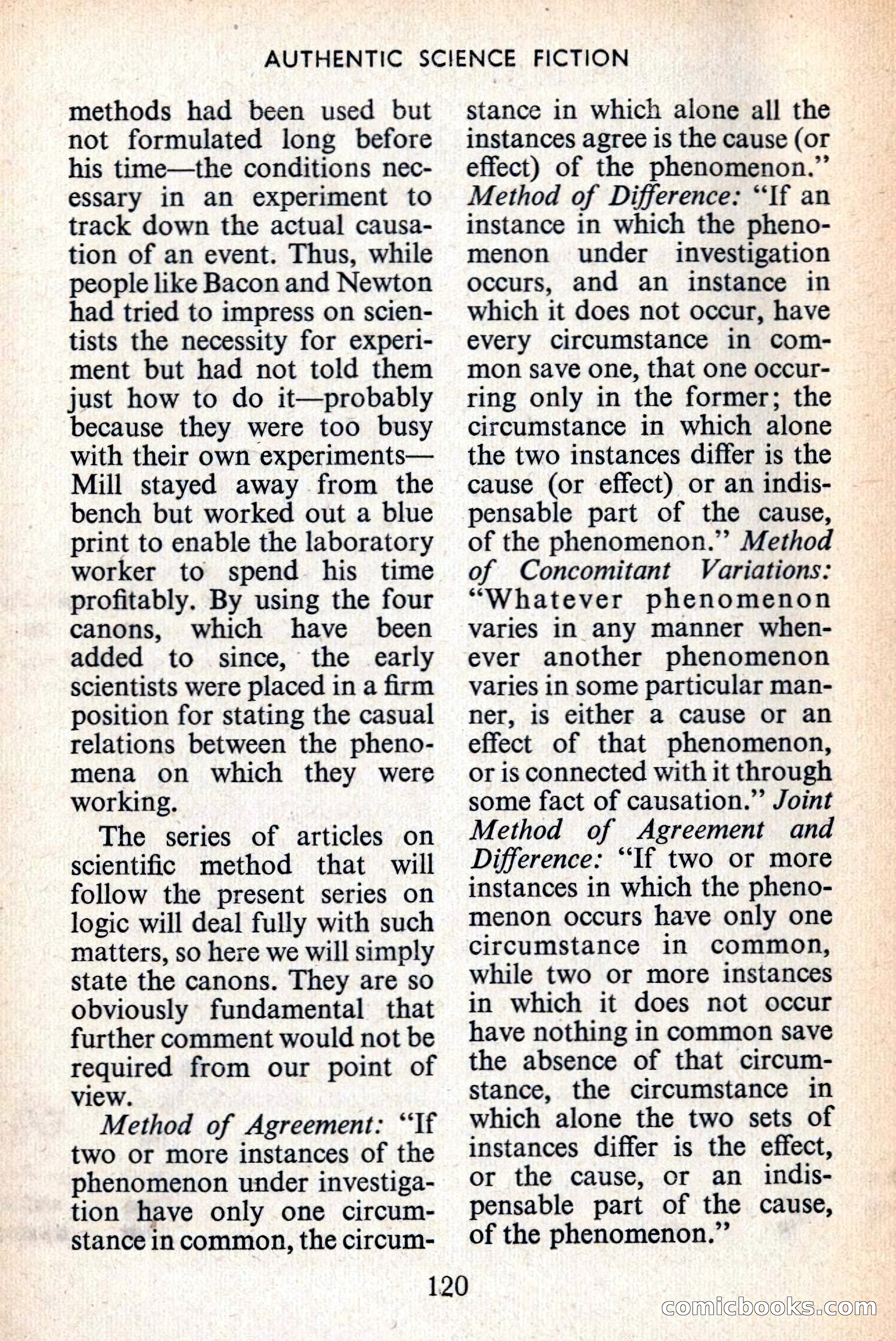
A restored page from Pulp Fiction, 1954. Page through the whole issue in the reader above.
📄 Transcribed text from this page (OCR, searchable)
Machine-transcribed from the original scan — historical spelling and the odd misread are preserved.
AUTHENTIC SCIENCE FICTION methods had been used but not formulated long before his time—the conditions nec- essary in an experiment to track down the actual causa- tion of an event. Thus, while people like Bacon and Newton had tried to impress on scien- tists the necessity for experi- ment but had not told them just how to do it—probably because they were too busy with their own experiments— Mill stayed away from the bench but worked out a blue print to enable the laboratory worker to spend his time profitably. By using the four canons, which have been added to since, the early scientists were placed in a firm position for stating the casual relations between the pheno- mena on which they were working. The series of articles on scientific method that will follow the present series on logic will deal fully with such matters, so here we will simply state the canons. They are so obviously fundamental that further comment would not be required from our point of view. Method of Agreement: “If two or more instances of the phenomenon under investiga- tion have only one circum- stance in common, the circum- 120 stance in which alone all the instances agree is the cause (or effect) of the phenomenon.”’ Method of Difference: “If an instance in which the pheno- menon under investigation occurs, and an instance in which it does not occur, have every circumstance in com- mon save one, that one occur- ring only in the former; the circumstance in which alone the two instances differ is the cause (or effect) or an indis- pensable part of the cause, of the phenomenon.” Method of Concomitant Variations: “Whatever phenomenon varies in any manner when- ever another phenomenon varies in some particular man- ner, is either a cause or an effect of that phenomenon, or is connected with it through some fact of causation.” Joint Method of Agreement and Difference: “If two or more instances in which the pheno- menon occurs have only one circumstance in common, while two or more instances in which it does not occur have nothing in common save the absence of that circum- stance, the circumstance in which alone the two sets of instances differ is the effect, or the cause, or an indis- pensable part of the cause, of the phenomenon.” comiclboooks.conn