
Pulp Fiction, 1954 · page 119 of 146
Authentic Science Fiction Monthly No. 48 — page 119: what you’re looking at
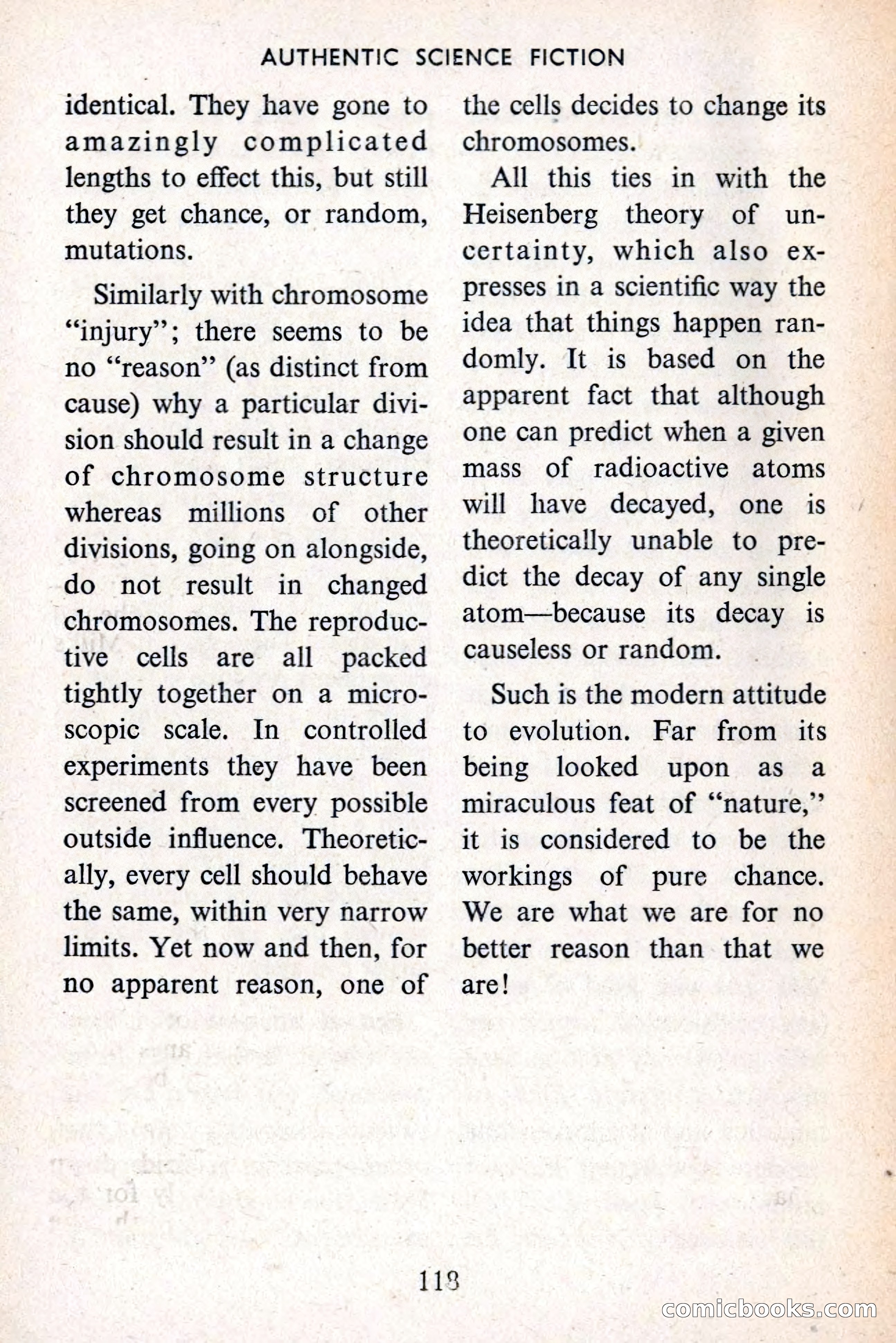
A restored page from Pulp Fiction, 1954. Page through the whole issue in the reader above.
📄 Transcribed text from this page (OCR, searchable)
Machine-transcribed from the original scan — historical spelling and the odd misread are preserved.
AUTHENTIC SCIENCE FICTION identical. They have gone to amazingly complicated lengths to effect this, but still they get chance, or random, mutations. Similarly with chromosome “injury”; there seems to be no “reason”’ (as distinct from cause) why a particular divi- sion should result in a change of chromosome structure whereas millions of other divisions, going on alongside, do not result in changed chromosomes. The reproduc- tive cells are all packed tightly together on a micro- scopic scale. In controlled experiments they have been screened from every possible outside influence. Theoretic- ally, every cell should behave the same, within very narrow limits. Yet now and then, for no apparent reason, one of 19} the cells decides to change its chromosomes. All this ties in with the Heisenberg theory of un- certainty, which also ex- presses in a scientific way the idea that things happen ran- domly. It is based on the apparent fact that although one can predict when a given mass of radioactive atoms will have decayed, one is theoretically unable to pre- dict the decay of any single atom—because its decay is causeless or random. Such is the modern attitude to evolution. Far from its being looked upon as a miraculous feat of “‘nature,”’ it is considered to be the workings of pure chance. We are what we are for no better reason than that we are! conicloooks. com