
Pulp Fiction, 1954 · page 118 of 146
Authentic Science Fiction Monthly No. 48 — page 118: what you’re looking at
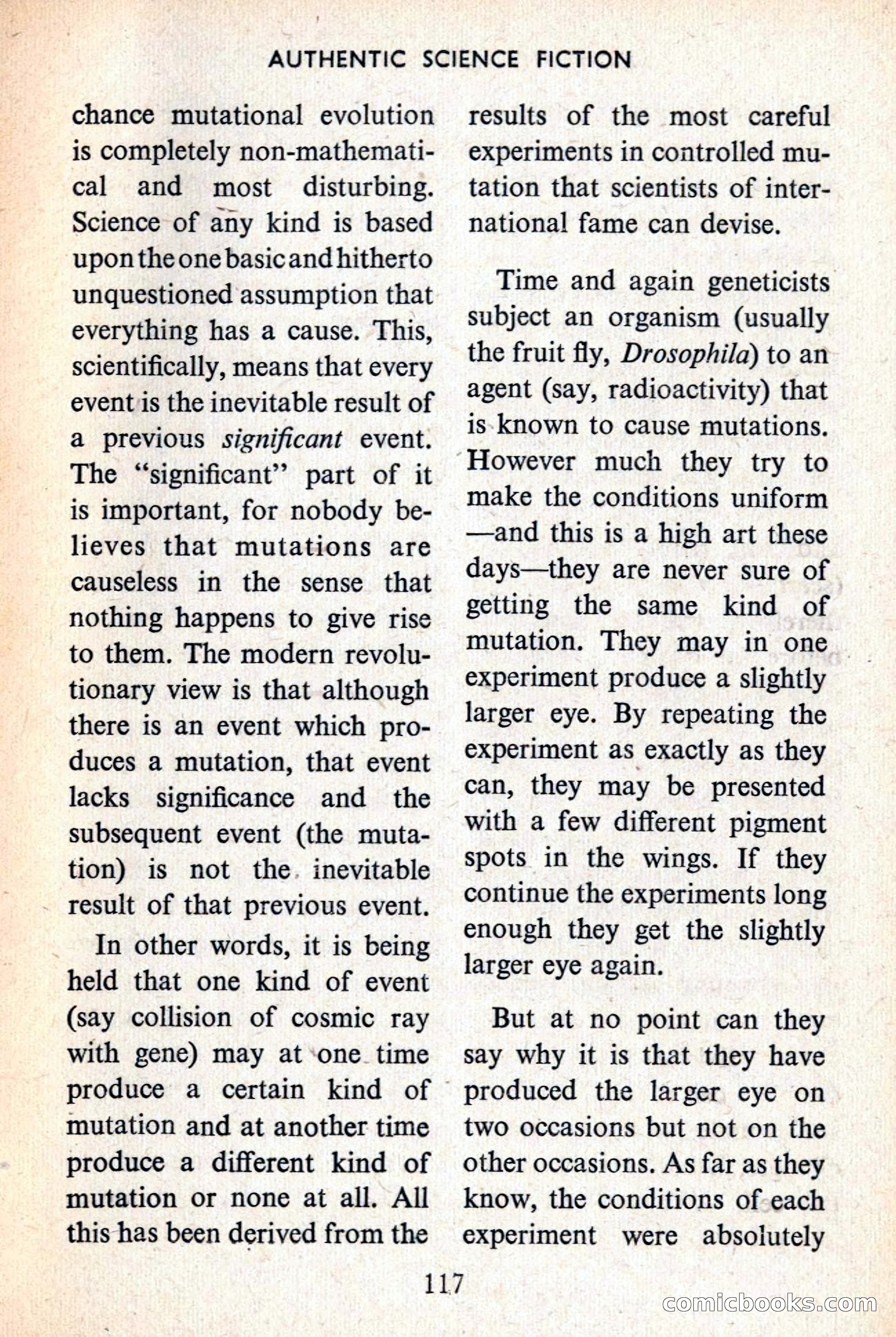
A restored page from Pulp Fiction, 1954. Page through the whole issue in the reader above.
📄 Transcribed text from this page (OCR, searchable)
Machine-transcribed from the original scan — historical spelling and the odd misread are preserved.
AUTHENTIC SCIENCE FICTION chance mutational evolution is completely non-mathemati- cal and most disturbing. Science of any kind is based upon the one basicand hitherto unquestioned assumption that everything has a cause. This, scientifically, means that every event is the inevitable result of a previous significant event. The “significant” part of it is important, for nobody be- lieves that mutations are causeless in the sense that nothing happens to give rise to them. The modern revolu- tionary view is that although there is an event which pro- duces a mutation, that event lacks significance and the subsequent event (the muta- tion) is not the. inevitable result of that previous event. In other words, it is being held that one kind of event (say collision of cosmic ray with gene) may at ‘one time produce a certain kind of mutation and at another time produce a different kind of mutation or none at all. All this has been derived from the results of the most careful experiments in controlled mu- tation that scientists of inter- national fame can devise. Time and again geneticists subject an organism (usually the fruit fly, Drosophila) to an agent (say, radioactivity) that is-known to cause mutations. However much they try to make the conditions uniform —and this is a high art these days—they are never sure of getting the same kind of mutation. They may in one — experiment produce a slightly larger eye. By repeating the experiment as exactly as they can, they may be presented with a few different pigment spots in the wings. If they continue the experiments long enough they get the slightly larger eye again. But at no point can they say why it is that they have produced the larger eye on two occasions but not on the other occasions. As far as they know, the conditions of each experiment were absolutely 117 comicloooks.com