
Pulp Fiction, 1954 · page 114 of 146
Authentic Science Fiction Monthly No. 48 — page 114: what you’re looking at
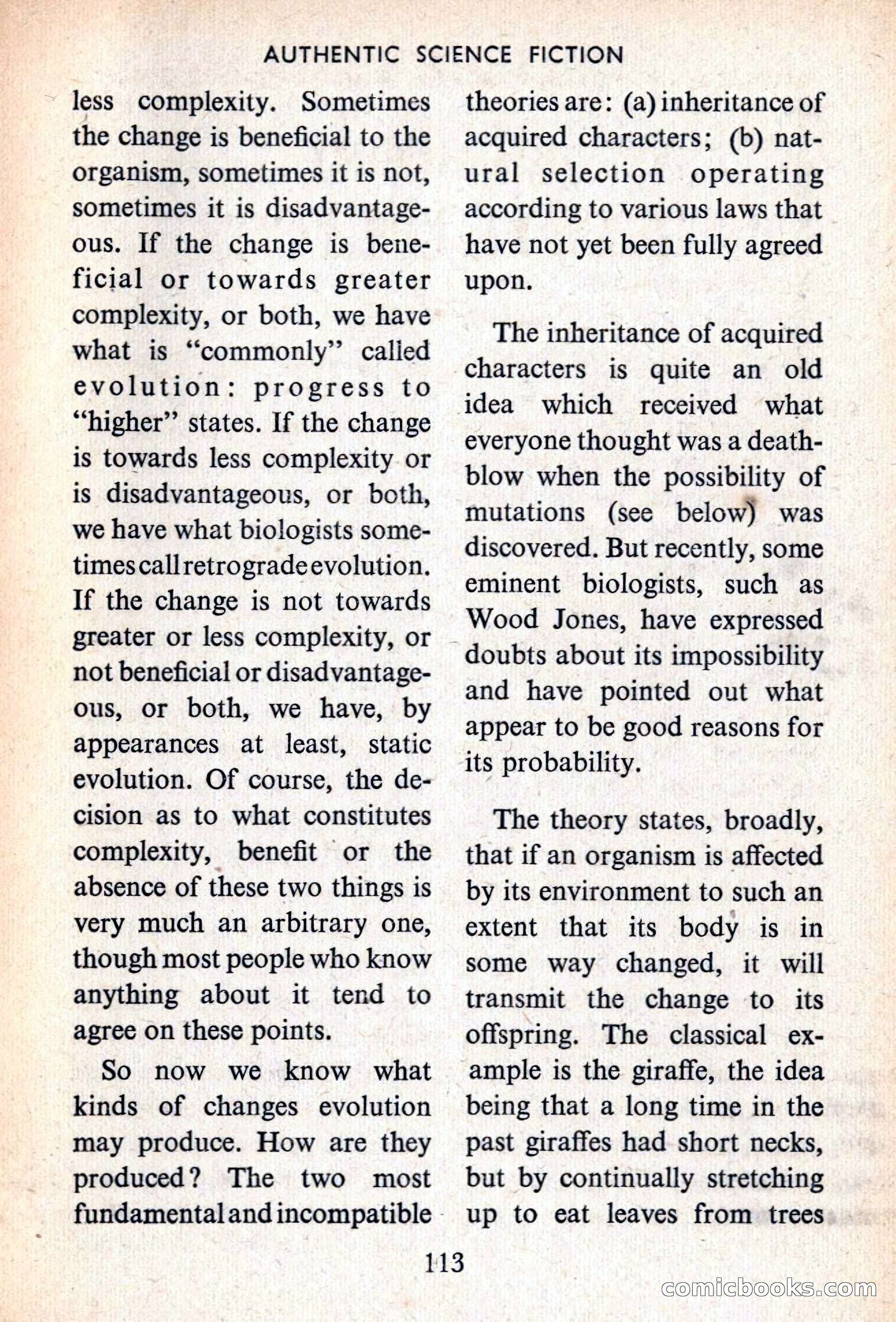
A restored page from Pulp Fiction, 1954. Page through the whole issue in the reader above.
📄 Transcribed text from this page (OCR, searchable)
Machine-transcribed from the original scan — historical spelling and the odd misread are preserved.
AUTHENTIC SCIENCE FICTION less complexity. Sometimes the change is beneficial to the organism, sometimes it is not, sometimes it is disadvantage- ous. If the change is bene- ficial or towards greater complexity, or both, we have what is “commonly” called evolution: progress to ““higher”’ states. If the change is towards less complexity or is disadvantageous, or both, we have what biologists some- times callretrogradeevolution. If the change is not towards greater or less complexity, or not beneficial or disadvantage- ous, or both, we have, by appearances at least, static evolution. Of course, the de- cision as to what constitutes complexity, benefit or the absence of these two things is very much an arbitrary one, though most people who know anything about it tend to agree on these points. So now we know what kinds of changes evolution may produce. How are they produced? The two most fundamental and incompatible - 113 theories are: (a) inheritance of acquired characters; (b) nat- ural selection operating according to various laws that have not yet been fully agreed upon. The inheritance of acquired characters is quite an old idea which received what everyone thought was a death- blow when the possibility of mutations (see below) was discovered. But recently, some eminent biologists, such as Wood Jones, have expressed doubts about its impossibility and have pointed out what appear to be good reasons for its probability. The theory states, broadly, that if an organism is affected by its environment to such an extent that its body is in some way changed, it will transmit the change to its offspring. The classical ex- ample is the giraffe, the idea being that a long time in the past giraffes had short necks, but by continually stretching up to eat leaves from trees comiclooks.com