
Pulp Fiction, 1954 · page 113 of 146
Authentic Science Fiction Monthly No. 48 — page 113: what you’re looking at
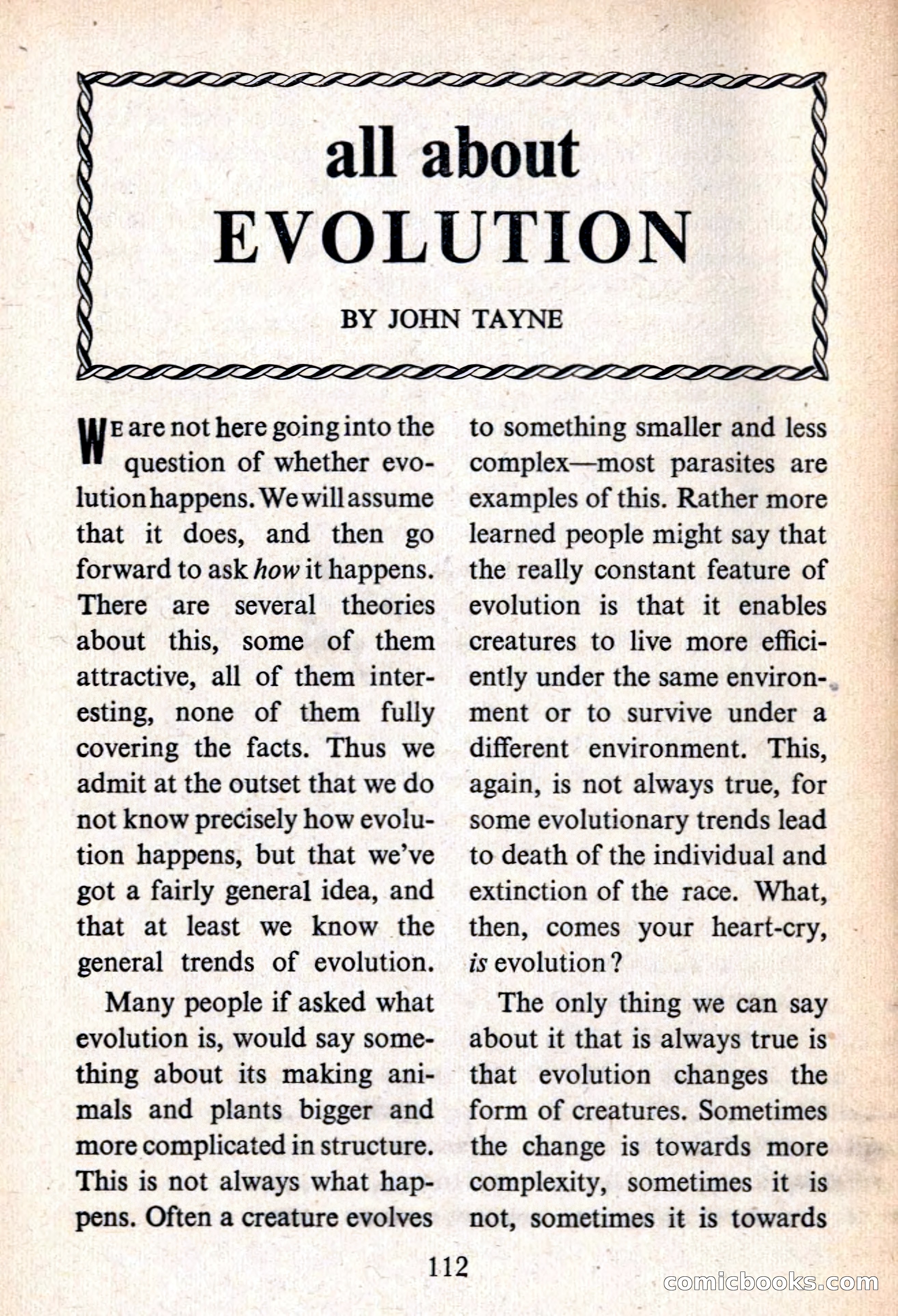
A restored page from Pulp Fiction, 1954. Page through the whole issue in the reader above.
📄 Transcribed text from this page (OCR, searchable)
Machine-transcribed from the original scan — historical spelling and the odd misread are preserved.
all about EVOLUTION BY JOHN TAYNE We are not here going into the question of whether evo- lution happens. We willassume that it does, and then go forward to ask how it happens. There are several theories about this, some of them attractive, all of them inter- esting, none of them fully covering the facts. Thus we admit at the outset that we do not know precisely how evolu- tion happens, but that we’ve got a fairly general idea, and that at least we know the general trends of evolution. Many people if asked what evolution is, would say some- thing about its making ani- mals and plants bigger and more complicated in structure. This is not always what hap- pens. Often a creature evolves 112 to something smaller and less complex—most parasites are examples of this. Rather more learned people might say that the really constant feature of evolution is that it enables creatures to live more effici- ently under the same environ-, ment or to survive under a different environment. This, again, is not always true, for some evolutionary trends lead to death of the individual and extinction of the race. What, then, comes your heart-cry, is evolution ? The only thing we can say about it that is always true is that evolution changes the form of creatures. Sometimes the change is towards more complexity, sometimes it is not, sometimes it is towards comiclooks.conn