
Pulp Fiction, 1954 · page 115 of 146
Authentic Science Fiction Monthly No. 48 — page 115: what you’re looking at
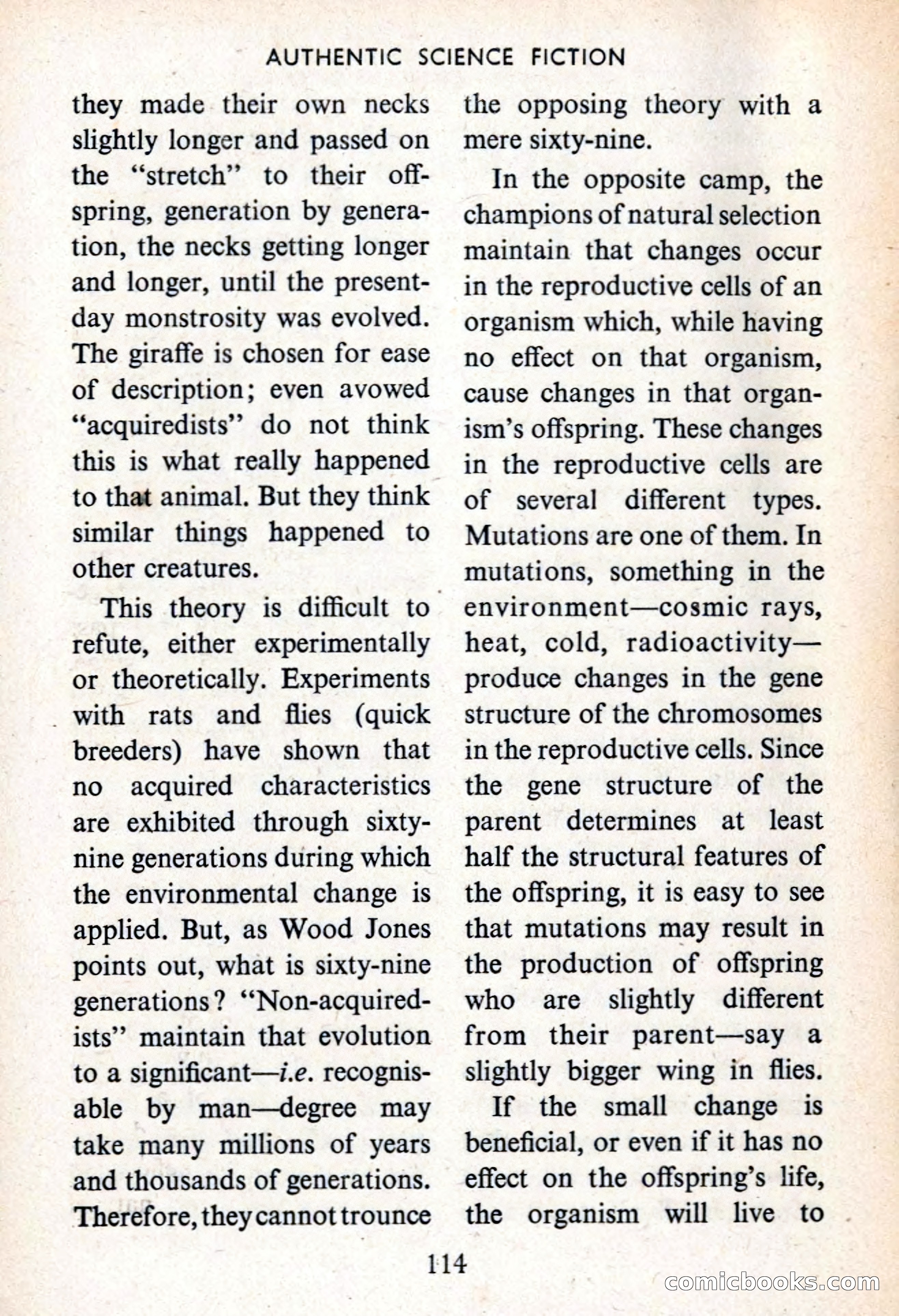
A restored page from Pulp Fiction, 1954. Page through the whole issue in the reader above.
📄 Transcribed text from this page (OCR, searchable)
Machine-transcribed from the original scan — historical spelling and the odd misread are preserved.
AUTHENTIC SCIENCE FICTION they made their own necks slightly longer and passed on the “stretch” to their off- spring, generation by genera- tion, the necks getting longer and longer, until the present- day monstrosity was evolved. The giraffe is chosen for ease of description; even avowed “‘acquiredists’’ do not think this is what really happened to that animal. But they think similar things happened to other creatures. This theory is difficult to refute, either experimentally or theoretically. Experiments _with rats and flies (quick breeders) have shown that no acquired characteristics are exhibited through sixty- nine generations during which the environmental change is applied. But, as Wood Jones points out, what is sixty-nine generations? “‘Non-acquired- ists’ maintain that evolution to a significant—i.e. recognis- able by man—degree may take many millions of years and thousands of generations. Therefore, they cannot trounce the opposing theory with a mere sixty-nine. In the opposite camp, the champions of natural selection maintain that changes occur in the reproductive cells of an organism which, while having no effect on that organism, cause changes in that organ- ism’s offspring. These changes in the reproductive cells are of several different types. Mutations are one of them. In mutations, something in the environment—cosmic rays, heat, cold, radioactivity— produce changes in the gene structure of the chromosomes in the reproductive cells. Since the gene structure of the parent determines at least half the structural features of the offspring, it is easy to see that mutations may result in the production of offspring who are slightly different from their parent—say a slightly bigger wing in flies. If the small change is beneficial, or even if it has no effect on the offspring’s life, the organism will live to 114 comiclbooks.conn